
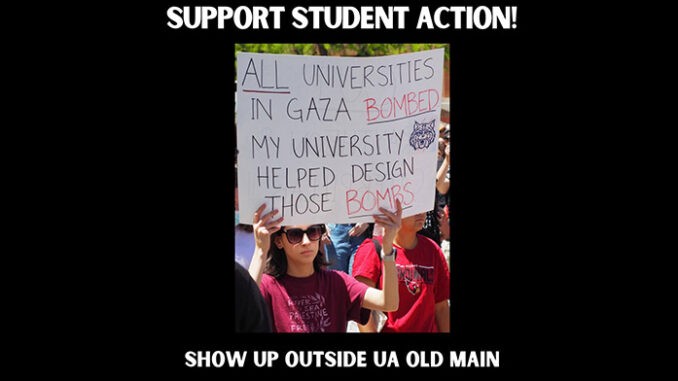
University of Arizona (U of A) faculty members aligned with pro-Palestinian activism following the Hamas terrorist attack on Israel in 2023, newly uncovered emails showed.
The emails were obtained by FOIAzona founder Brian Anderson — but not without a fight. U of A refused to release the records for a year, until Anderson threatened legal action.
NEW 🚨 After a 1-year #FOIA fight, I have obtained 1,000 pages of internal emails exposing how @UArizona bent over backward for pro-Palestine activists after October 7
Incredibly grateful for @WSJ's editorial board writing about it in today's issue 1/4https://t.co/a2BbqIhb48 pic.twitter.com/dEm6WBkK2U
— Brian Anderson (@AZBrianAnderson) November 1, 2025
Anderson requested the records after U of A leadership voted against an anti-Semitism resolution last May. U of A did eventually send the records — over 1,000 pages — but they redacted most of the pro-Palestine faculty names in the records.
The vote occurred months after the terrorist organization Hamas’ surprise attack on Israel in October 2023. Per the Department of Justice (DOJ), Hamas killed approximately 1,200 individuals in the attack, which included 49 U.S. citizens. Hamas abducted approximately 250 other individuals, of which eight were U.S. citizens.
According to the emails obtained by Anderson, U of A faculty were angered by former U of A President Robert Robbins’ statement condemning Hamas and their supporters, namely Students for Justice in Palestine (SJP) which he described as “antithetical” to U of A values.
Emails show faculty members made their complaints about Robbins’ remarks on SJP known to Leila Hudson, faculty chair and School of Middle Eastern and North African Studies professor.
It would be Hudson that much of the initiative on defending the pro-Palestinian faction on campus. She was also behind the decision to quash the anti-Semitism resolution last May — emails revealed that she wanted, instead, to expand the language to focus on administrative actions and police violence against student protesters.
As a faculty chair, Hudson has authority over university policymaking. That’s not the limit to Hudson’s authority, according to her.
In a recent feature article with The Arizona Daily Star, Hudson indicated that she and other elected faculty leaders had as much control over university governance as the president, and that the current president, Suresh Garimella, was “only here” because of the work that she and other elected faculty leaders did uncovering the previous administration’s issues.
“When faculty are not getting the information they want, they know to turn to us and that we can use our access and use our leverage to get information that people would like to have, or to spread information that faculty think the community should know about,” said Hudson.
“And, whether [Garimella] acknowledges it or not, this is how faculty governance and shared governance actually work. We have the pulse of the faculty especially when it’s difficult or challenging, and we will articulate those concerns.”
It appears other members of the faculty understand this power dynamic well.
One professor, whose name was redacted, complained to Hudson that Robbins’ statement had a “chilling of free speech” effect on SJP dissent, citing the SJP chapter at U of A’s decision to postpone a pro-Palestine protest. That individual announced they would be coordinating with other faculty and gathering information to file a complaint with Palestine Legal, the ACLU, and the Center for Constitutional Rights (CCR).
Following this complaint and others, Hudson responded to Robbins’ statement with a counter-statement.
“It is my sincere hope that I represent the faculty as well when, speaking for myself and for so many in our University community who have contacted me, I condemn with equal force the illegal violent collective punishment being visited upon the civilian population of the besieged Gaza Strip. War crimes and terrorism do not justify war crimes and terrorism,” said Hudson. “The University of Arizona must be a safe and inclusive space for all of us, where we are careful not to assign guilt by association or identity.”
Certain associations and identities made it clear they supported the violence and murder committed by Hamas. The Coalition of Black Students and Allies sent an email several weeks after the attack, calling it “a powerful emblem of Palestinian resistance, perseverance, and liberation for the people of Gaza and Palestinians everywhere” and condemning Robbins’ statement as “Zionist rhetoric.”
A Regent’s Professor of History, Julia Clancy-Smith, forwarded colleagues a fundraising request email from Amnesty International denouncing the Israeli government’s response “in the occupied West Bank” to the Hamas attack.
And after two U of A professors — Rebecca Lopez and Rebecca Zapien — were suspended for teaching their class that Hamas wasn’t a terrorist group and encouraging students to boycott Israel and attend pro-Hamas rallies, fellow Palestine supporters consulted with Hudson about how to identify the individual who obtained and leaked the recording of Lopez and Zapien to the Israel War Room account on X.
Hudson agreed to have the Middle East Studies Association (MESA) Committee on Academic Freedom (CAF) investigate.
“That would be excellent to have MESA’s CAF look into the issue,” said Hudson. “Let me consult further with the principals before proceeding.”
In an education class at @uarizona, these professors chose to discuss the current Israel-Gaza war and the broader Israeli/Palestinian conflict. What was shared was an entirely BIASED, ANTISEMITIC, BLATANTLY FALSE, and TERRORISM-SUPPORTING narrative. Listen for yourself. 🧵
(1/9) pic.twitter.com/rF4EQ9j5nC— Israel War Room (@IsraelWarRoom) November 12, 2023
Hudson interviewed with multiple media outlets to defend Lopez and Zapien. In emails, Hudson encouraged faculty to take a similar approach to the two educators by teaching students about the reasons Hamas committed their attack. Upon the reinstatements of Lopez and Zapien, Hudson sent them an email of support.
“It’s been a privilege to stand with you in this harrowing episode,” said Hudson.
Hudson went on to form a Campus Climate response team to take action against speech critical of pro-Palestinian stances. The response team resulted in a legal threat from the Foundation for Individual Rights and Expression (FIRE).