

The experts have spoken on why houses are unaffordable for many Americans.
Those on the left blame greedy landlords and builders, Wall Street avarice, suburban sprawl, declining wages, capitalism, global warming, heartless Republicans, and King Donald.
Those on the right blame restrictive zoning and building codes, the Federal Housing Administration, the Department of Housing and Urban Development, the government-sponsored enterprises of Fannie Mae and Freddie Mac, the Federal Reserve’s interest rate machinations, and Democrat socialists.
Enter a non-expert. That would be me. I blame two trends for most of the unaffordability.
First, houses have grown larger than even waistlines over the decades. On average, they have more than doubled in size since the 1950s, ballooning from about 1,000 sq. ft. to about 2,500 sq. ft. During the same period, the number of occupants per house has fallen, along with falling birth rates and a decline in two-parent families.
Second, the HGTV network and its inane home remodeling shows have convinced the masses that the bare necessities of life include granite or quartz countertops, six-burner stoves the size of a Volkswagen Beetle, kitchen islands larger than a ping-pong table, vaulted ceilings tall enough to accommodate a basketball hoop, walk-in closets larger than bedrooms in Europe, and a toilet for each derrière in the house as well as for visiting derrières.
This is not to suggest that housing should resemble the tenements of the late nineteenth and early twentieth centuries, when large families were crammed into one or two rooms, when wives did piecework at home for extra money, when single working men paid room and board to live with families, and when outhouses were still common.
It is to suggest, however, that the pendulum has swung too far in the opposite direction, and that houses would be much more affordable if they were more like the houses of my youth.
Take the two-story duplex in the photo below. Not a bad looking house, eh? Located in the Italian section of St. Louis known as the Hill, the duplex is over 100 years old and has about 1,600 sq. ft. of combined living space between the upstairs and downstairs units, not counting the basement. In the couple of decades following the Second World War, nine people lived in the duplex at the same time, for about 178 sq. ft. per person.
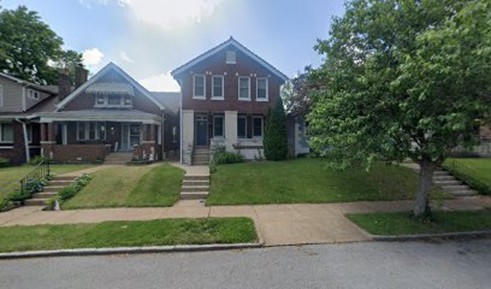
Why do I know so much about the house? Because it was the home of my fraternal grandparents, my aunt and uncle, and my five cousins.
Note: I’ll be using my family as an example of affordable housing in the past, because the Cantoni clan was representative of what life was like for a large swath of Americans, and, in that sense, quite ordinary.
Grandma and Grandpa lived in the second-floor unit, where there were two tiny bedrooms, one bath, a small living room, and a small kitchen. My aunt and uncle lived in the first-floor unit, which had one tiny bedroom, one bath, a small kitchen, and a combination living room and dining room that converted to a bedroom at night. Four of their five kids slept downstairs, and the fifth, upstairs with Grandma and Grandpa.
Every inch of the tiny backyard was filled with a vegetable garden and an arbor that produced grapes for Grandpa’s homemade wine, which he made and fermented in the basement, or cellar. Also in the cellar were homemade salamis hanging from the floor joists above to cure.
Upon immigrating to the US, Grandpa was a coalminer in southern Illinois, where my dad was born in a godforsaken mining town. After moving to St. Louis, Grandpa was a barkeep in a speakeasy during Prohibition and then in a tavern after Prohibition. Yet he and Grandma could afford to buy the duplex on their meager income. My uncle was a tile setter, my aunt was a stay-at-home mom, and whatever financial arrangement they had with Grandma and Grandpa, they certainly benefited from family togetherness and the sharing of housing expenses.
All of them also benefited from living in a close-knit community—a real community of shared values, not a phony one of today. Residents of the Hill had so much community pride that they would sweep the alley behind their home.
The neighborhood was also walkable before “walkable” became a buzzword. Residents could walk to parks, church, and locally-owned markets, delis, bakeries, taverns, and restaurants—without fear of crime and without encountering trash, deranged people on drugs, or homeless people sleeping in alleys and begging on street corners. Many of the men worked in the nearby clay mines or in a factory that produced clay sewer pipes. Children were free-range.
Baseball notables Yogi Berra and Joe Garagiola grew up in the hood and were descendants of Italian immigrants. A statue of an Italian immigrant family still stands in front of the parish church, commemorating those who made it to America before the Immigration Act of 1924 was passed to stem the influx of Italians and other Southern Europeans, who were denigrated by the WASP establishment for being Catholic and non-white.
A 15-minute drive away is my boyhood home.
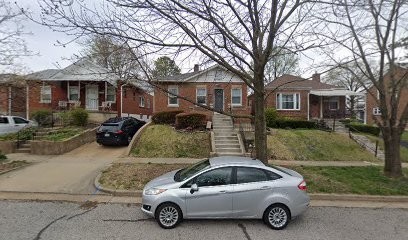
When my mom and dad bought the house, it was a “fixer-upper,” to use today’s euphemism. Actually, it was dilapidated. Mom worked as a clerk and Dad was a non-union tile setter. He spent most evenings and weekends over most of his life renovating the 900 sq. ft. house with sweat equity. Speaking of sweat, although St. Louis summers are hot and steamy, the house wasn’t air-conditioned until I was in my teens.
After my dad passed, I found a copy of a paid-off loan of $5,000 from my dad’s uncle for much of the purchase price of the house.
As with the Italian neighborhood, my boyhood neighborhood was a stable community of shared values and interests. My boyhood friend Steve is a retired machinist who still lives in the house of his youth, the one on the left. His dad, an auto mechanic and part-time fireman, died at an early age, leaving his widow to raise Steve and his sister as a single mom.
Steve’s house had a still in the basement during Prohibition. In the event of a raid by federal liquor agents, the bootleggers could escape through a tunnel that ran from the basement, under the driveway, and into the basement of what would become our house. As a kid, I could see the outline of the manhole cover that had been cemented over in our basement floor.
Maybe I’m Pollyannish, but it sure seems that housing was more affordable when houses were smaller, communities were more cohesive, families were more intact, waistlines were smaller, and HGTV didn’t exist.
Or maybe moonshine had something to do with it.
Retired in Tucson, Mr. Cantoni can be reached at [email protected].
so the house mom bought in the 1950s was $5600 dollars its now available for the high 200’a to the low 300s
Can CO-OP Builders build them for 60s or 80 with the land?
Can this be ‘owner – builder’ neighborhood labor built “homes” at a fraction of the cost?
Can the neighborhood co-op become a reality?
I’m in and I don’t need one.. but I don’t want my kids saddled to this BS!
One of the main components of housing affordability is the cost to own property. When you have ever rising insurance costs to pay for insurance company losses in other areas like wildfires in CA or hurricanes in FL and ever rising property taxes, affordability is tough. When you have socialists/communists like Jen Allen. Andres Cano, Matt Heinz and Rex Scott raising your property taxes to pay for their pet projects, you are doomed to unaffordable properties.