
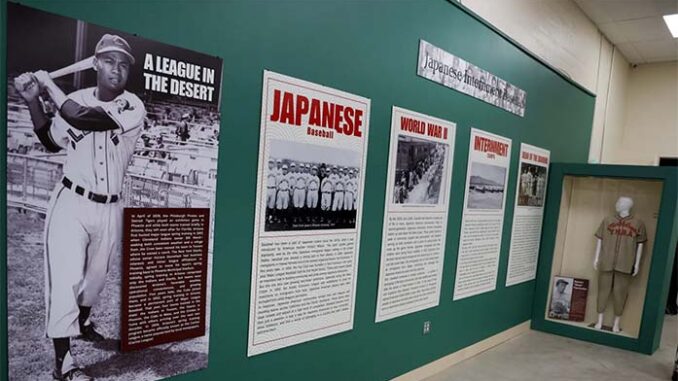
Baseball has played an integral role in Arizona’s history for well over a century.
Stories have been passed down through the years – from the tale of “Flame” Delhi, the first Arizona-born major league player, to accounts of Japanese Americans playing baseball while held at the Gila River War Relocation Center – but it takes more than just word of mouth to preserve decades of the state’s rich baseball history.
Thus, the idea for Arizona’s first baseball museum took shape.
Located in Mesa, the Arizona Baseball Museum opened Feb. 21. The first of its kind in the Grand Canyon State, the museum was created to share the history of the game in Arizona through photographs, memorabilia, alternating exhibitions and personal stories.
“We knew the main story we wanted to tell and that was how baseball began in Arizona,” said Susan Ricci, executive director of the Mesa Historical Museum. “That was so important. You can’t have a museum like this without talking about how it all got here.”
During the establishment of the Arizona Territory from 1863-71, soldiers, settlers and copper miners first introduced the game to the area.
According to multiple accounts, the earliest recorded mentions of baseball in Arizona date back to 1872, when military troops at Fort Whipple and Camp Hualpai – ordered to protect settlers from the natives in the area – formed their own baseball club. The first official game was documented shortly afterward.
The museum covers more than a century of monumental moments in Arizona’s baseball history, from the sport’s post-Civil War origins, the evolution of spring training in the state to more recent events, such as the Diamondbacks’ 2001 World Championship.
Current exhibits feature the birth of the Cactus League, baseball in Japanese internment camps, fan experiences and a tribute to a couple of veteran baseball organists.
Other displays portray different avenues of the game’s evolution – from heavier bats, smaller gloves and flimsier facemasks to the modern equipment in play today.
Several of baseball’s greats are highlighted throughout as well, and an interactive touchscreen system sits toward the end of the tour with options for trivia, additional historical facts and more.
“The biggest thing is the narration of the content and how the story flows,” said Tony Peters, the museum’s exhibition designer who has worked on museums and galleries for more than 30 years. “Does this work better here as opposed to over there? Then once you get into a flow, some things kind of just fall into place.
“We want people to walk out of here and go, ‘Wow, I did not know that.’ That’s kind of what this is all about.”
To match the artifacts housed inside, the building has its own story.
Originally constructed in 1936 as a Works Progress Administration (WPA) project, the venue was intended to be the Lehi School Auditorium. Because of its sturdy construction and 10-inch thick walls, it was later designated as the community bomb shelter during the Cold War.
For decades, the space has sat unused due to a lack of updated facilities. Nearly 90 years after its creation, renovation was a daunting task, especially for a crew of just three people who received occasional help from volunteers.
“It has been a really hard journey,” Ricci said. “It was stressful, because we felt like we would raise enough and we would get so far, and then we would hit another roadblock. Then you wonder at some point, ‘Is this project ever going to get finished?’”
Toward the beginning of the endeavor, the main support truss in the roof needed to be replaced, as did some of the wood in the structure which dated back to its original installment. Those two projects alone cost over $140,000.
Fortunately, fundraising and acquiring sponsors is one of Ricci’s specialties, and eventually the vision was completed.
“The city of Mesa really helped make this happen,” Ricci said. “They came in with resources in the ninth inning and really just helped us push this over the finish line.”
The hope is that the museum serves as an extension to the baseball experience in Arizona, giving fans a reason to stick around in Mesa longer.
“Our big opening day will maybe be the moment where I can absorb what we’ve done,” Ricci said before the doors opened. “It’s just surreal, because I’ve lived with it for over two years, so it’s hard to believe that this is done.”