
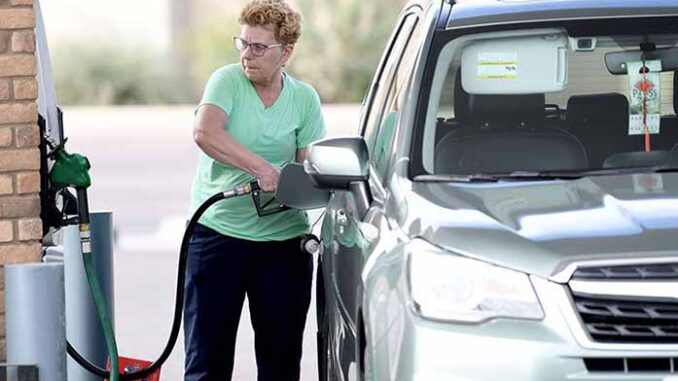
When it comes to motor fuel prices, Arizona is in a unique situation. In addition to being to the mercy of events that have nationwide effects, we are forced to use special blends that are more expensive to produce and are subject to shortages that tend to drive up the cost at the pump. This is particularly true of Maricopa County, where a large portion of Arizonans reside.
That is why, in a recent News Release, Representative Julie Willoughby praised the Trump administration for its Nationwide Emergency Fuel Waiver with this statement.
“Arizona families needed action, and I am glad to see the federal government responding to the fuel-supply risks we have been raising for months. I applaud the Trump Administration for stepping in to strengthen supply, expand fuel options, and help lower costs for drivers in Arizona and across the country. Families in Maricopa and Pinal counties have been paying more because Arizona is forced to rely on a costly boutique fuel produced by only a limited number of refineries. I have been raising concerns for months about California refinery closures, supply disruptions, and the risk that these actions pose to Arizona drivers. This is an important step, but it is only temporary. I will keep fighting for long-term solutions that expand supply, lower costs, and protect Arizona drivers from future shortages and price spikes.”
That waiver, according to the EPA, consists of a “temporary emergency fuel waiver to allow nationwide sales of E15, gasoline blended with 15 percent ethanol, and to remove all federal impediments to selling E10, gasoline blended with 10 percent ethanol, across the country”.
Of particular interest to Arizonans is the fact that the EPA is also waiving federal enforcement of all state “boutique” fuel requirements for gasoline. These waivers are set to become effective May 1.
Because of Clean Air Act restrictions, this relief will be in effect for only 20 days. However, extensions are likely.
The fight for long-term solutions that Rep. Willoughby alluded to in her comments are supported by her introduction of bills designed to improve the situation, as described in the news release:
“HB 2400 to suspend the state’s 18-cent gas tax on summer fuel in Maricopa and Pinal counties, HB 2401 to require regular review of lower-cost fuel options that still meet federal air quality standards, HB 2696 to expand long-term infrastructure such as additional pipelines and in-state refining capacity, and HB 2955 to move Arizona away from its costly boutique-fuel mandate and toward a more widely available fuel standard.”
Two other legislators have joined Rep. Willoughby in her quest to bring relief to Arizonans. Rep. Pamela Carter, LD4, introduced bill HB4025, which would be the first step in bringing refineries to Arizona, and Rep. Gail Griffin, LD19, introduced bill HB2145, dealing with easing the waiver situation.
In total, six bills have been introduced, aimed at addressing various aspects of the fuel crunch in Arizona, with extremely poor success. Only two are still viable:
HB2145 – petition; waiver; fuel formulations – Failed in Senate committee
HB2400 – motor fuel tax holiday – HELD in Senate committee, most likely dead
HB2401 – fuel formulations; biennial review Died in Senate committee
HB4025 – study committee; gas; petroleum; refinery – Failed in House 3rd Reading
HB2955 – gasoline formulations; air quality – Committee hearing scheduled
HB2696 – commerce authority; gas; prices; prioritization Committee hearing scheduled
Be the first to comment