
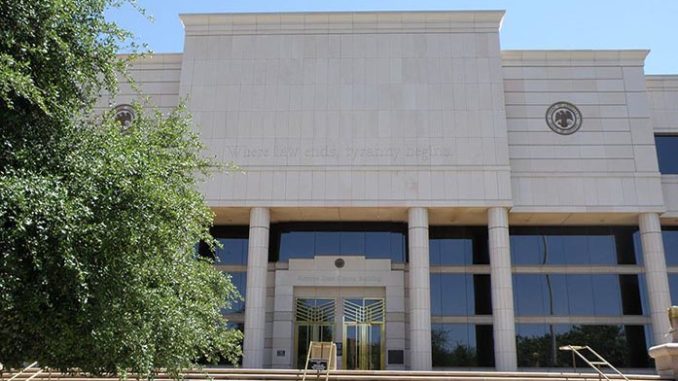
The Arizona Supreme Court is taking on the case of two Green Party candidates who were effectively denied Clean Elections funding.
Risa Lombardo and DuWayne Collier, the Green Party candidates for governor and secretary of state, requested the Arizona Supreme Court to review their case last week. The court granted their petition on Thursday.
The Citizens Clean Elections Commission (CCEC) accused Lombardo and Collier of committing fraud to qualify for Clean Elections funding, though both candidates’ submissions to the Clean Funding program were approved by the secretary of state’s office and CCEC has yet to conclude its investigation.
Lombardo and Collier sued CCEC for advising them that they would have to repay millions in Clean Elections funding. The pair argued in their lawsuit that this notice from CCEC without a formal investigation finding them of wrongdoing was equivalent to bullying them to suspend their campaigns.
Clean Elections candidates may not raise private funding, and Lombardo and Collier feel that CCEC’s warning has pressured them to not spend the campaign funds they’ve been allotted.
Together, the candidates had to submit at least 6,500 of $5 qualifying contributions in order to participate in the Clean Funding program. Qualifying $5 contributions must be made by registered voters within the candidate’s district.
CCEC ordered Tom Collins, its executive director, to report the results of the investigation into Lombardo and Collier by October 29, which is five days before the general election.
It was Collins who claimed in notice letters to Lombardo and Collier preceding the CCEC decision to open an investigation that his staff’s preliminary findings substantiated his suspicions of fraud. Collins referenced Arizona Mirror reporting issued the same day of his letters, and echoed their claims of the two candidates sharing many contributions from the same voters on the same dates — some of whom claimed to the outlet that they had not donated to either candidate.
Collins also said the pair were “sham” candidates, quoting the Arizona Green Party which has rejected the candidacies of both.
“All of these facts together, which as you can see are largely substantiated, represent a level of suspicious activity well beyond what I have witnessed in 16 years as the Commission’s executive director,” wrote Collins.
Lombardo and Collier received $4.7 million collectively; if CCEC substantiates their publicized claims against the two candidates, the pair would have to repay $3.7 million.
The Arizona Supreme Court will determine whether CCEC possesses legal authority to determine the secretary of state’s certification of qualifying contributions was incorrect. If the court finds that to be the case, the court will then decide whether CCEC possesses authority to repay those funds to Lombardo and Collier.
The court ordered that it would consider the case on an expedited basis without oral argument.
As CCEC is running its civil investigation into Lombardo and Collier, Attorney General Kris Mayes’ office confirmed that they are running a criminal investigation. Scott Neely, Republican candidate for governor, is not part of the Lombardo-Collier lawsuit, but he is also facing a civil investigation by CCEC and a criminal investigation by Mayes’ office.
Be the first to comment