
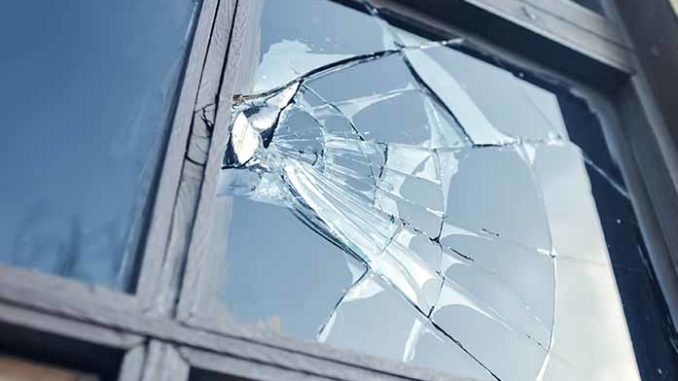
Incremental degradation is the tendency of smaller problems to turn into larger ones if left unaddressed.
If that observation seems commonsensical and not profound, then why is it widely ignored, often with dire consequences?
The phenomenon strikes cities, states, the nation, and society at large. The same for individuals, households, businesses, nonprofits, or any type of human organization.
An example at the individual level is high cholesterol. If someone ignores the problem and continues with the same dietary habits, it can eventually lead to heart disease, costly medical treatments, and even death.
Businesses are of course not immune to incremental degradation. The textbook example is the American auto industry letting quality decline during its heydays. In a very real sense, the first time that management allowed a car to roll off the assembly line with defects, the outcome was pre-determined: loss of market share to Japan, shuttered assembly plants, unemployed workers, and eventual government bailouts and protective tariffs.
Deficit spending is an example at the national level. When deficit spending became the norm, it was inevitable that the national debt would eventually grow into the gargantuan monster of today and become a threat to the republic. The time to stop the inevitability was the first year that Congress considered passing an unbalanced budget for non-emergency reasons. Once the precedent was set, it became increasingly difficult to reverse it.
At the municipal level, there are two examples in my adopted hometown of Tucson: crumbling streets and homelessness.
Crumbling streets abound in metro Tucson. They are the result of decades of deferred maintenance. As streets have incrementally degraded year after year, the cost of bringing them up to standard has increased exponentially, much more than what the cost would have been if maintenance had not been deferred.
Even wealthy Tucson suburbs are afflicted with this. The deteriorated street in the photo below is one example of many. It is in the wealthy suburban area known as the Foothills.
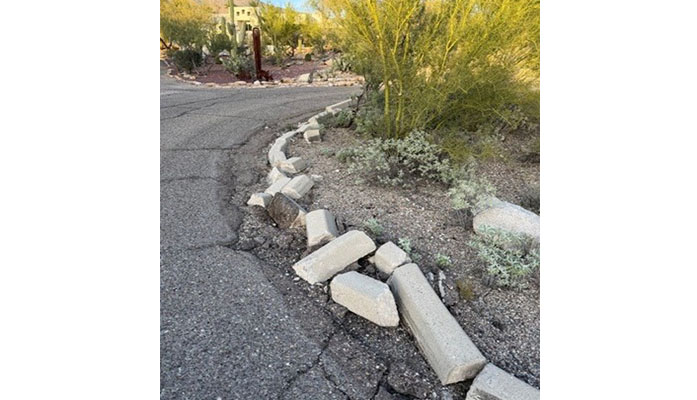
How long did it take for the curbing to break apart like this? Well, neighborhood residents claim that maintenance has not been done to their streets for 20 years or more.
Homelessness also abounds in Tucson, as it does in much of the country, especially in the Sunbelt, where the homeless (or “unsheltered” if you prefer) don’t have to worry about freezing to death. Of course, they still have to worry about being assaulted by deranged street people, and, if they are drug addicts, about dying of a drug overdose.
As homelessness has increased, the quality of life of everyone else has declined, not only from living with the sobering scenes of panhandlers on street corners and homeless encampments on roadsides, but also from higher crime and from the unsightliness of trash, shopping carts, needles, and even human feces left in parks, alleys, and elsewhere.
The problem is now so big that it has overwhelmed city resources and become a political hot potato. As with deficit spending, the time to solve the problem was when it first began to appear, ideally in a humane manner.
Actually, the problem goes back to the early 1960s. That’s when thousands of people with a mental illness were deinstitutionalized across America by being released from psychiatric “hospitals.” The plan was for them to receive care at community centers, which were to be funded by the federal government. However, only a handful of centers were built before Congress stopped the funding. Sixty years of incremental degradation later, Tucson and other cities are left with the result.
Incremental degradation also occurs when crime is allowed to proliferate. Broken-window policing is a method of countering this. It is based on the idea that serious crime increases when petty crimes are overlooked, and when broken windows and other signs of disorder become a beacon to criminals. To reduce serious crime, then, petty crimes also have to be reduced.
In addition to crime, it seems as if there has been an increase over the decades in degeneracy, vulgarity, decadence, rudeness, and slovenliness. Daniel Patrick Moynihan warned about this degradation in his famous and controversial 1965 report, which is now referred to as the “Moynihan Report.” He wrote it when he was Assistant Secretary of Labor under Kennedy and then Johnson.
After serving in various other capacities in both Democrat and Republican administrations, Moynihan would go on to serve as a US Senator (D-NY) from 1977 to 2001. In 1993, he published another controversial article, “Defining Deviancy Down How We’ve Become Accustomed to Alarming Levels of Crime and Destructive Behavior.”
As with his 1965 report, a main thesis of his 1993 paper was that many social pathologies are caused by the decline in two-parent families—a decline that is fueled by badly designed welfare programs, which seem to have the goal of rewarding and incentivizing counterproductive behavior instead of reducing it. The pathologies include not only crime but poor grades, delinquent behavior in schools, and serious health problems.
Because the degradation has occurred incrementally over time, Americans have become desensitized to the consequences. Moynihan gave the example of how shocked Americans were over the 1929 Saint Valentine’s Day massacre in Chicago, in which gangsters executed seven enemy gangsters. Americans are no longer shocked, he went on to say, when that many people are murdered in just one weekend in a big city.
Even more surprising for a Democrat, Moynihan explained that nonprofits that provide services to the disadvantaged now have a vested interest in not solving root problems, because solving the problems would end their source of revenue.
Can incremental degradation be stopped? I’m not optimistic, but keep in mind that I live in a city where the local government kicks residents to the curb—and a badly broken curb at that.
Mr. Cantoni can be reached at [email protected].