
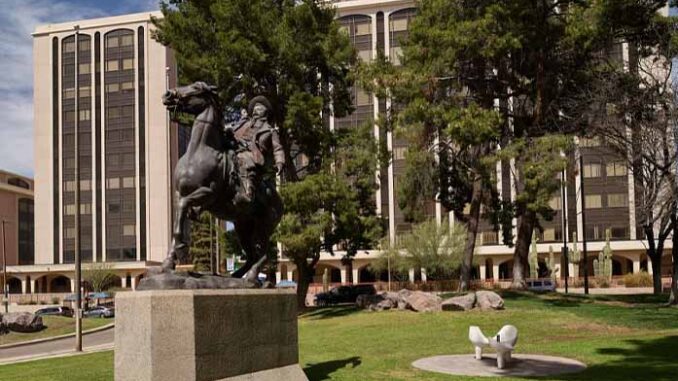
According to 13 News in Tucson, the Tucson city council is considering a $3 per month Clean City Fee to fund “graffiti abatement, homeless encampment cleanup, illegal dumping response, community cleanups, and a homeless work program.” Supposedly, this will help to close a $30 million budget deficit.
The story didn’t say if that’s $3 per household, per person, or what.
In any event, it’ll take more than three bucks to clean up Tucson, but give them credit for realizing that the “Dirty T” has a problem, a problem that has been decades in the making, corresponding to decades of bad governance.
Ugly aesthetics are anathema to a tourism economy. They are also a repellant to corporate executives looking for a locale for their high-wage offices. Widespread seediness and shabbiness send a message that crime is high, civic-mindedness is low, and local government is out to lunch.
It speaks volumes that the city is considering a separate fee for a basic service such as cleanups, as if this is something special and not an essential part of what a city should be doing as a matter of course. What’s next? Fees for traffic lights? Fees for law enforcement? Fees for using parks?
Meanwhile, rides on city buses are free, thus making bus stops, transit centers and buses magnets for deranged drug addicts, who are mischaracterized as the homeless or unsheltered, as if the root problem is a lack of housing. Hardly a week goes by without one of them stepping in front of a car and being killed. In some parts of the US, moose, elk or deer are a hazard to drivers. In Tucson, it’s human beings.
The suburbs aren’t much better, and in some respects are worse. That’s because a whopping 36 percent of metro Tucson is unincorporated county; that is, a government that is better suited for rural areas than suburban ones—or for cattle instead of people.
As I’m writing this, the Cologuard golf tournament is being held in the unincorporated Foothills, on a course that abuts the main east-west artery of Sunrise Rd. In attendance are players, TV crews, corporate sponsors and fans from other cities—especially pristine cities where professional golfers tend to live.
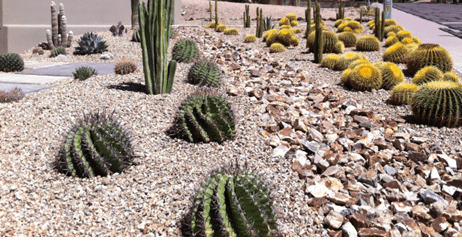
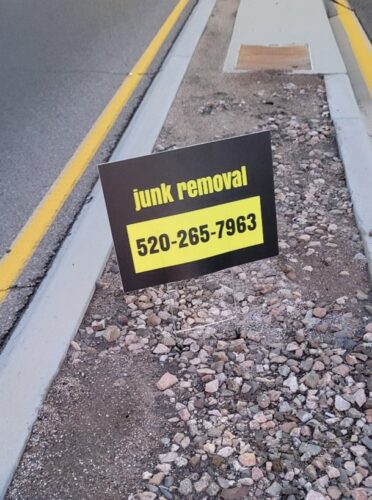
As such, one would think that the county would have spruced up that section of Sunrise. But the county has left it looking as it always looks: with bare dirt, stumps and scraggly shrubs in medians and on shoulders, instead of attractive landscaping of crushed granite, riprap, native trees, succulents and cactus.
And in a sign of desperation in a low-wage economy, the scores of illegal signs planted by shady outfits have been left along the right-of-way, advertising everything from junk removal to DNA testing. Well, at least there isn’t a sign advertising colonoscopies—not yet, anyway.
In other words, the landscaping along Sunrise doesn’t look like this:
But it does look like this:
If metro Tucson governments weren’t so parochial, they would replicate what some other cities have done to be aesthetically pleasing. They have required businesses and other property owners to keep their frontages and the public right-of-way clean and nicely landscaped up to the curb. And, as part of a widely publicized campaign, they have honored citizens, volunteer groups and businesses with lunches and awards for picking up litter.
Eventually, such efforts become part of the local culture, thus enabling the cities to spend less and less time and money on cleanups and compliance. At the same time, in a virtuous circle, they are able to increase the tax base by attracting high-wage businesses and jobs.
I’ll bet you three bucks that nothing will change as a result of Tucson’s Clean City Fee.
Mr. Cantoni can be reached at [email protected].
We took a drive up to South Dakota and back last fall. We noted that along the roads and highways there was virtually no trash visible for nearly the whole road trip. That is, unless you count Arizona. We immediately noticed the change when we crossed back into the state and it just got worse the farther in we came. I-10 coming into the Tucson area resembled a garbage dump. Why should the city be any different? It’ll cost more than $3 to clean up this place.
Once again the vocal minority has raised a point but it is the wrong one IMO. To get business to come in you need to have an economic infrastructure to begin with. Tucson has an airport, it has a couple of truck stops not sure if the RR station still works and greyhound, but has no desire to have an ECONOMY. Just look at who gets elected and their message is never one for economic growth. Good roads and quality schools are a must something tucson has NEITHER of. Just look at the ‘tucson at work’ signs aqll over. Dug up roadways all blocked with construction signs BUT no CONSTRUCTION going on! Then they block off the streets with no consideration of traffic flow just look at I10 and its access, 22d st bridge going to be closed for 3 years, park ave has been limited for a minimum of 6 months now with nothing going on and then there are the side streets that rely on the main avenue. Pretty medians mean NOTHING when the streets themselves are a mess, plus when they plant trees, or bushes they fail to keep trimmed and then the bushes grow out and become another hazard to traffic. The roadways have been a mess for years and now they want to charge $3 what a joke. Get ride of the grijalfa grifters is the 1st thing needed. Remember the ‘mayor’ blocked GCU from establishing a campus here in tucson add in PCC, and the UA and we still have questionable higher ed. Here is a question I dont have an answer to, but where is all the local traffic going to in the mornings and afternoons in tucson? There is no economic base here so at around 0800 and 16-1800 hrs the streets are clogged and the tucson at work guys are not to be seen! So whats up?
Could care less about the clean city. I’m wondering why the hell there’s a statue of pancho villa? Didn’t he attack the United States and murder citizens? He killed his own people and his army raped and pillaged throughout mexico. Meanwhile we’re busy getting rid of anything Chavez.
Just one more tax……and the money will simply disapear into the general fund. The city does’t give a damn about how it looks and the Dirty T nickname was justly deserved.
Code enforcement, not more taxes and fees! Typical liberals! “What’s in your wallet?”
As long as we have this homeless problem the city will never truly be clean. Tourists and businesses don’t want to see mile after mile of homeless encampments as the drive down Gold Links or walk downtown. Easier and safer to go elsewhere to spend their money
True. A clean city attracts tourists and commercial entities. Locals can better enjoy going out and feel honored to live in a nice environment. When civic groups, churches, youth organizations, etc take ownership of a section of public space, they can advertise their being a good citizen which in turn encourages others.