
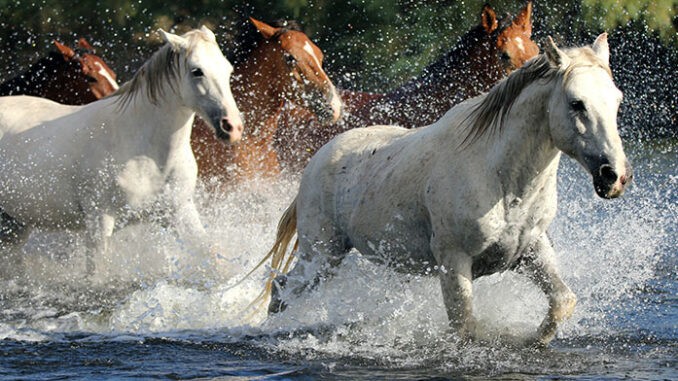
PHOENIX — Arizona should complete an independent scientific review before reducing a free-roaming horse herd below 150 animals, according to one of the nation’s leading equine population geneticists.
Dr. E. Gus Cothran, a renowned equine population geneticist and professor emeritus at Texas A&M University, said a population of 150 to 200 horses is generally considered the minimum needed to protect genetic health over the long term.
“At the most basic level, 150 to 200 animals is a minimum number,” Cothran said. “This is the number that, if everything goes right and only population genetics is involved, should maintain genetic health for 200 years or so.”
Cothran cautioned that there is no single number that guarantees a herd’s survival. The outcome also depends on the ages and sexes of the horses, how many mares and stallions reproduce, the herd’s existing genetic diversity and whether unrelated horses enter the population.
However, his answer provides an important scientific warning against reducing a herd far below the 150-to-200 range without first studying the consequences.
That means a small herd might continue producing foals for a period of time, but that does not guarantee it will remain genetically healthy over the long term.
Cothran said a population that remains too small will likely experience inbreeding and related losses in vigor, fertility and viability, although it is impossible to predict exactly how quickly those problems would appear.
In plain language, a herd that becomes too small may eventually produce fewer healthy foals, become less able to adapt to disease or environmental changes and require increasing human intervention to survive.
“Genetic testing can give a good estimate of genetic history, which likely can be used to determine if the herd has a history of isolation in the area,” Cothran said.
He said testing 20% to 25% of a herd would provide a reasonable sample.
The findings do not establish a specific carrying capacity or management number for any individual Arizona herd. That would require herd-specific genetic testing, population records, reproductive data and a scientific evaluation of the habitat.
Supporters of the herd say the findings show why Arizona should not permanently remove horses based on an unsupported target, informal vote or administrative preference.
Friends of the Salt River Wild Horses is calling on Arizona officials to pause permanent removals until the state:
- Completes an independent genetic study of the herd;
- Releases the data and scientific method used to establish its proposed herd-size target;
- Determines whether that target will preserve a healthy, self-sustaining population; and
- Allows the findings to be reviewed by independent experts.
A herd can continue to exist for years while quietly losing the genetic diversity needed for its long-term survival. Once that diversity is lost, it is gone forever, claim supporters.
Supporters of the herd say that before a single horse is permanently removed, Arizona should demonstrate through independent science that the remaining herd will be genetically healthy and capable of surviving for generations. Friends of the Salt River Wild Horses calls upon Governor Hobbs to halt removals, to do the science, and respect the public process.
The Governor and state officials need to pause the removals of these beautiful and magnificent wild horses (scheduled to begin in September!), until the proposed reduction has been independently reviewed and supported by credible science!!
More and more people every day are learning about this issue – you can no longer ignore the public outcry. Before a single horse is removed, the State of Arizona should be able to demonstrate that its approach to herd reduction is based on peer-reviewed science and will preserve the Salt River wild horse herd for generations to come.
Thank you ADI, for speaking for the Salties. There are many Arizonans that support keeping the horses safe and free. The number of people who are FOR REDUCING the number of horses, is far less than than the number of Arizonans who are FOR KEEPING the horses free. That in itself should speak loudly to Governor Hobbs, as many of those constituents who had voted for her in the last election, are speaking out that they will not be voting for her again. They no longer trust her. She is breaking the law to pursue having these beautiful wild horses’ lives, families, and their existence put at risk!
In addition, an independent science study needs to be completed to provide evidence that by reducing the numbers of the remaining
herd, they would be reducing the chance of keeping the horses genetically healthy and to continue having healthy foals, in order
for them to survive. How many times do we all hear about preventing extinction of animal, birds, frogs, ect. The Salt River Wild Horses should not be forced into extinction. Keep them all alive, free, and on the only land that they know as Home.
Thank you so much for this article. Please let them be wild and free. This should also apply to the Heber wild horses as well!!
Governor Hobbs You voted for the bill to protect these beautiful family oriented Arizona treasures. What happened between now and then? Money? They don’t cost our state a dime
They arr well managed by a caring group of volunteers- and voters.
Thank you for this article!
Every Arizonan deserves to behold our historic Salt River Wild Horses! Do right for us governor by halting the removal of any horses now!
FOREVER WILD & FREE!💜💪🏻🐴💪🏻💜
Gov Hobbs herself voted for the Salt River Horse Act but now she is disregarding this law and mandating removals. She cannot be trusted to serve the best interests of the people of Arizona or even uphold an actual law that SHE supported!
You are so right Colette! It is so wrong for the Governor to disregard a law she was involved with putting in place. The Arizona Salt River Horses deserves better than this.
Let them all stay free Governor Hobbs!
A true scientific study needs to be done and the voice of the people who manage and protect these horses need to be heard. I’ve traveled to photograph wild horses all over the US including the Salt River Horses. This area is managed incredibly well, the horses are heathy and there’s plenty of land and food. All wild horses are protected and should continue to be protected, especially this herd.
There are humane ways to keep the herd smaller. What is going on is inhumane and is not in Arizona’s best interest. Most of this is becuse the cattle growers want the land for their herds; but, there is room for both. Save the Salties and other Arizona Wild Horses. NO MORE HELOCOPTER round-ups. No more selling the horses for slaughter.
Governor Hobbs should listen to the will of the people of Arizona No removals without independent scientific review.
Before any Salt River Wild Horses are removed, please do the science first. These majestic icons of the southwest call the Salt River home and we are lucky to be in their presence. Removing horses without research on their positive environmental impact in reducing fires and harm to genetic wellness is just plain ignorant.
I think we should let the AZ Game & Fish Department manage them, since all the horse wackos think they are somehow “wildlife”.
God Bless andProtect our Salties all wild horses! 🙏
Can we stop reducing, decimating, and weakening what nature has given us? We have a responsibility to preserve these Wild Horses in their centuries long habitat for generations of Arizonans and Americans to come. Destroying is easy. It takes real intelligence and strength to preserve. Step Up Governor Hobbs!
Governor Katie Hobbs needs to listen to the science. She needs to stop this plan of rounding up half of our Salt River Horses. It is a violation of the AZ Statute 3-1491 The Salt River Horses ACT to round them up for a non humane reason. These wild horses have been living in the Salt River area since before AZ even became a State. They are a big part of our AZ Heritage and they need to be Preserved, and protected for future generations.
Thank you Arizona Independent for running this very important story, about our Treasured Historical Salt River Wild Horses.
Do the science . Don’t remove one horse until this is done.We have to make sure there will be a genetically viable herd
Analysis needs to be done to see how these escaped livestock are affecting wildlife.
Science 1st. These horses deserve to stay free and at home with intact families. They were not asked to shrink their home We as humans did that. Our society wants to destroy anything and everything for the big might buck.WE MUST STOP BEFORE WE CAN’T
NO HORSE REMOVED WITHOUT A Scientific study..
Please we need Katie Hobbs decision revoked until the science can be understood. I don’t understand the urgency from Katie Hobbs, when there are so many unanswered questions and this bill had unwavering support from the house. I question if Katie’s campaign for re election is receiving some funding from the livestock industry. They are pushing so hard for the removal of wild horses nationally for cattle grazing.
Thank you for bringing this to the public’s attention. WE must protect this majestic herd and follow the documented science in order to contnue their heritage and legacy
Please let them be free , they have been here since the 1600’s and have every right to be free. ❤️
lol, that’s not accurate.
Escaped livestock.
Please Governor Hobbs, do the right thing, do what you voted for as a senator in 2016 under the Salt River Horses Act and reinstate their protection. Authorize the science-based study before irreversible removals are made. The horses are being managed and will continue to be managed by the Salt River Wild Horse Management Group, at no expense to the state, getting their numbers down with fertility control and attrition.
I, as well as many others have requested to meet with Governor Hobbs regarding the Salt River horses. Each and every time we have been sent denial letters. In 2016, Governor Hobbs supported The Salt River Horse Act, and it became the law that was intended to protect this herd. My question to the Governor is, why are you choosing to no longer protect these historic horses? They are Arizona’s living history. People come from all over the world to see them, and that equates to millions of dollars in tourist revenue. Halt the removals Governor, do the science! Otherwise, all that will be left of our beloved Salties will be a paragraph in a history book.
Thank you! Please shout this loud and clear for all to hear–especially Gov. Hobbs! PLEASE send this article to TV, radio, social media all around Arizona! I cone from Wisconsin just to see the Salt River Wild Horses.
Please everyone, be a voice for our beloved Salt River Wild Horses! The herd is already quite small, and further reductions will be harmful. We advocates are only asking that scientific studies be done, per AZ current law, before any removals take place! It’s all up to Gov. Katie Hobbs at this point, so let’s all let her know we want NO REMOVALS. These horses live in close-knit family bands and they are healthy and happy being wild & free! Let’s keep them that way!
Yes, let them be wild and free. Stop the roundups and slaughter of these magnificent animals. Thank you so much for this article defending the wild horses. They are loved by so many people all over the country.
Thank you for sharing this article! The Salt River Wild Horses are Arizonas treasure and responsibility. It is horrible to see that our own governor does not respect these beautiful animals and that she is not keeping her word to support the Salt River Wild Horse Act!
Governor Hobbs has ignored the Salt River Horses Act that was meant to protect them, a law she voted for. She has ignored the overwhelming majority of Arizonans who want these horses protected. She is refusing to do the science first. She refuses to meet with wild horse advocates. She won’t even acknowledge the issue, let alone take responsibility for her decision. That is not good leadership.
Yeah, maybe said scientist and special interests can pay for that, otherwise, nothing lasts forever. Cull them to a healthy population, like deer, and let Mother Nature do her thing for “better” or “worse” (the arrogance of humans).