
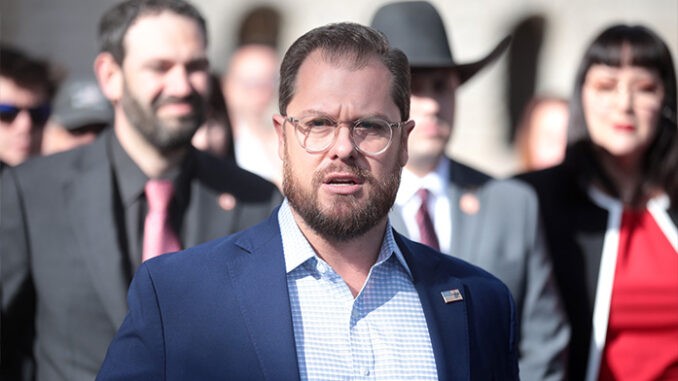
A political consulting firm owned by Arizona State Senator Jake Hoffman (R-LD15) is seeking a federal injunction barring officials of the Arizona Citizens Clean Elections Commission (CCEC) from enforcing a subpoena issued in connection with an investigation into the campaign finances of Republican Arizona Corporation Commission candidate Dr. Ralph Heap. Attorneys representing the Commission have opposed the injunction.
According to State Affairs, the underlying investigation concerns allegations that Heap failed to properly disclose spending on campaign signs.
In a lawsuit filed November 18 in the U.S. District Court for the District of Arizona, 1Ten LLC alleges that a subpoena issued by CCEC Executive Director Thomas Collins violates the First and Fourteenth Amendments by compelling the disclosure of private campaign communications and political associations beyond the scope of the campaign finance investigation.
According to the complaint, the deadline for compliance with the subpoena was extended to November 25. Attorneys representing the Commission have since filed an opposition to the requested injunction.
The lawsuit, brought by attorney and State Rep. Alexander Kolodin (R-LD3), names Collins and commissioners Mark Kimble, Galen Paton, Sam Crump, Christina Estes-Werther, and Steve Titla as defendants in their official capacities.
Arizona law already requires political committees to disclose qualifying contributions, expenditures, and outstanding extensions of credit under A.R.S. § 16-926, with records publicly searchable through the Secretary of State’s campaign finance database. Candidates participating in the Clean Elections system are subject to additional reporting requirements, including detailed descriptions of consulting and advisory services.
Under A.R.S. § 16-958(F), candidates are also required to make their campaign bank accounts, financial reports, and related financial records available for public inspection during primary and general election periods in accordance with Commission rules.
Heap voluntarily participated in Arizona’s Clean Elections public campaign financing program, subjecting his campaign to the associated financial reporting and oversight requirements.
The constitutional challenge centers on the scope of the subpoena, which 1Ten alleges extends beyond the financial records necessary to investigate Heap’s campaign sign purchase and into confidential political communications, campaign activities, and relationships.
Clean Elections Commission Responds
In a response filed November 24, attorneys representing the Commission opposed 1Ten’s request for injunctive relief, arguing that the subpoena seeks information necessary to determine whether a publicly funded candidate complied with Arizona campaign finance laws.
Commission attorney Craig Morgan stated that Heap reported a $644.47 payment to Mesa Sign Shop, while a complaint documented 184 campaign signs deployed throughout Arizona. Morgan noted that invoices were addressed to Hoffman’s firm and that one reflected a payment of $96,500.
The Commission maintains that its requests are limited to records concerning Heap’s campaign and do not seek 1Ten’s client or donor lists.
Morgan also argued that 1Ten had failed to utilize the administrative procedures available under Commission rules to seek modification or withdrawal of the subpoena and that enforcement would require proceedings in Maricopa County Superior Court.
The Commission argues that 1Ten’s claims of injury are premature because it has yet to seek judicial enforcement of the subpoena.
According to the Commission’s attorneys, granting the requested injunction could allow publicly funded candidates to circumvent financial oversight by routing campaign expenditures through political consulting firms.
Morgan further disputed the relevance of a declaration submitted in support of 1Ten’s lawsuit by Republican Rep.-elect James Rogers (R-LD10), a client of the firm, arguing that the subpoena seeks no records from Rogers and reaches the shared invoice only insofar as it concerns Heap’s campaign.
The Campaign Finance Investigation
The case stems from a CCEC investigation designated MUR 26-06, concerning campaign signs ordered by Heap from Mesa Sign Shop in April and completed in late May.
The Commission voted August 14 to investigate Heap over potential violations of state campaign finance laws while authorizing the release of his public campaign funding. Mesa Sign Shop owner Jim Torgeson provided an affidavit stating that the signs had been supplied to Heap on credit.
According to the lawsuit, the Commission subsequently approved a compliance order on August 27 directing Heap to produce records and communications related to the sign purchase and agreements for campaign services. Collins also subpoenaed Mesa Sign Shop for its business records pertaining to the transaction.
Under A.R.S. § 16-956(B), the Commission has statutory authority to subpoena witnesses and compel the production of records material to the performance of its duties. Its administrative rules also establish procedures through which subpoena recipients may apply to the Commission to quash or modify a subpoena within five days of receiving it.
Kolodin alleges that Collins exceeded the scope of the Commission’s authorization when he issued a separate subpoena to 1Ten on November 3, which was delivered to the firm’s counsel on November 6.
“The Commission never voted to authorize the subpoena the Executive Director issued to 1Ten,” Kolodin wrote in the complaint. Rather, he wrote, the Commission “voted ‘to proceed with an investigation’ of Dr. Heap.”
The lawsuit states that the Commission expressly authorized Collins to issue and enforce subpoenas against witnesses in three other candidates’ investigations during its August 27 meeting, but adopted no corresponding motion in the Heap investigation.
The subpoena directed at 1Ten, as reproduced in the complaint, contains five requests for records without specifying a date range. Among them are demands for documentation identifying the sources of payments made on Mesa Sign Shop invoices, including a $96,500 payment reflected on Invoice No. 2947, and records identifying individuals involved in collecting, transporting, placing, or removing Heap’s campaign signs.
The complaint states that the invoice also includes another candidate’s signs and is already in the Commission’s possession. The $96,500 payment is not identified in the complaint as an expenditure attributable exclusively to Heap’s campaign.
The subpoena further demands records of other goods and services provided or arranged by 1Ten for Heap’s campaign, associated payments and reimbursements, and communications between the firm, Heap, and Mesa Sign Shop.
1Ten Alleges Compelled Disclosure Of Private Political Associations
While existing campaign finance disclosure requirements make many financial relationships between candidates, consultants, and vendors publicly identifiable, the subpoena also seeks information concerning individuals whose involvement in a campaign may not be reflected in publicly filed financial reports.
One provision specifically requires 1Ten to identify relevant records outside its possession and the individuals who possess them.
“If relevant records are not in your possession, please provide an index identifying the records and who is in possession of such records,” the subpoena states, according to the complaint.
Kolodin argues that the provision would require the company to identify political associates whose involvement could otherwise remain private, furnishing investigators with the identities of additional individuals from whom records could be sought.
“That index is a map of political associations,” the complaint states. “For records of private campaign dealings, it can connect a person to particular work, payments, or communications and supplies the State with the next custodian to pursue.”
The lawsuit also alleges that political adversaries of Heap and Hoffman sought to use the Commission’s investigation to identify campaign advisers and pressure Heap to withdraw from the race.
The complaint cites a memorandum from the Arizona Public Integrity Alliance (AZPIA), which it says called upon the Commission to identify individuals who advised Heap regarding the sign purchase, its financing, and the campaign’s reporting obligations.
It also cites statements made by Arizona Corporation Commission Chairman Nick Myers, who was defeated in the July Republican primary.
According to the complaint, Myers told the Commission on August 14 that the campaigns’ activities were “coordinated presumably by a single consultant” and that “it’s reasonable to conclude that Jake Hoffman played a central role,” while acknowledging that further financial records were needed to establish that with certainty.
Kolodin argues that the absence of express confidentiality protections in the subpoena, coupled with the Commission’s previous publication of investigative correspondence in its public meeting packets, creates a risk that private campaign communications and relationships could be exposed publicly.
The lawsuit is supported by a declaration from Rogers.
In his declaration, Rogers stated that the subpoena has made him less willing to communicate candidly with the firm, put campaign matters in writing, identify supporters, or place orders alongside another candidate. His concerns persist even if the information disclosed remains with the Commission.
In support of its constitutional challenge, 1Ten cites the U.S. Supreme Court’s 2021 ruling in Americans for Prosperity Foundation v. Bonta, which established that compelled disclosure requirements subject to exacting scrutiny must be narrowly tailored to the government’s asserted interest.
The company also cites the Ninth Circuit Court of Appeals’ ruling in Perry v. Schwarzenegger, addressing First Amendment protections against compelled disclosure of internal political campaign communications.
The complaint states that 1Ten’s requested relief would leave the Commission’s investigation of Heap intact and would permit the continued use of records already lawfully obtained.
Federal Court Proceedings
ABC15 Data Analyst Garrett Archer reported on the lawsuit via X, also noting a business relationship between Kolodin’s Secretary of State campaign and Hoffman’s consulting operations.
https://twitter.com/Garrett_Archer/status/2125376378438844877
Campaign finance records cited in subsequent reporting by KJZZ also identified expenditures by 1Ten benefiting Kolodin’s campaign.
Both Heap and Kolodin were unsuccessful in their respective bids for statewide office in the November 3 general election, according to the reported election results.
1Ten is asking the federal court to declare the subpoena unconstitutional, issue preliminary and permanent injunctions prohibiting its enforcement or the issuance of further process seeking the same information from the firm and its representatives, and award reasonable attorneys’ fees and court costs.
The case has been assigned to U.S. District Judge Diane J. Humetewa under case number CV-26-10652-PHX-DJH.
Federal docket entries indicate that two responses to the motion were filed November 24, followed by a reply November 25. As of Wednesday afternoon, the court had not ruled on the requested injunction, according to KJZZ.
The status of 1Ten’s compliance with the subpoena was not immediately clear.
Be the first to comment