
Many urban planners still believe that a thriving downtown is a prerequisite for a thriving city. Sometimes that’s true but oftentimes it isn’t. Tucson and Dallas are examples of the latter, for different reasons.
Let’s begin with the megapolis of Dallas.
A recent Wall Street Journal story described how metro Dallas is booming while downtown Dallas is declining, in spite of downtown being the location of the Kay Bailey Hutchison Convention Center, the American Airlines Center (arena), office towers, and the headquarters of AT&T and other giant corporations. (“Dallas Is Booming—Except for Its Downtown,” the Wall Street Journal, Dec. 28, 2025.)
The corporate giants are moving from downtown Dallas to nice city neighborhoods or the suburbs. At the same time, corporate giants relocating to Dallas from other states are also shunning downtown.
The same phenomenon is happening in several other cities.
Why? Four reasons:
– Crime and the homeless tend to be concentrated in downtowns.
– Downtowns tend to have higher costs and more traffic congestion.
– Like them or hate them, but most corporate executives prefer suburban living for their families, due in large part to better schools.
– Suburban corporate campuses offer easy parking, beautifully landscaped open areas, a short commute for those who live nearby, and safety for employees.
These suburban preferences are furthered in Dallas by the fact that the Dallas-Fort Worth metroplex has several suburbs that are large and self-contained cities in their own right. For example, the “suburban” City of Plano has a population of 285,494; the City of Frisco, 245,494; and the City of Irving, 256,684.
There are unique neighborhoods and communities within each of these suburbs, with varying levels of education and income. For example, Los Colinas is a mixed-use community in Irving. As detailed here, it has a staggering number of corporate headquarters and major operations. It also ranks near the top in the US in the percent of Asians who live there. Of its 38,857 residents, 41.4% claim to be of Asian ancestry.
Metro Phoenix also has scores of municipalities, including the very large suburban cities of Mesa (population 504,259), Scottsdale (241,361) and Tempe (180,587).
By contrast, the City of Tucson has a population of 542,629, while the suburban towns of Marana, Oro Valley and South Tucson have populations of 51,908, 47,070, and 4,613, respectively. None of these can be characterized as an economic dynamo or a magnet for major corporate operations or headquarters.
Tucson’s lack of economic dynamism and diversity is exacerbated by the fact that a whopping 36% of metro Tucson is unincorporated county. As a result, more than a third of the metropolis is an amorphous blob without a soul, distinguishing characteristic, responsive and accessible government, or the public amenities and services that corporate decision makers seek.
Another drawback is a lack of political competition in Tucson. The City of Tucson and Pima County, which together comprise about 88% of the metropolis, have been run for decades by the same political monopoly. As with all monopolies, this leads to complacency, hubris, insularity, inefficiencies, and incompetence.
Still another drawback is metro Tucson’s abysmal transportation planning. The Regional Transportation Authority is beset by infighting, uncertain funding, and decades of deferred maintenance. It is 50 years behind transportation planning and funding in metro Phoenix.
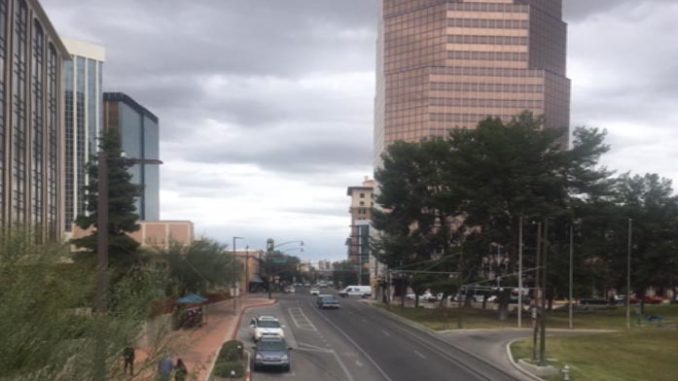
Meanwhile, as with many downtowns across the nation, downtown Tucson has been redeveloped by means of a tax abatement scheme. Although the odds are slim of it becoming a major corporate center, downtown has become a center for bars, restaurants, and entertainment venues, as well as what is typically found in downtowns: government offices, courts, law firms, a convention center, and a smattering of hotels and apartments.
Downtown Tucson’s saving grace is that it is near the University of Arizona and its 35,000 students. In addition, special clean-up crews and extra security keep it from becoming seedy again and being overrun again by criminals and the homeless. If only the city’s residential neighborhoods were that fortunate.
Will Tucson’s spiffy downtown be the catalyst for transforming the rest of the metropolis into an economic dynamo? No, not as long as the aforementioned political monopoly stays in power and continues to shortchange the rest of the metropolis.
That raises an important question: Why does the rest of the metropolis put up with this?
Mr. Cantoni can be reached at [email protected].
I worked in the “New Downtown” for almost a year. The place is a joke, overpriced restaurants that are unkempt, homeless people wandering around during the day. Poop Alert!!Look where you step!
(There is a Crazy Guy that argues with himself every Friday, in an alley by the planning and development office)
I keep hoping it will get better..
your chances of getting stabbed downtown are 10x higher than Marana or Oro Valley
Hooray… bars and over-priced restaurants. Only reason to go downtown is Miller’s Surplus and jury duty. Wouldn’t mind seeing a few hockey games but I’m not going downtown to do it.
‘ONLY’ reason to go downtown is to deal with government by force – a ticket – thank GOD the cameras are gone! downtown is just that ‘drugs – thugs – BS – lots of alternatives to that metro outhouse’ oh and where is the ‘government promised ‘hotel’.. no matter no one will stay in it. I just ‘attended a Phx convention’ have to do the same again in March – didn’t leave the hotel after attending – the streets are a S’t Hole. Dismal traffic and traffic flow.
Tucson’s downtown can never be “spiffy” as government offices are the predominant consumer of office space/buildings.