
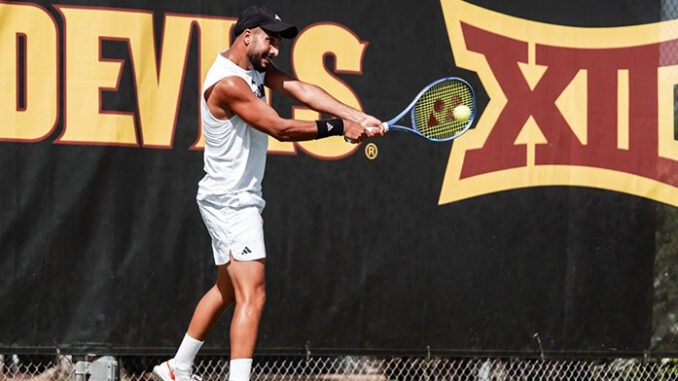
When the Arizona State men’s tennis team took down Texas Tech 4-3 on April 3, the scoresheet omitted a familiar name – Bor Artnak.
The junior from Slovenia had been the Sun Devils’ No. 1 singles player since Murphy Cassone decided to forgo his senior year of eligibility to play on the Associations of Tennis Professionals tour, but then Artnak abruptly left the team in late March.
Even without Artnak’s services, the Sun Devils were ready to move forward.
In stepped Ofek Shimanov, a sophomore transfer from Southern Methodist University who had primarily played No. 3 singles for the Sun Devils.
Although Mathis Bondaz, a redshirt senior cemented at No. 2 singles, appeared an obvious choice to move up, Shimanov’s consecutive performances against TCU’s Duncan Chan, the No. 7 singles player in the country, and Baylor’s Zsombor Velcz, ranked No. 39, convinced coach Matt Hill to back his young prospect. The Israeli was up 5-2 in a deciding set against Chan that went unfinished and was locked into a battle with Velcz that also wasn’t complete.
“Seniority is not the decision-making factor for us on who to play where,” Hill said. “You (compete with) those two guys, you can beat anybody in college tennis. He was showing some great progress in his game. He’s showing the weapons and the ability to take points, collect points, hurt a player, which you need to have at line one.”
Shimanov’s tennis journey began as a 3-year-old coached by his father, Ariel, in his hometown of Ramla. Despite the familial bond, Shimanov moved to the Israel Tennis & Education Center as a teenager for better opportunities, living at the academy.
After receiving an army exemption when he turned 18 due to medical problems, Shimanov got the opportunity to play collegiate tennis in the US. Hill was initially interested in bringing Shimanov to Tempe as a freshman, but uncertainty around Cassone’s pending led the Israeli to head to SMU instead.
The first thing Hill recalled from scouting Shimanov was his timing of the ball, referring to Shimanov’s ability to sync his swing, body movement and racket contact point with the incoming ball’s speed and trajectory to produce a clean shot.
“His timing is not normal,” Hill said. “(It’s) super special.”
Shimanov entered SMU speaking almost no English, a difficult transition on a team featuring nearly all American-born players, but the process helped the freshman experience the culture of college tennis.
“I saw how college is working when it’s a system with a coach coming to you and doing the matches and (it’s) so loud and millions of things going on during the match,” Shimanov said. “I think I got the experience there, and just to move, I think I did a really, really good choice.”
Shimanov’s goal is to turn professional, and during his lone year as a Mustang, he came to the conclusion that SMU wasn’t the right environment for him to do so. Revisiting his previous relationship with Hill, Shimanov took a trip to ASU, where he felt at home.
“I have one more Israeli guy here (Roi Ginat),” Shimanov said. “I felt (like I was) in Israel with the weather, with the places, with the trees, and with the people and with the food.”
ASU’s roster is now primarily made up of international students and Ginat, a senior who came to Tempe from Kfar Saba in 2023, was Shimanov’s biggest reason for becoming a Sun Devil.
Ginat and Shimanov have a relationship stretching back to their childhood in Israel, and the senior aided Shimanov’s decision-making throughout the transfer process, even advocating for Hill to pursue the freshman in the portal.
“When you have Roi here, another Israeli that’s been here for four years, and can help guide you, that’s been incredible,” Hill said.
Starting the season behind Artnak and Bondaz, two upperclassmen returning from last season, Shimanov began at singles No. 3, a position he was familiar with from his time at SMU. His doubles partners frequently shifted around but he’s been paired with sophomore Milos Mikovic for the latter half of the season, a partnership that’s just starting to develop.
“It’s growing, the trust in each other, and that’s really important in doubles, knowing that you can rely on your teammates no matter (what), especially deuce points,” Mikovic said. “If he’s returning better this game, you have to be like, ‘Hey, dude. You got this, I believe in you’, and that means a lot.”
Since taking over the top spot, Shimanov has continued to expand his game. Hill has worked on increasing Shimanov’s net clearance on serves and being more aggressive in tight spaces, pushing him to drive balls from the corners that he would previously slice.
Hill noticed a rare “sureness” that Shimanov carries with him throughout his matches, one that carries over to his return game. Those fast hands and eye for timing have enabled Shimanov to improve tactically, balancing which points to be aggressive on and which situations to play more safely.
Juxtaposed with his energetic demeanor on-court, Shimanov is reserved as a person. Part of it ties back to his lack of familiarity with English but when he does speak, his words carry “a lot of weight,” Hill said.
Physical changes have also aided Shimanov’s transformation across his first season in Tempe. When ASU hosted regionals in October, the staff highlighted weaknesses in Shimanov’s physicality, where he lagged behind the rest of the draw.
“(Shimanov) made a commitment at that time to pull back on the competitive calendar and get in the gym double time,” Hill said. “He’s been doing pretty much double (the) gym of any other player.”
Near the end of Shimanov’s interview with Cronkite News, he asked for the time and then asked if he could leave early. He was headed for the gym, with his ultimate pursuit of turning professional taking another step.
For now, Shimanov is hoping to help the Sun Devils extend their season when they open the NCAA Tournament on Friday in San Diego against No. 20 UCLA.