
This Independence Day season, Arizonans were reminded that freedom has many forms.
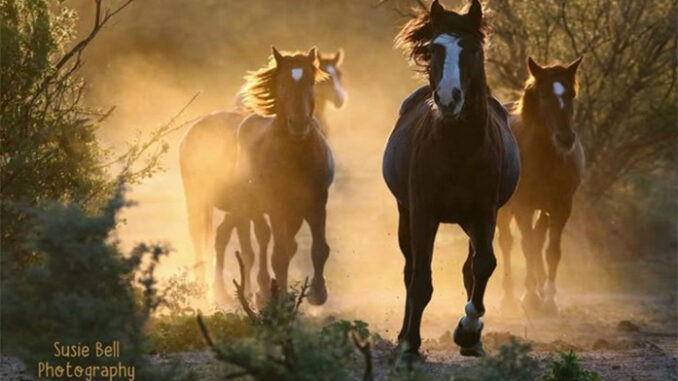
It flies above front porches. It lights the desert sky. And along the lower Salt River, it moves in bands through the mesquite and cottonwoods, drawing photographers, kayakers, hikers, families and visitors who come hoping to see one of Arizona’s most iconic living symbols: the Salt River wild horses.
For many visitors, seeing the horses in the wild is not a side note to the Arizona experience. It is the experience.
The Salt River corridor is already one of the state’s most beloved outdoor recreation destinations, offering tubing, kayaking, paddleboarding, hiking, birding, photography and scenic desert views within easy reach of metro Phoenix. The wild horses add something no marketing campaign can manufacture: authenticity.
They are part of the emotional landscape of the place.
That connection was captured this holiday season in the poem Freedom Runs the Salt:
“Along the Salt River, beneath canyon walls,
A timeless spirit still answers freedom’s call.
Hooves drum the earth where their ancestors ran,
Untamed and unbroken by the hand of man.”
For Arizona’s tourism industry, that image matters. Destinations are not built only on hotels, restaurants and attractions. They are built on identity. The Salt River horses help define Arizona’s outdoor identity in a way that is distinctly local, highly visual and deeply shareable.
They are also a draw at a time when travelers increasingly seek nature-based, authentic and place-specific experiences. A visitor can see desert scenery across the Southwest. But the chance to see wild horses moving freely along the riverbanks and desert foothills of the lower Salt River is rare.
That rarity creates value.
The current debate over reducing the herd from approximately 274 horses to about 120 over the next five years is therefore not only an animal management issue. It is also a tourism, heritage and economic development issue.
The urgency has increased because SB1199, the bill intended to require scientific review before reducing the herd, is no longer moving this session. The measure passed the Senate earlier in the year and later passed the House but did not receive final Senate action after being transmitted back. That leaves one immediate path before removals are expected to begin in September: Governor Katie Hobbs can commission an independent, peer-reviewed scientific assessment and direct a pause until Arizona knows whether reducing the herd to 120 would jeopardize its genetic health, visibility and long-term sustainability. Such a study should examine the herd’s demographics, genetic diversity, mortality rates, fertility-control impacts, carrying capacity, habitat conditions and long-term future.
Advocates argue that before Arizona moves forward with removals, Governor Katie Hobbs should commission an independent, peer-reviewed scientific assessment of the Salt River herd’s long-term viability. Such a study should examine the herd’s demographics, genetic diversity, mortality rates, fertility-control impacts, carrying capacity, habitat conditions and long-term sustainability.
Research associated with renowned equine geneticist Dr. E. Gus Cothran has generally pointed to the need for total herd sizes of roughly 150 to 200 animals to maintain genetic diversity in free-roaming horse populations. A reduction to 120 raises questions about whether the herd would remain genetically sustainable over time.
That question should matter to Arizona’s tourism industry, and it should matter to the Governor’s Office.
A herd managed below viability is not a long-term attraction. A herd that loses genetic strength, family structure or visibility along the river could diminish one of the state’s most recognizable wildlife-viewing experiences. The issue is not whether the horses should be managed. The issue is whether they will be managed in a way that protects the very qualities that make them valuable to Arizona.
Other states offer examples. Colorado’s Sand Wash Basin has used fertility control, partner involvement and smaller-scale management tools as part of an approach intended to reduce reliance on large removals. North Carolina’s Corolla wild horses are treated as a heritage tourism asset, supported by monitoring, education, emergency response and public stewardship.
Arizona should be able to do the same. Our wild horses are protected by the Arizona’s Salt River Horse Act / A.R.S. § 3-1491. The next step is ensuring that protection is guided by science, transparency and recognition of their broader value to the state.
The Salt River horses are already protected under state law. The next step is ensuring that protection is guided by science, transparency and recognition of their broader value to the state. That means looking beyond a population target and asking a larger question: What does Arizona lose if one of its most beloved tourism symbols is reduced too far?
Arizona’s wild horses represent freedom, yes. But they also represent a promise: that the state can protect its natural and cultural assets while welcoming the visitors who come to experience them.
As Freedom Runs the Salt concludes:
“So this Independence Day, let our voices ring clear:
Keep the Salt River horses wild, treasured, and near.
For a nation that cherishes freedom in every way,
Must protect those who embody it each and every day.”
For Arizona’s tourism economy, the Salt River horses are more than beautiful. They are part of the brand, part of the visitor experience and part of the story that makes this place unlike anywhere else.
Before that story is diminished, Governor Hobbs should commission an independent scientific study and pause removals until Arizona knows whether reducing the Salt River herd to 120 horses can be done without jeopardizing its genetic health, visibility and long-term future.
Governor Hobbs has a clear choice. She can allow removals to begin before the science is complete and risk being remembered as the governor who diminished one of Arizona’s most beloved wild herds, or she can insist that decisions be guided by independent science and help protect the Salt River horses for generations to come.
Protecting the Salt River wild horses is not only an act of compassion. It is responsible tourism stewardship.
Editor’s Note:
Advocates are asking Governor Katie Hobbs to commission an independent scientific study of the Salt River wild horse herd and pause removals before they begin in September. Those who wish to support that request may sign the petition here: Save The Salt River Wild Horses
Save these wild horses they are beautiful animals and they deserve to be free right where they’re at
Save our horses. Keep them wild and free in the environment hey call home.
Great article! The Salt River horses are an important part of Arizona’s heritage. We must be smart and informed. Governor Hobbs, choose the scientific study and herd protection by genetic strength. These horses are a treasure to protect and for Arizona to cherish.
Leave the wild horses alone. STOP ALL THE ROUNDUPS!!! Wild horses are part of the American West, a part of our American heritage. Let them be free!
Everyone should forward this Governor Hobbs at [email protected] and [email protected] and [email protected].
The horses should remain free. Helicopter round-ups often result in injuries or death. There is more than enough land for these horses to remain free. Horses rounded up are often kept in terrible conditions. There are positive ways to manage herds without removing ANY. They were born free, let them remain free. Excellent article
Leave them alone and let them be free
This was an excellent piece, Karen Schutte. Thank you for giving insight to others who are not as familiar with the Arizona Salt River Wild Horses. These Wild Horses need to remain free in their land! It is unfair of Governor Hobbs to not uphold her own law (AZ State Statute 3-1491). It would help to understand why she is not taking the time to meet with her constituents, in fact, she is refusing to meet with many who have properly requested an appointment to meet with her, to have a proper discussion and provide her with insight as to how the Wild Horses are a benefit to Arizona tourism as well as the ecosystems of the Salt River and the Tonto Forest. It’s not just about these specific things. There are many things that factor into keeping these horses free to roam in their homeland. If there is a reduction of too many, their viability, their genetic lines will dwindle to the point where they will die off due to inbreeding errors. Not only that, but these horses and their bands have a great love and bond with their immediate and distant family members. To the point that most people could learn so much from them. These horses experience love and sadness. To see the bond a mother and father horse have for their newborn is absolutely amazing! And when a young foal loses their life due to nature being nature, the sadness that the father horse, mother horse, and even siblings, is palpable! They mourn and we mourn with them.
There are those that have organized to work together to “be there” for the horses if need be. Not to provide daily care or regular feedings, but to be there if a specific situation needs eyes or hands when something calls for that, a case by case decision can be made by the organized group.
Governor Hobbs, please, at least uphold the already existing law before ignoring what will happen if you will not support and sign your name to support SB1199—to secure a study of genetics—as has been done in other states that don’t want to see their wild horses fall into extinction.
There is evidently a speculation that someone or some group may do an investigation of sorts, to follow the money, as to why there appears to be/has been, an avoidance as to why SB1199, cannot get a fair opportunity to be officially voted on, rather than to be ignored.
Generations of these beauties were here long before any of us. They are gorgeous, majestic, and necessary to the ecosysyem of the desert in which they live. Please leave our Salties FOREVER WILD AND FREE!!
Research shows that wild horses were moving back and forth across the land bridge between continents. Long before the Spanish explorers ever arrived in the New World. Seeing the posts and videos of the Salt River horses each morning brings me joy and brightens my whole day. I consider them an important part of our heritage and want them to always be part of our future. And I add my voice to all of those who want their lives preserved and free.
Our Salt River Wild Horses are a big part of our Arizona Heritage and they have been here since before AZ was even a state.They have been protected by AZ State Statute 3-1491 from removals. Governor Katie Hobbs needs to uphold this law, allow science be done first, before one horse is removed. Protect and Preserve our Salt River Horses for future generations.
These horses are a national treasure and should be treated as such!
Outdated and faulty science was originally used against the herd to mandate population control. The SRWHMG has been successfully using birth control on them and brought their numbers down 40%, along with natural causes and predation, to a sustainable genetically diverse population. The ecosystem remains stable & diverse with a wide variety of flora & fauna. Anyone who thinks otherwise has not enjoyed an outing in the recreation sites along the lower Salt River. In fact, any damage I’ve seen has been from human recreation, cattle and javelinas. Pause removals at the very least until an updated scientific study is ordered and completed. Besides too much misinformation reaching the eyes of AZ’s politicians, Governor Hobbs’ has declined to step in to date, which is suspect as she once voted to enact a law to save them years ago. Save our Salties!
I’ve been observing the Salties in their natural habitat since I was a little girl. They’re a very important part of this country’s heritage. It’s a privilege to be able to see something so majestic running wild this day and age. They’ve been in the area hundreds of years and deserve to continue living there. I’m devastated by the roundups and the treatment of the wild horses and burros that are supposed to be protected for generations to come.
I do not live in AZ, but learned of the Salt River Wild horses through my dad who was a resident. My first trip to AZ was to visit my dad and he was going to take me to the river to see them, but my dad died the day we left for AZ. We went to the river anyway because we knew how much my dad wanted me to witness the beauty of the herds. Once you have spent time on the river just watching the family bonds they become something for you to care for, they become something you want to witness every day possible. I have returned to AZ many times only to see the Salties. I have spent my money in AZ, but if the Governor Hobbs cannot see how important having the science behind her before the removals when it will be too late, my money will be spent else where.
Governor Hobbs, you constituents want your support of saving the Salties.
Please do the right thing for our state, for the horses, and for the love of animals!
PLEASE save the Salties!
Thank you,
Lyn Gray
Thank you for this excellent article. We need our Salt River wild horses. The herd should not be reduced. Please find ways to let them stay.
Let them be forever free!! Arizona state government and its entities need to do better….Do the study and keep our beloved Salties for future generations! Thank you to everyone who is standing in the gap to fight for Arizona heritage!
We live in New England but spend winters in Mesa. I visit the lower Salt River to bird but enjoy seeing the beautiful wild horses, too. This past winter, every time I was there, every person I passed asked if I had seen any horses. They are obviously a very big attraction and are a local treasure.
Not one horse removed!
Not one horse removed!
This is a great article. All points are valid. I support the Salt River Wild Horse Managament Group whose management has already reduced the herd by 40% through birth control and humane removals of only injured or ill horses. Praying Gov. Hobbs does the right thing and stops the mandated removals before they start in September -waiting until the science is done first. I have taken many friends to the Salt River to see the horses and I have several more who are planning trips specifically to see the horses. They are a vital part of tourism in AZ.
Excellent article! As an Arizonan I support the protection of the Salt River Wild Horses. My family and I enjoy going out to see them and witness their family bonds. Let not one horse be removed from the only land they know as home! The horses are being humanely managed and their numbers are lessening by proper management and natural attrition. Governor Hobbs has the power to stop the slated removal coming up in a couple of months. Governor Hobbs, should implement the scientific study first before any horses are removed.
Excellent article! The Salt River horses are an enormous economic boost to the State of Arizona. I know, because I was one of those tourists that specifically came to the Salt River to see the horses before moving here. Now I see hundreds of others from around the world that also come specifically to see these amazing horses. I am completely baffled why Governor Hobbs is refusing to meet with myself, along many others who were denied a meeting to discuss this issue. She helped pass the law that was intended to protect them, Ars3-1491. This law is now being ignored. Governor Hobbs, I grew up in a state where there are no wild horses. My jaw dropped the first time that I saw them, and that feeling of awe never goes away. Perhaps you have become ignorant of just how special they are. They are the only horses on the world known to snorkel for food! In addition, they are historic, majestic and iconic to not only the State of Arizona, but to our country. I can not fathom how you don’t see this. They cost the taxpayers absolutely nothing as the contract to manage them is a zero dollar contract. If scientific studies are not done, and the herd eventually goes extinct, will you read their story to the next generation from a history book? Will you tell them how people came from all over to see them, and how much they were loved? Don’t let them become a paragraph in a history book, step up and halt the removals!
Governor Hobbs please read this, pay attention to what wanted by your constituents and do the science. These Wild Horses represent everything Arizona!
NO ONE is asking for ALL the horses to be removed. There was a massive effort at trying to come to a science based decision 7 years ago. 75% of the attendees (Governor appointed) said to reduce the numbers to 50-100… with supplemental feedings. The feedlot scenario that exists behind the work center on the Beeline is cruel punishment to the horses.
Thank you for your insightful article explaining what is happening with our Salt River Wild Horses.
These beautiful, sentient beings are beloved by so many and deserve to remain in the Tonto National Forest—the only home they have ever known. Local residents, as well as visitors from across the United States and around the world, travel to the Phoenix area specifically to see them. They are a tremendous tourist attraction and contribute significantly to our local economy by supporting area businesses.
Anyone who has spent time observing these horses understands that they are highly social animals with complex behaviors and rich emotional lives. They form strong bonds with one another and are capable of showing affection, loyalty, empathy, and grief. Scientific research and countless observations have demonstrated that horses experience a wide range of emotions, responding to positive experiences with curiosity, contentment, and playfulness, while reacting to negative experiences with fear, stress, and anxiety.
Governor Hobbs should stand up for these iconic Arizona horses and honor their right to remain wild and free in their historic home. No removals until decisions are based on sound, peer-reviewed science—not politics.
No Removals. Protect the Salt River Wild Horses.
Gov Hobbs…INDEPENDENT STUDY!!! SAVE OUR BELOVED HORSES!!!!!!🙏🙏🙏🙏
Thank you for this. The science should be done first. Great acknowledgement of what these horses are to arizonans and visitors from around the world
Remove “feral” from your vocabulary! We are to be good stewards of the Earth! ❤️🐎🇺🇸
I pray that the Governor will commission an independent, scientific study for this herd of American mustangs. Herd size has already decreased significantly due to attrition and the use of birth control. The Governor has 2 choices: she can be remembered as the governor that saved and protected the Salties or her legacy can be that she facilitated a genetically nonviable herd that will lead to inbreeding and extinction and the loss of tourism dollars that will follow. America was built on the backs of horses. They deserve and we demand better for them. In honor of America’s 250th birthday, these icons of the West should be revered and protected, forever and always.
Wild horses are America’s history and treasure.
A lot of misunderstandings and propaganda being spread about them.
The bands of horses are families, they are sentient beings. A great many rounded up are simply sent to slaughter.
Should all wildlife be extinguished because you don’t understand?
Wild horses are not harmful to the environment and their numbers are maintained humanly.
Let them be free as they are meant to be.
Do your research, learn of their possible fate, learn about the wild horses before condemning them.
I’m from Missouri and we have our own free roaming Wild Horses that call the Ozark National Rivers their home land. Because of these horses people (tourism) come from miles away to view and photograph these beautiful creatures that have been roaming the Ozark Hills for centuries.
What I just wrote about our Missouri horses holds true for Arizona also. People come from miles away (tourism – spend money) to see and photograph Arizona’s Beautiful and Majestic Salt River Wild Horses. These horses have been on this land for centuries. Not One Horse Should Be Removed!!
Governor Hobbs please do the Right Thing and vote for the Legislation that would protect these beautiful majestic horses that call the Salt River their home.
No horse should ever be uprooted from their families and removed from their native land for any reason such as power and greed. There is enough land for the cattlemen. Leave the Wild Horses alone!!!
Governor Hobbs if you remember there is a Bill that was passed that already protects these beautiful native horses. Do the Just Thing and again and vote to protect these beautiful native Salt River Wild Horses. Stand up and do what’s right for your state and for your constituents instead of being swayed by the Cattle Association.
Just remember these beautiful horses bring lots of money to your state.
Please urge Governor Hobbs to follow the law she voted for and do scientific studies before any of the Salt River Wild Horses are removed. It’s all up to her! She is demanding removals to reduce the herd size without doing the scientific studies that the law requires. These beautiful horses are an asset to Arizona, and they live in closely bonded family bands. Removing even one horse hurts the herd! It’s a myth that they destroy the land–they actually enhance it! Please join us in keeping our beloved Salties wild & free!
The Salt River Wild Horses are a valuable asset for Arizona, and are beloved by many, not just Arizonans, but people from all over. The current law is clear, and by demanding removals, Gov. Hobbs is not following the very law she voted for. We, the Saltie supporters, have been begging the governor to change her mind and halt removals until further scientific studies can be done. The herd lives in family bands, where the bonds are very strong, and removals hurt the herd overall. The truth is, these horses actually enhance the land they live on, not destroy it! And they should be allowed to remain wild & free. If you follow the herd on social media, you will see why this is so crucial!
Great article.
I 100% support SB1199 and have written Hobbs repeatedly. Her vote is on the line. Let science speak before removal!!
Let the science work before removalease. They are a part of Arizona
Heritage we need to save
Excellent article. Thank you for so eloquently stating what a majority of constituents want. Governor Hobbs enact SB1199 honor the “Wild” of Arizona. Preserve economic tourism. Allow the study to take place.
The wild horses in Arizona are one of my favorite things to witness and be a part of. I will never forget the time I witnessed a Salt River horse funeral. ( I don’t know what else to call it) A mare and her foal had passed away and bands of horses from the Salt River came as if to pay their respects. They literally walked past mother and foal and then gathered amongst themselves. They are caring, feeling living creatures that form strong family bonds and relationships with others. Treat them with respect and save them and their families. They are being humanly managed as to protect the environment so there is enough for every living creature.
I corrected my typos – These horses have been here for centuries and provide so much beauty and incentive to visit the salt river. I never considered visiting the Salt River until I learned about the horses. They’re the only reason I go up there and they bring so many other people there as well! Governor Hobbs needs to research this before brutally removing them- NOT ONE HORSE REMOVED!!
Governor Katie Hobbs Do the right thing & pass the SB1199 Let’s let the professionals do the science! What is the hurry the Wild Horses deserve to live in there home Wild & Free it is a very healthy ecosystem!
Thank you
Greg & Karin Copeland
These are feral horses. They are not wild. Cull the heard!
These horses have been here for centuries and provide so much beautify and incentive to visit the salt river. I never considered visiting the Salt River until I learned about the horses. They’re the only reason I go up there and they bringing so many other people there as well! Governor Hobbs needs to research this before brutally removing them- NOT ONE HORSE REMOVED!!
Preserve the herd!
These beautiful horses have every right to stay where they are and be protected by the law that was created for them. Those of you who have not experienced the beauty and seeing these horses at the river, you need to try to find time to go and see for themselves. Honestly, what would it hurt to give it time to do the science and see that it is working. They are one of God‘s beautiful creations. Give them a chance to continue to be free. ❤️🐴❤️🐴
Follow the science and maintain herd size that keeps the heard genetically viable and strong.
These horses are a an integral part of Arizona’s history and culture.
Keep them wild, healthy and in numbers that are best for the herd.
We entrusted GovernorKatie Hobbs to make good choices and we are counting on her to step up and advocate for our Wild horses.
November comes quick.
We need a leader who keeps her word, not one who follows the money trail.
We need this study. Decisions can be reversed based on findings but they can’t be undone if the herds are no longer genetically modified. Let’s look to at independent research on the damage horses create vs cattle. The government is a steward of the lands for the people. I would like to see the science and the input from the public. There are so many that come from near and far to see the horses. They bring such joy. I do not want to see 300lb cattle grazing in our national forests. I’m fed up with the feral vs wild conversation. The cattle are not wild either and are much larger than their ancestors.
Thank you so much for bringing this to the attention of all wild horse lovers ..we all wish we could be as free as these beauties.
Thank you for this insightful article. Freedom on Independence Day includes the treasured Salt River wild horses! They have lived in the Tonto National Forest for over a century — wild and free. However, Governor Hobbs and her AZDA have mandated removals of these horses, ignoring the Salt River Horse Act, the very law SHE voted for! Let the scientific study be done to determine their impact on the environment. The horses clear the excess eel grass from the river and the dry brush, mitigating fire danger. Urge the governor to protect Arizona’s beautiful Salties before it’s too late.
These are wild horses that have called the Salt River their home for over 200 years. I’ve been down there from Prescott to see them and it is truly a remarkable experience to witness their affinity for the deep and running water. They eat the eel grass on the river bottom which is very interesting to watch while they tilt their heads to grab some. A unique way for a horse to eat. They are beautifully healthy and an Arizona treasure. Please let them be and live forever wild.
Thank you Karen for this beautiful article
bringing much needed awareness to our advocacy for the sake of the Salt River Wild Horses. Not one removal !!!
The Salt River Wild Horses represent Freedom are part of Arizonas heritage. People come from all over the country to see them. They are not hurting anything . Most importantly how does the Governor and the AZDA get to break the law? There is a Salt River Wild horse act that is being violated .
Thank you for the wonderful article summing up what is going on with the Salt River Wild Horses. Governor Katie Hobbs needs to stand up for the law that she herself voted for as a senator in 2016, giving the horses protection. They have been managed well, as you noted, getting their numbers down and they will continue to be managed while a science-based study would be done, if only Governor Hobbs would order the study. This would only put a hold on removals of healthy horses, but there would still be attrition and fertility control, getting their numbers down to 168 over the next 5 years, which was the plan before the decision was made to lower the number to 100-120. This number would be genetically viable to save the herd, while further information is obtained. We need to protect these wonderful symbols of the West, so future generations can enjoy them as I have.
It’s truly amazing how much hate gets directed at our Salt River wild horses—especially when they don’t impact anyone’s daily life in any way, shape, or form. The horses simply roam their home in the Tonto National Forest, bringing joy to so many Arizonans. Maybe those spreading negativity could stick to their own circles and let the rest of us focus on protecting these beautiful, low-impact animals with facts and science.”
Excellent piece. As for the wild horse adversaries and their hateful rhetoric, wild horses have been part of the Western ecosystems for hundreds of years. They forage for different plants than the vast majority of the other wildlife eats. Both the 1971 Wild and Free-Roaming Horses and Burros Act as well as well as the Salt River Horses Act have declared them wild and free-roaming, not feral or unauthorized livestock, as wild horse haters love to call them. Public policy polling consistently shows that an average of over 80% of Americans want wild horses protected as icons of the West. A recent AZCENTRAL online poll resulted on 97% of Arizonans wanting our wild ones protected. So when the very vocal wild horse haters spew their talking points, which are not based in fact,it is important to remember what a small percentage of the population they truly are. One last point for the wild horse hating trolls, horses actually originated in North America. Then, they migrated over the Bering Strait while the remainder were over-hunted by humans. They disappeared from this continent about 5,000+ years ago. When the Spanish brought them to the western hemisphere 500 years ago, they were returning the species to their place of origin. They were once among the large herbivores grazing on this continent.
Lastly, the Salt River Wild Horses are beloved, provide a very positive economic impact and are being well managed with humane herd reduction at the core of the effort. The overwhelming number of Arizonans say, let them all be forever free!
This is absolutely ridiculous! These are feral animals that do not belong on our public lands. These animals compete directly with our native wildlife for the limited resources of the desert southwest. They should all be removed. If you want to be a horse lover, go buy a damn horse.
and that my friend is why we now have this problem
the RODEO-CHEDISKI fire caused many to release their horses into wild
and today we have massive herds over grazing our forests
The fire that you sre referring to did not take place anywhere near the Salt River. It happened in another part of the state.
Dear Johnny Law, Telling people who care about these horses to “go buy a horse” ignores the real issue. This isn’t about owning horses. It’s about preserving a unique piece of Arizona’s heritage while using science-based management to protect the ecosystem.
The cattle aren’t wild either. Feeal from the settlement days. What does that line get drawn. I’m sure game and fish are managing animal populations that didn’t exist back then. It’s like saying you’re not American because your ancestors were settlers. This whole argument is mute because those horses will be replaced with cattle. The public want to see the horses not 300lb cattle!
Johnny you seem to be the only one that doesn’t like the wild horses. They were there way before your Grandparents were born. They are wild Mustangs. Let them be FREE.
Oh Johnny… For shame & great sadness. Ignorance seems your bliss, evil does your heart, & disgraceful is your lack of empathy & compassion. Karma comes to ALL beings, especially those who willfully harm others.
how long ago is, was ‘native’ born here so they are citizens 🙂 with all legal rights.. seriously ; who left the gate open? Now look what you did…..