
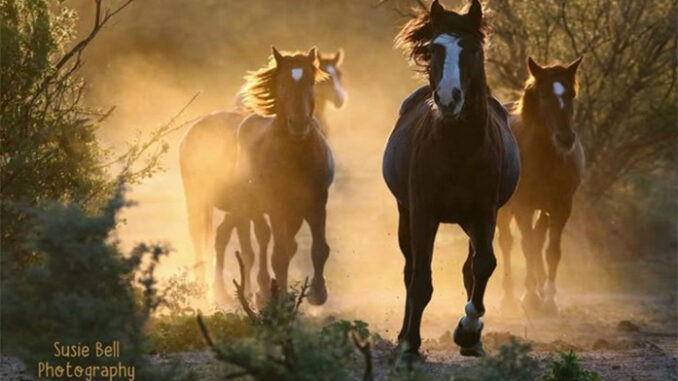
Sometimes a single idea arrives at exactly the moment you need it.
I recently began reading Linda Kohanov’s work and, only a few pages in, encountered two concepts that immediately made me think about the fight to protect the Salt River horses: cathedral thinking and equanimity.
Cathedral thinking asks us to think beyond the immediate moment.
The great cathedrals of Europe were often built over generations. The people who laid the first stones knew they might never see the finished structure. Some would spend their entire lives working on something their grandchildren, or even their grandchildren’s grandchildren, might ultimately complete.
And yet they laid the stones.
They understood that their contribution mattered even if they would never personally witness the finished cathedral.
There is something important in that idea for those of us fighting to protect the Salt River horses.
Right now, our immediate goal is clear: we do not want horses removed from the Salt River.
We want decisions about this herd based on independent science. We want humane management. We want transparency and accountability. And we want the public, which has fought for these horses for years, to have a meaningful voice in determining their future.
But advocacy has a way of making us measure everything by what happened today.
- Did someone return the phone call?
- Did the agency listen?
- Did the legislation pass?
- Did the newspaper publish the opinion piece?
- Did the meeting change anyone’s mind?
- Did we stop the removal?
When the answer is no, it is easy to believe the work failed.
Cathedral thinking tells us otherwise.
We are living that lesson right now.
Friends of the Salt River Wild Horses has submitted more than 70 requests asking Governor Katie Hobbs to meet with advocates before planned September removals proceed. Those requests have gone unanswered. Yet the work continues. We keep writing. We keep asking. We keep gathering the science, the public records and the people willing to stand up for these horses.
You do not stop laying stones because the person in power has not answered the door.
Each effort becomes part of something larger.
- The public records request is a stone.
- The letter to an elected official is a stone.
- The scientific question nobody at the agency wants to answer is a stone.
- The opinion piece that reaches someone who never thought about wild horses before is a stone.
- The legislator who begins asking questions is a stone.
- The citizen who attends a rally for the first time is a stone.
- And perhaps even the 71st request for a meeting is a stone.
Even legislation that fails can become a stone if its ideas return stronger in the next legislative session.
We cannot always know which one will matter most.
That brings me to the second word: equanimity.
Equanimity means maintaining calmness and balance, particularly when circumstances are difficult or uncertain. It does not mean indifference. In fact, it may be most necessary when we care deeply.
For advocates, that distinction matters.
Caring about these horses can be emotionally exhausting. Every setback can feel enormous because the stakes are living, sentient beings we are trying to protect.
Equanimity asks something different of us.
- Care deeply, but do not allow every setback to consume you.
- Remain determined without becoming defeated by every disappointment.
- Recognize what you can control, do that work well, and then keep going.
That is especially important when another email goes unanswered, another meeting request receives no response or another door appears to close.
Equanimity does not mean accepting the silence. It does not mean abandoning urgency. It means refusing to let frustration consume the energy we need for the next letter, the next question, the next piece of evidence and the next person who may finally listen.
Perhaps that is one of the things horses themselves have to teach us.
They are extraordinarily aware of their surroundings. They notice changes humans miss. They respond to danger when necessary, yet when the danger passes, they return to grazing, resting, interacting and simply being horses.
There is a steadiness in that.
And maybe those of us fighting for them need some of it too.
Cathedral thinking and equanimity belong together. One gives us the patience to understand that meaningful change can take years. The other gives us the steadiness to endure those years without losing sight of why we began.
We absolutely want to stop the removals facing the Salt River horses now. Cathedral thinking does not mean accepting something we believe is wrong because change might come someday.
It means understanding that whatever happens in one battle, the larger work continues.
- We keep demanding science.
- We keep asking questions.
- We keep educating the public.
- We keep building relationships.
- We keep challenging decisions that deserve to be challenged.
And when one approach fails, we learn from it and lay the next stone.
Someday, perhaps, the cathedral we are building will be a permanent system of protection for the Salt River horses that no longer depends upon who happens to occupy the Governor’s Office, who runs a particular agency or what agreement happens to be in effect.
- Maybe we will see that day.
- Maybe those who come after us will.
- Either way, the work before us is the same.
We may not know which stone will ultimately save the Salt River horses. Our responsibility is to keep laying them.
That is cathedral thinking. And perhaps equanimity is what gives us the strength to keep laying the stones, even when we cannot yet see the cathedral they will become.
Excellent analogy but I believe those who lay the stones will see its completion due to the everlasting nature of all of life particularly conscious beings
I really like this article, and I beleive The Salt River Horses ACT was intended to protect them for future generations. There is no loophole, the AZDA, and Governor Hobbs are blatenly violating this law. AZ Statute A.R.S 3-1491 which clearly states no removals except for humane reasons. The AZDA has to follow the law. This plan was done by a straw poll, and absolutely no humane, nor scientific reason for any removals at all. Infact Ecologist Craig C Downer says that they are helping the environment not damaging it. We need real scientific studies done before one horse is removed. If these removals take place it will cause permanent irreconcilable damage that will decimate the Salt River Wild Horses to Extinction.. We need to Save,Protect,and Preserve them NOW, and Permanently for future generations. They are Important to Arizonans and they have been historically documented being here since long before Arizona was a State and before The Tonto National Forest was designated.. They belong at the Salt River, and removing them will cause permanent damage to the herd, and to the River, and to the surrounding area in the Tonto National Forest. We all must continue to speak up for our Salt River Wild Horses.
Excellent article. Absolutely love this idea of thinking. We can and will continue to lay the foundation that will become the Salt River Horses future and legacy allowing them to forever be free and wild.
When Artificial Intelligence leads humans to destroy Community and bring them to the ledge of self destruction. Maybe we’ll need to revert back to that natural “One Horse Power” thing.
The Bible speaks of similar times ahead.
The management of our beloved Salties by the SRWHMG has already proven through their efforts the number of wild horses has dramatically reduced along with natural attrition. The wild horses play a very important role in the entire environment in which they live. Let us prove through science that the horses should remain. It’s an 80+% issue in favor of the horses remaining wild and free.
The Salties are so important to the people of Arizona. They were supposed to have protection under The Salt River Horses Act, but due to a loophole in the law, now are slated for removals. They have been managed and their numbers brought down from over 450 to about 270 over the last 5 years, with fertility control and attrition, not be removing healthy horses from the only home they have ever known. This management will continue bringing their numbers down even further, so there is no need to remove any from the river. Humane people want humane management of the horses.
Yes! Right on the money! 🎯
The horses are such a wonderful asset to Arizona. They are being managed and being managed well, reducing their numbers from over 450 to around 270 over the last five years or so. This is done by fertility control and attrition, not by removing healthy horses from the only home they have ever known. There is no need to speed this process up, it will continue and get them down to well under 200 over the next five years. Please help save our SALTIES and let the management group continue to manage them as they have been. Humane people want humane management of the horses. Arizonans and Americans agree, the majority of people want to manage the horses, not get rid of them.
“… we do not want horses removed from the Salt River. We want decisions about this herd based on independent science.”
And what ̶i̶f̶ when the two clash? What happens when science says we don’t need that many for a healthy heard? If 150 is the “right” number, per the science, then 250+ is, objectively, disastrous.
Indeed, I’ve seen unregulated prairie dog towns in public parks. The poor creatures were mangy, flea-bitten, diseased, unusually thin, scarred from fighting, and looked all the worse for misplaced “compassion.” One cannot look at the _results_ and think that anyone actually loves those animals; one might even suspect callousness, at best, or malice.
I’m reminded of that ridiculous line in The Matrix when Agent Smith tells Morpheus, “Every mammal on this planet instinctively develops a natural equilibrium with the surrounding environment.” No, they do not. Without predators, healthy mammals will eat themselves out of house and home, then they will fight over scare resources, and ultimately they will starve or disease themselves to death.
Be merciful to the herd; manage it wisely, not sentimentally.
Well “independent science” will tell you that feral/invasive animals always do harm to native wildlife and habitats Ms. Schutte. Just because you (and others) feel some emotional attachment to these animals, that does not mean they belong on our public lands.
And how long have wild horses been on the American continent?
They originated in North America. Look it up.
That does not somehow make them “native wildlife”, so time is irrelevant. Wild horses are domestic animals that have been turned loose/escaped captivity. Wildlife is animals that have evolved in their habitat. They are not the same. Trust the science Willie.
SCIENCE: The landmark paper “Wild Horses as Native North American Wildlife” (Science and Conservation Center Zoo, Billings, Montana) argues that modern horses (Equus caballus) are biologically indigenous to North America and should be legally reclassified as native wildlife rather than non-native feral invaders.
Core Arguments of the paper
Evolutionary Origin: The genus Equus evolved in North America millions of years ago before migrating across the Bering land bridge into Asia and Europe.
Genetics Over History: Fossil and DNA evidence shows that prehistoric North American horses and modern Equus caballus share the same lineage and are biologically identical, meaning the return of horses via European ships was technically a repatriation of a native species.
Management Implications: Government groups like the Bureau of Land Management treat wild horses as non-native livestock or feral animals to justify population controls, a stance the authors challenge using biological and paleontological data.
The genus Equus, which includes modern horses, zebras, and asses, is the only surviving genus in a once diverse family of horses that included 27 genera. The precise date of origin for the genus Equus is unknown, but evidence documents the dispersal of Equus from North America to Eurasia approximately 2–3 million years ago and a possible origin at about 3.4–3.9 million years ago. Following this original emigration, several extinctions occurred in North America, with additional migrations to Asia (presumably across the Bering Land Bridge), and return migrations back to North America, over time. The last North American extinction probably occurred between 13,000 and 11,000 years ago (Fazio 1995), although more recent extinctions for horses have been suggested. Dr. Ross MacPhee, Curator of Mammalogy at the American Museum of Natural History, and colleagues, have dated the existence of woolly mammoths and horses in North America to as recent as 7,600 years ago. Had it not been for previous westward migration, over the Bering Land Bridge, into northwestern Russia (Siberia) and Asia, the horse would have faced complete extinction. However, Equus survived and spread to all continents of the globe, except Australia and Antarctica.
https://awionline.org/programs/equines/wild-horses-and-burros/wild-horses-as-native-north-american-wildlife/
In 1493, on Columbus’ second voyage to the Americas, Spanish horses, representing E. caballus, were brought back to North America, first in the Virgin Islands, and, in 1519, they were reintroduced on the continent, in modern-day Mexico, from where they radiated throughout the American Great Plains, after escape from their owners or by pilfering (Fazio 1995).
Critics of the idea that the North American wild horse is a native animal, using only selected paleontological data, assert that the species, E. caballus (or the caballoid horse), which was introduced in 1519, was a different species from that which disappeared between 13,000–11,000 years before. Herein lies the crux of the debate. However, neither paleontological opinion nor modern molecular genetics support the contention that the modern horse in North America is non-native.
Equus, a monophyletic taxon, is first represented in the North American fossil record about four million years ago by E. simplicidens, and this species is directly ancestral to later Blancan species about three million years ago (Azaroli and Voorhies 1990). Azzaroli (1992) believed, again on the basis of fossil records, that E. simplicidens gave rise to the late Pliocene E. Idahoensis, and that species, in turn, gave rise to the first caballoid horses two million years ago in North America. Some migrated to Asia about one million years ago, while others, such as E. niobrarensis, remained in North America.
In North America, the divergence of E. caballus into various ecomorphotypes (breeds) included E. caballus mexicanus, or the American Periglacial Horse (also known as E. caballus laurentius Hay, or midlandensis Quinn) (Hibbard 1955). Today, we would recognize these latter two horses as breeds, but in the realm of wildlife, the term used is subspecies. By ecomorphotype, we refer to differing phenotypic or physical characteristics within the same species, caused by genetic isolation in discrete habitats. In North America, isolated lower molar teeth and a mandible from sites of the Irvingtonian age appear to be E. caballus, morphologically. Through most of the Pleistocene Epoch in North America, the commonest species of Equus were not caballines but other lineages (species) resembling zebras, hemiones, and possibly asses (McGrew 1944; Quinn, 1957). Initially rare in North America, caballoid horses were associated with stenoid horses (perhaps ancestral forerunners but certainly distinct species), but between one million and 500,000 years ago, the caballoid horses replaced the stenoid horses because of climatic preferences and changes in ecological niches (Forstén 1988). By the late Pleistocene, the North American taxa that can definitely be assigned to E. caballus are E. caballus alaskae (Azzaroli 1995) and E. caballus mexicanus (Winans 1989—using the name laurentius). Both subspecies were thought to have been derived from E. niobrarensis (Azzaroli 1995).
Thus, based on a great deal of paleontological data, the origin of E. caballus is thought to be about two million years ago, and it originated in North America. However, the determination of species divergence based on phenotype is at least modestly subjective and often fails to account for the differing ecomorphotypes within a species, described above. Purely taxonomic methodologies looked at physical form for classifying animals and plants, relying on visual observations of physical characteristics. While earlier taxonomists tried to deal with the subjectivity of choosing characters they felt would adequately describe, and thus group, genera and species, these observations were lacking in precision. Nevertheless, the more subjective paleontological data strongly suggests the origin of E. caballus somewhere between one and two million years ago.
Reclassifications are now taking place, based on the power and objectivity of molecular biology. If one considers primate evolution, for example, the molecular biologists have provided us with a completely different evolutionary pathway for humans, and they have described entirely different relationships with other primates. None of this would have been possible prior to the methodologies now available through mitochondrial-DNA analysis.
A series of genetic analyses, carried out at the San Diego Zoo’s Center for Reproduction in Endangered Species, and based on chromosome differences (Benirschke et al. 1965) and mitochondrial genes (George and Ryder 1986) both indicate significant genetic divergence among several forms of wild E. caballus as early as 200,000–300,000 years ago. These studies do not speak to the origins of E. caballus per se, but they do point to a great deal of genetic divergence among members of E. caballus by 200,000 to 300,000 years ago. Thus, the origin had to be earlier, but, at the very least, well before the disappearance of the horse in North America between 13,000–11,000 years ago. The relatively new (30-year-old) field of molecular biology, using mitochondrial-DNA analysis, has recently revealed that the modern or caballine horse, E. caballus, is genetically equivalent to E. lambei, a horse, according to fossil records, that represented the most recent Equus species in North America prior to extinction. Not only is E. caballus genetically equivalent to E. lambei, but no evidence exists for the origin of E. caballus anywhere except North America (Forstén 1992).
According to the work of researchers from Uppsala University of the Department of Evolutionary Biology (Forstén 1992), the date of origin, based on mutation rates for mitochondrial-DNA, for E. caballus, is set at approximately 1.7 million years ago in North America. This, of course, is very close, geologically speaking, to the 1–2 million-year figure presented by the interpretation of the fossil record.
Carles Vilà, also of the Department of Evolutionary Biology at Uppsala University, has corroborated Forstén’s work. Vilà et al. (2001) have shown that the origin of domestic horse lineages was extremely widespread, over time and geography, and supports the existence of the caballoid horse in North American before its disappearance, corroborating the work of Benirschke et al. (1965), George and Ryder (1995), and Hibbard (1955).
A study conducted at the Ancient Biomolecules Centre of Oxford University (Weinstock et al. 2005) also corroborates the conclusions of Forstén (1992). Despite a great deal of variability in the size of the Pleistocene equids from differing locations (mostly ecomorphotypes), the DNA evidence strongly suggests that all of the large and small caballine samples belonged to the same species. The author states, “The presence of a morphologically variable caballine species widely distributed both north and south of the North American ice sheets raises the tantalizing possibility that, in spite of many taxa named on morphological grounds, most or even all North American caballines were members of the same species.”
In another study, Kruger et al. (2005), using microsatellite data, confirms the work of Forstén (1992) but gives a wider range for the emergence of the caballoid horse, of 0.86 to 2.3 million years ago. At the latest, however, that still places the caballoid horse in North America 860,000 years ago. The work of Hofreiter et al. (2001), examining the genetics of the so-called E. lambei from the permafrost of Alaska, found that the variation was within that of modern horses, which translates into E. lambei actually being E. caballus, genetically. The molecular biology evidence is incontrovertible and indisputable, but it is also supported by the interpretation of the fossil record, as well.
Finally, very recent work (Orlando et al. 2009) that examined the evolutionary history of a variety of non-caballine equids across four continents, found evidence for taxonomic “oversplitting” from species to generic levels. This overspitting was based primarily on late-Pleistocene fossil remains without the benefit of molecular data. A co-author of this study, Dr. Alan Cooper, of the Australian Centre for Ancient DNA, stated, “Overall, the new genetic results suggest that we have underestimated how much a single species can vary over time and space, and mistakenly assumed more diversity among extinct species of megafauna.”
The fact that horses were domesticated before they were reintroduced matters little from a biological viewpoint. They are the same species that originated here, and whether or not they were domesticated is quite irrelevant. Domestication altered little biology, and we can see that in the phenomenon called “going wild,” where wild horses revert to ancient behavioral patterns. Feist and McCullough (1976) dubbed this “social conservation” in his paper on behavior patterns and communication in the Pryor Mountain wild horses. The reemergence of primitive behaviors, resembling those of the plains zebra, indicated to him the shallowness of domestication in horses.
The issue of feralization and the use of the word “feral” is a human construct that has little biological meaning except in transitory behavior, usually forced on the animal in some manner. Consider this parallel. E. Przewalskii (Mongolian wild horse) disappeared from Mongolia a hundred years ago. It has survived since then in zoos. That is not domestication in the classic sense, but it is captivity, with keepers providing food and veterinarians providing health care. Then they were released during the 1990s and now repopulate their native range in Mongolia. Are they a reintroduced native species or not? And what is the difference between them and E. caballus in North America, except for the time frame and degree of captivity?
The key element in describing an animal as a native species is (1) where it originated; and (2) whether or not it co-evolved with its habitat. Clearly, E. caballus did both, here in North American. There might be arguments about “breeds,” but there are no scientific grounds for arguments about “species.”
The non-native, feral, and exotic designations given by agencies are not merely reflections of their failure to understand modern science but also a reflection of their desire to preserve old ways of thinking to keep alive the conflict between a species (wild horses), with no economic value anymore (by law), and the economic value of commercial livestock.
Native status for wild horses would place these animals, under law, within a new category for management considerations. As a form of wildlife, embedded with wildness, ancient behavioral patterns, and the morphology and biology of a sensitive prey species, they may finally be released from the “livestock-gone-loose” appellation.
They originated here in North America, crossed the Bering Land Bridge into Europe and the Spaniards reintroduced these horses five hundred years ago.
If you were paying attention to the management of the Salties, you would know that they have been very successful in reducing the numbers over the last 5 years. It’s humane. Eventually, the remaining horses will age out. The current birth rate along with natural predators will not allow numbers to increase or for that matter make up for losses. They should remain wild until. The last band is gone. Let’s do the science and see the truth.
The “Salties” – yes, you’re not emotionally attached, now are you?
There was an enormous stone laid down in 2016. It was so large, we can call it a boulder. That was the year the Salt River Horse Act was overwhelming passed as a bipartisan bill in Arizona. The intent of this law, and yes, Governor Katie Hobbs voted for it, was to protect the historic horses from random removals. The act states that horses can only be removed for, ” humane reasons.” I have emailed, requested meetings with the Governor, called, and asked more than one time, what are the humane reasons that over half of this herd is being removed? Silence. I have read Dr. Cothran’s reports on wild horse genetic viability. According to his studies, our Salt River horses will no longer be genetically viable with a number of 100 horses remaining. Who overturned this bolder, and why?
People come from all around the world to see these horses. Their economic value is something that should not be discounted. Look at the businesses surrounding the Salt River, go inside. You will see murals and photographs highlighting the horses. They are an important part of our history. Halt the removals, do the science. Don’t let them become a paragraph in the next generations history book.
Have you looked at the correlation between the Bald Eagle population along the White, Black and Salt and where the most successful Bald Eagle nesting occur now? Yep in the same area the horses occupy.