
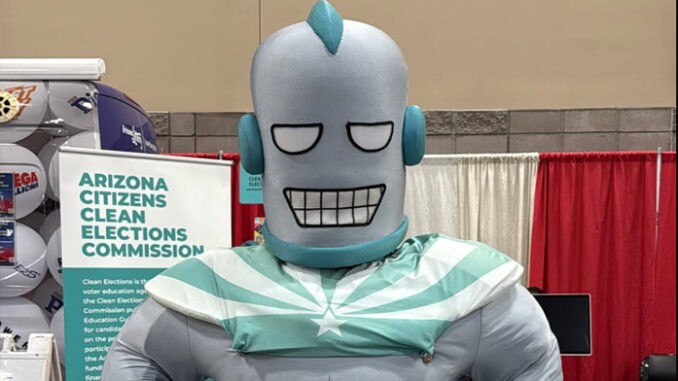
PHOENIX — The Arizona Supreme Court has unanimously ruled that the Citizens Clean Elections Commission (CCEC) exceeded its authority when it attempted to override the Secretary of State’s certification of qualifying contributions submitted by two Green Party candidates seeking public campaign funding.
The ruling represents a significant setback for the Commission, whose actions against Green Party gubernatorial candidate Risa Lombardo and Secretary of State candidate Duwayne Collier have raised questions about political motivations and potential interference in their campaigns.
The dispute began after the Commission accused Lombardo and Collier of fraud in connection with the $5 qualifying contributions required to receive public campaign funding. Both candidates had already received approval from the Arizona Secretary of State’s Office confirming that they had collected the necessary contributions.
Despite that certification, the Commission challenged their eligibility and warned that they could be required to repay millions of dollars in Clean Elections funding.
Attorney Tim LaSota, representing both candidates, filed a special action with the Arizona Supreme Court, arguing that the Commission had unlawfully attempted to overrule the Secretary of State.
The justices unanimously agreed.
In the Court’s order, Chief Justice Ann Timmer rejected the Commission’s claim that it possessed the authority to overturn the certification.
“… both the Director and Commission argue that the Commission does possess such authority,” Timmer wrote. “It does not.”
The Court explained that Arizona law specifically assigns responsibility for certifying qualifying contributions to the Secretary of State and county recorders, not the Clean Elections Commission.
“The statute does not confer authority upon the Commission over that process, nor do the rules contemplate it,” Timmer wrote.
Lombardo and Collier argued that the Commission’s actions threatened to derail their campaigns by creating uncertainty over whether they could spend the public funds they had been awarded.
Under Arizona’s Clean Elections system, participating candidates are prohibited from raising private campaign contributions beyond those permitted under the program. The candidates maintained that the possibility of being forced to repay millions of dollars effectively pressured them to suspend campaign spending, even though no formal investigation had established wrongdoing.
The two candidates were required to collect a combined minimum of 6,500 qualifying $5 contributions from registered voters in their respective districts to participate in the public financing program.
The Supreme Court’s decision reinforces the statutory limits on the Commission’s authority and affirms the Secretary of State’s role in certifying qualifying contributions.
“The Commission has engaged in extraordinary efforts to interfere with our democratic elections this cycle, and this is the first step to stopping them,” LaSota told the Arizona Daily Independent. “The Commission, and Mr. Collins will continue to be held accountable for their civil rights violations, and this Supreme Court rebuke to the Commission and Mr. Collins is a well deserved one.”
While the ruling addresses the Commission’s authority rather than resolving every allegation surrounding the candidates’ submissions, it raises broader questions about the Commission’s handling of the dispute and the potential consequences of its actions for candidates relying on public campaign financing.
Be the first to comment