
Local government tries to beautify a road while inconsiderate residents and businesses try to uglify it, which discourages government from trying.
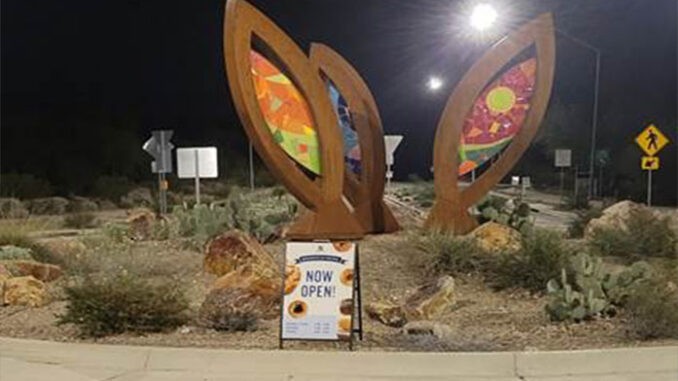
As part of an expensive reconstruction of Kolb Rd. from Sunrise Rd. to Sabino Canyon Rd. a couple of years ago, the intersection was transformed into an attractive traffic circle, accented with artwork and nice landscaping. Equally amazing, the circle has even been kept free of weeds.
This departs from the Tucson tradition of not giving much thought to aesthetics in road design and maintenance, and it mirrors what prosperous and well-governed cities outside of Tucson began doing long ago to improve their appearance and attract high-wage industry.
Granted, the new circle is not perfect. It’s too small for tractor-trailer trucks to get around it without driving over the sidewalk and crushing storm water inlets—inlets that Pima County has refused to repair. Still, it’s a commendable improvement over what was there.
How have Tucson residents and businesses reacted?
A large segment of them can always be counted on to trash beautification attempts and make the community look shabby. They throw litter out of their car window and place tacky advertising signs along roadsides, including the circle. In so doing, they give a new meaning to the word “literati.”
My wife and I try to keep up with the litter on our daily walks, but it’s becoming overwhelming with our advancing age.
Below is a photo of the latest illegal sign at the circle. It’s an advertisement for an expensive bakery that recently opened at a nearby strip mall.
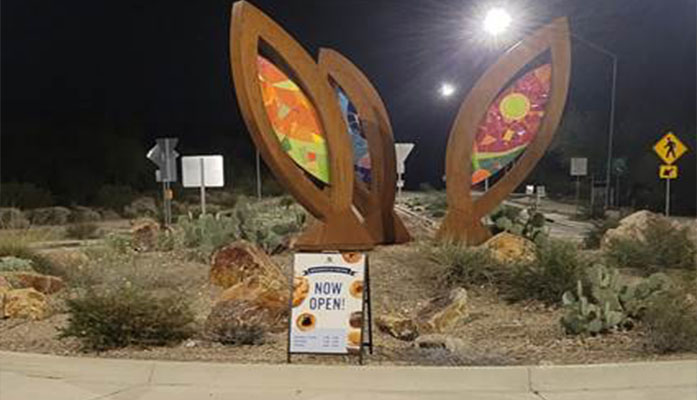
Photo by Craig Cantoni.
High prices don’t mean that a place has good manners and neighborliness.
Such signs trigger chimpanzee behavior, as in Monkey see, monkey do. One illegal sign will attract other illegal signs and eventually turn into a forest of tackiness if left unaddressed.
Sure enough, three other signs were planted near the intersection soon after the one in the photo was planted. They can’t be seen in the photo.
If you think that I’m exaggerating the extent of the problem, consider this: More than 100 signs sprout each year at another intersection near the circle.
The scofflaws might gain a temporary advantage over businesses that are good neighbors and advertise the proper way, but in the long run, they hurt themselves and everyone else. That’s because the business climate would be better in Tucson if the city were more prosperous, and it would be more prosperous if it looked better.
In addition to the unsightliness, there is a safety aspect to the signs.
Traffic circles are generally safer than standard intersections, but they require drivers’ full attention. Drivers approaching a circle are supposed to yield to cars already in the circle and coming from the left, some of which whip around at high speed. Pedestrian crosswalks on the approach add to the need for attentiveness.
Illegal advertising signs in the circle are a distraction—and are meant to be one. It would be nonsensical for inconsiderate businesses to put them at the circle and at other intersections if they didn’t want passers-by to read them.
Maybe the way to stop the miscreants from sticking signs along roadways is to hold them liable if a sign distracts a driver and causes an accident. For sure, appeals to civic-mindedness, neighborliness, and aesthetics won’t work with them.
Mr. Cantoni is an author, freelance writer, and retired business executive: Contact: [email protected].
Be the first to comment