
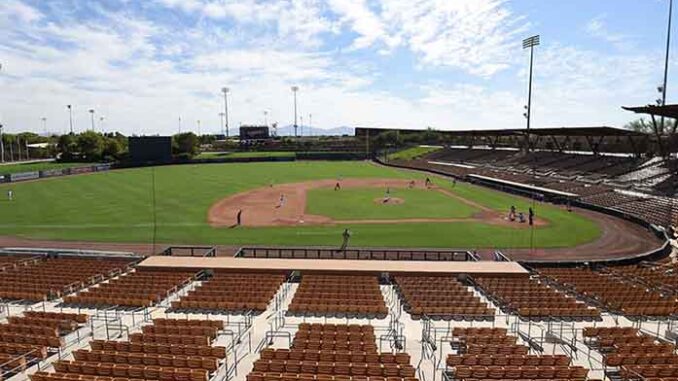
This month, Arizona welcomes the Cactus League as fifteen Major League Baseball teams take the field across ten stadiums in the Greater Phoenix area, competing for spring training bragging rights. The annual tradition brings a surge of seasonal tourism, boosting activity for local restaurants, retailers, hotels, and ground transportation providers throughout the region.
Beginning February 20th, the 2026 Cactus League continues a legacy that dates back to 1947, when the Cleveland Indians (now the Cleveland Guardians) faced the New York Giants (now the San Francisco Giants). This year, an estimated 1.8 million fans are expected to attend games and take part in the festivities, along with:
- 1,050 players,
- 120 uniformed coaches and managers,
- 600 administrative/field staff (40 per team),
- 35,000 event/facility staff worker-shifts.
Of the teams, only one – the Arizona Diamondbacks – are headquartered in the state, meaning that most of the additional economic activity generated by the games is coming from outside of the state. This report evaluates how much of an impact the Cactus League will have on Arizona’s economy.
Key Findings
- Over the coming six weeks, the Cactus League will include:
- 1.8 million spectators,
- CSI estimates that out-of-state visitors – be they spectators, family members, players, coaches, administrative staff – will spend approximately $210-$590 million directly on hotels, restaurants, groceries, transportation, and game tickets.
- This injection of spending from out-of-state residents is expected to boost GDP by between $210 million and $953 million, and result in a boost to disposable personal incomes in the state of up to $486 million.
- For the first time, if visitors to the Grand Canyon State enjoy their visit and spend a little more than they have in the past, the economic impact of spring training may surpass $1 billion this year.
- Overall, the Cactus League supports upwards of over 9,400 seasonal, part-time, and full-time jobs in the state, largely among the state’s accommodation, food and beverage service, transportation, and amusements industries.
Locations and Number of Games
Visitors will come to 10 stadiums, including Surprise Stadium, Peoria Sports Complex, Camelback Ranch-Glendale, American Family Fields of Phoenix, Goodyear Ballpark, Tempe Diablo Stadium, Sloan Park, Hohokam Stadium, Scottsdale Stadium, and Salt River Fields at Talking Stick. All of the locations are within a 50-mile radius of each other within the greater Phoenix metro area.
Overall, from February 20 through March 24, 225 scheduled games will take place in the state, with the 15 teams each playing 30 games.
Spectator Attendance
In 2025, nearly 1.7 million attended spring training games across the valley. Of these, around 60% of ballpark attendees came from outside of Arizona.
Projecting to 2026, and assuming approximately 65% of this year’s attendees come from out of state, CSI estimates around 1.2 million attendees will come to the state at some point to enjoy spring training in 2026.
In this context, one attendee does not necessarily translate to one person, as people often attend multiple spring training games in a trip. To account for this and avoid over counting, CSI assumed a range of between 2 and 3 games attended. This gave a range between 388,900 and 583,300. Additionally, although it is common for people to attend games without a party, it is more common for people to attend with friends, family, and other party members. CSI employed an average range of between 1.5 and 3 people per party and assume the members share on expenses like travel and lodging.
In addition to the fans, approximately 1,050 players and 120 coaches/managers will be staying six weeks in the state. Of these, all but 70 players and 8 coaches/mangers will be visitors to the state. Additionally, teams arrive to state with an estimated 600 administrative/field staff, or 40 per team. Of the 600, we assume almost all – 560 staff – will come from outside of the state. The makeup of the staff comprises:
- Team travel/operations (4),
- Clubhouse/equipment managers (9),
- Medical/athletic training/rehab (9),
- Strength/conditioning/performance/nutrition (5),
- Video/baseball technology/analysis support (5),
- PR/media relations/content (4), and
- Security/player services/miscellaneous operations (4).