
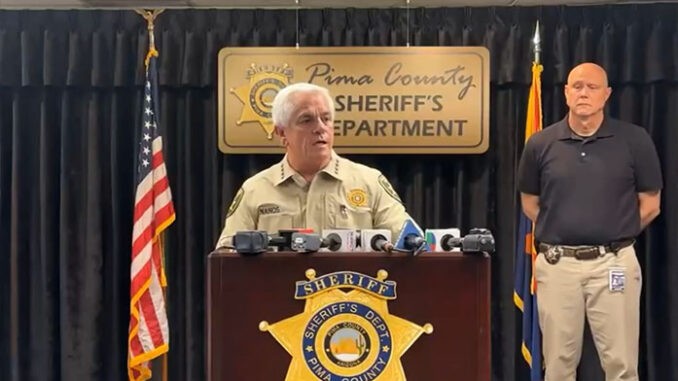
The Nanos–FBI dispute shows why residents deserve facts, a verified timeline and accountability—not jurisdictional finger-pointing.
Pima County’s problem is not one isolated scandal. It is what happens when one party controls nearly every lever of local government and accountability becomes optional.
Pima County democrats’ weak oversight, recurring management failures and lack of meaningful accountability have left the county in disarray. Over the next few months, I will examine that record one issue at a time. I will rely on documented facts, separate allegations from established findings and ask three questions: Who was responsible? What went wrong? What was done to keep it from happening again?
I have watched Pima County government for years, and the pattern is familiar. When serious questions arise, officials debate jurisdiction, defend procedure and delay accountability until public attention moves elsewhere.
The first article in this series concerns democratic Sheriff Chris Nanos and the handling of the Nancy Guthrie investigation—specifically, the conflicting accounts offered by the Pima County Sheriff’s Department and the FBI.
Nancy Guthrie and her family deserve compassion, answers and justice. The active investigation must also be protected from disclosures that could compromise it. But investigative secrecy cannot prevent legitimate oversight of command decisions already being disputed publicly by the county sheriff and the FBI director.
Who was responsible—and who was allowed to help?
Let’s be clear: The FBI does not simply take over a local case. Guthrie was taken from a home in unincorporated Pima County, making the Sheriff’s Department the initial local agency responsible for the crime scene and investigation.
The FBI explains that state and local agencies are not subordinate to the Bureau. When both state and federal laws may apply, the agencies generally work together and combine their resources.
Federal law still matters. Under 18 U.S.C. § 1201, federal authorities may investigate a possible federal kidnapping before 24 hours have passed. If a victim has not been released within 24 hours, the law creates a rebuttable presumption that interstate or foreign transportation occurred for purposes of the federal kidnapping statute.
That does not remove the county from the case or prove that a federal crime occurred. It does mean this was never simply a choice between county and federal jurisdiction. Both had legitimate roles. The management question is whether Nanos used the FBI’s personnel, digital expertise, laboratory capacity and national reach as quickly and fully as the circumstances demanded.
Two officials, two different accounts
FBI Director Kash Patel has said the Bureau was kept out of the investigation for four days. He also said that once the FBI became involved, it worked with Google to recover cached home-security-camera images showing a masked, armed person at Guthrie’s door.
Patel later claimed that the delay may have allowed other video data to disappear before it could be recovered. The Sheriff’s Department denies that account. It says the FBI was promptly notified, an FBI task-force member was present the night of the incident and coordination began without delay. Nanos has said federal personnel were there on day one and that Patel was misinformed.
It is possible that the two sides are using the word “involved” differently. One task-force representative at a scene is not necessarily the same as full access for the FBI’s investigative and technical teams. But press conferences cannot settle that dispute. The records can.
A second disagreement involves physical evidence. Reuters reported that a federal law-enforcement official said the FBI requested evidence, including a glove and DNA material, for analysis at its national laboratory in Quantico. According to that official, Nanos instead selected a private laboratory in Florida, delaying the FBI’s ability to help.
Nanos denied blocking the Bureau. He said one laboratory would keep the evidence, DNA profiles and markers together, and maintained that the FBI agreed with his reasoning.
I do not know which account the written record will support. Neither does the public. But Pima County made the evidence-handling decision, and county officials should be prepared to document why it was made, what turnaround time was expected and whether that expectation was met.
What residents are entitled to know
As of August 1, six months after Guthrie disappeared, no one has been arrested for her abduction. That fact alone does not prove misconduct. Even well-run investigations can remain unsolved. It does, however, make an honest review of the earliest decisions more important.
Residents deserve a timeline establishing:
- When the initial report was received and the home became a suspected crime scene.
- When the FBI was notified and when full federal assistance was offered, requested, accepted or declined.
- When preservation requests were sent to the home-security provider.
- When evidence was submitted to each laboratory.
- What turnaround times officials expected and actually received.
None of that requires investigators to reveal confidential leads or compromise the search for Guthrie. The county should preserve the emails, text messages, call logs, evidence-transfer records and interagency requests needed for an independent review. The factual findings should eventually be made public, with necessary protections for the investigation.
The larger Pima County problem
For too long, Pima County’s democratic establishment has treated questions about performance as partisan attacks. I have heard that response before: defend the officeholder, question the motives of the critic and wait for the controversy to fade. That protects institutions and political allies. It does not protect taxpayers or restore public trust.
Democrats hold most of the county’s political power. With that power comes responsibility. The same political network that helps elect county officeholders cannot then become reluctant to oversee them when serious problems arise.
The Guthrie case should never be reduced to political theater. Jurisdiction explains who had authority to make decisions; it does not relieve those officials of responsibility for the decisions they made.
If Nanos’s account is accurate, a documented timeline will support him. If federal assistance was limited or delayed, residents deserve to know who made that decision and why.
This is the standard I will apply throughout this series. Pima County residents deserve competent government, transparent leadership and accountability that does not depend on which party holds office. No elected official should be exempt—especially when life, safety and public trust are at stake.
Shelley Kais is a leadership architect and fractional strategy officer with more than three decades of experience in business, government, and nonprofit leadership. She helps leaders and organizations turn vision into strategy, structure, and measurable results.
Lets take a realistic look at Liberal Government.
Since the Floyd shooting Liberals have been at War with Law Enforcement. They have attached Officers and demoralized Officers and their Families. Liberals have cut support and funding for law enforcement in just about EVERY Blue run State. District Attorneys and Judges fail to mete out consequences for criminal behavior. The Criminals then take over the Community.
Why?
Because its part of the Marxist Playbook;
1) Demoralize and Disband all Security Forces, (ie.e the Police);
2) Interject every Vice, (i.e. Prostitution, Drugs and Violent Crime), into every Community;
3) Legalize Drugs to keep the Voters Intoxicated and disconnected with reality which allows the government to make unchallenged changes and gain uncontected control.
4) Lastly, Destroy Americanism and replace it with Communism.
Wake up America! We fought WWII exactly to prevent this type of control called; Communism!
This is an excellent article. As stated by Ms. Kais, for far too long the public has been left without any explanations or accountability coming from our county government. I am so glad someone is asking questions, and is planning to ask more! We elect our officials and expect them to represent our interests. Are they doing that?
Right to the point. Good article. Keep up the good work and stay safe and strong.
What a cry baby, bully, disaster Nanos is but just you wait and see, the uniformed voters in Pima Co just might reelect the SOB!
Well good luck Shelly but be prepared for Pima County et al to fight you every step of the way!