
Democratic and Republican leaders across the Lower Basin have opposed the U.S. Department of Interior’s water reduction plan for the Colorado River, while Upper Basin states have widely backed the move.
The department’s and Bureau of Reclamation’s Final Environmental Impact Statement from Friday has received little fanfare in Nevada and Arizona, where the proposal could make for significant water cuts.
The federal Colorado River proposal came after negotiations between the seven U.S. states that rely on the river – Colorado, Wyoming, Utah, New Mexico, Arizona, Nevada and California – missed two deadlines in November 2025 and February 2026. Arizona, Nevada and California are in the Lower Basin. The rest are in the Upper Basin.
The current framework for water management on the river is set to end in December. This comes in a year that has been defined by dry weather, a short and warm winter followed by fierce wildfires across much of the Southwest.
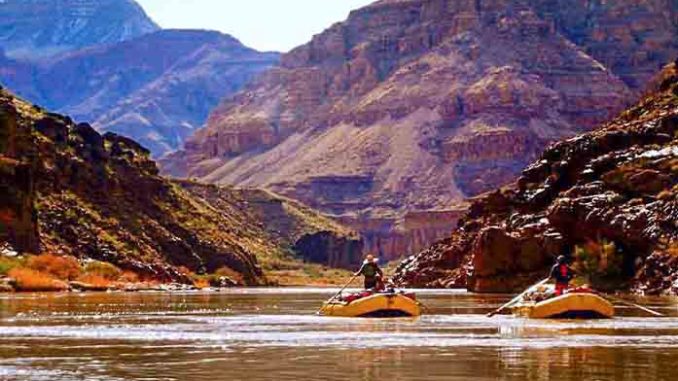
The Colorado River provides water for an estimated 40 million people and 5.5 million acres of agriculture to people in seven states, 30 tribes, and the U.S. and Mexico, according to the Bureau of Reclamation, which noted any threat to the river’s survival is serious.
As a response, the bureau and the Department of the Interior outlined several potential water usage plans for the river under different circumstances, where the most extreme would require California, Arizona and Nevada to cut annual water usage by 3 million acre-feet – nearly half of the states’ combined total allotment.
“Unfortunately, the Final Environmental Impact Statement (FEIS) released by the Department of the Interior today seeks to impose unrealistic reductions on Nevada and our water users,” said Nevada Gov. Joe Lombardo, a Republican, in a statement after the Friday announcement.
In Arizona, the state’s Democratic Gov. Katie Hobbs responded to the Bureau of Reclamation announcement with a similar lack of enthusiasm. She also expressed optimism that the federal government would embrace a proposal put forward by the Lower Basin states.
“While this FEIS still contains unacceptable options that include the federal government forcing Arizona to take the majority of draconian water cutbacks, implementing the Lower Basin agreement would protect Arizona from massive water cuts, distribute reductions more fairly across the Lower Basin States, and provide stability and protection to the water supply that our communities rely upon,” said Hobbs in a Friday statement.
The Lower Basin proposal from earlier this year included a combined 1.25 million acre-feet in reductions in 2027 and 2028.
But the federal government has emphasized the cuts Arizona and Nevada leaders have expressed concern over are not guaranteed.
“The 3 million acre-feet reduction is the upper end of the sideboard,” Bureau of Reclamation spokesperson Mary Carlson told The Center Square via email Monday. “It should not be interpreted that any year within the 10-year Decision Framework will definitively have 3 million acre-feet of shortages. This is the upper end of the sideboard that was analyzed and included within the Preferred Alternative. The Operating Guidelines will determine the level of shortages for each year, if any.”
In the Upper Basin, the Friday announcement was taken as promising news for the next decade of the Colorado River.
“We are witnessing the lowest reservoir levels in the Colorado River System’s history, and there is no guarantee regarding the future water supply,” said the governors of Colorado, Utah, New Mexico and Wyoming in a joint statement Friday. “Today’s framework does not represent a final solution, but enables the River to be managed in the short-term while the seven states and DOI continue to negotiate a consensus solution.”
Bipartisan leaders in the Upper Basin states also highlighted the need to return to multi-state negotiations over a federally-imposed solution.
“States in both the Upper and Lower divisions of the basin are feeling the pain of severe drought,” said the governors. “This is a reality that all states, and the federal government, will need to address practically, which is why a seven-state agreement will provide the best outcome for all water users in the Colorado River Basin. We are committed to continued good-faith discussions with our counterparts.”
Now state leaders must wait for the release of a plan called the Record of Decision by the Bureau of Reclamation and the Department of Interior. The plan is intended to be a clearer one for the next two years of river operations. The date of that plan’s release has not been announced, but is expected to come before the December 2026 deadline for a new Colorado River water management plan.
There not much choice, it has to be cut. The thing that bugs me the most is that California gets so much water and to make sure they keep getting it they waste it, use it or lose it they say. California has the senior water rights so they get first dibs. They make sure that they get a lot by taking more than they need. That’s the practical vs the legal argument. In any case, Arizona is going to get less and if the feds didn’t step in the states would drain the reservoirs completely. So the bipartisan complaining doesn’t mean much except waa waa I want it no matter the result…
maybe if we would STOP BUILDING like we have 100 year water
it would stabilize housing prices and rents
If Commiefornia would finish the California Water Proect as envisioned and started by Gov Pat Brown in the 60s they wouldn’t need Colorado River water thereby helping the other drier western states not blessed with such resources.