
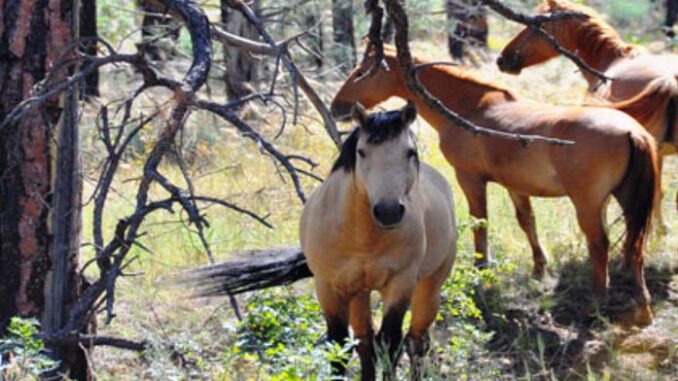
PHOENIX, Ariz. — After months of pressure from Salt River horse advocates and lawmakers, Governor Katie Hobbs announced Tuesday that her administration will pause removals from the Salt River horse herd through 2027 and pursue a genetic study, adopting portions of legislation advanced earlier this year.
The bill’s sponsor, State Representative Cody Reim, says Hobbs left “stronger protections for the horses behind.”
Hobbs announced this week that the Arizona Department of Agriculture will amend the Salt River Horse Herd Management Plan to suspend removals of horses for adoption to state-approved sanctuaries and refuges during 2026 and 2027. The pause is intended to allow a new genetic study to be completed and used to inform future management decisions.
The Governor says she has worked with the Arizona Board of Regents to identify funding for the genetic viability study, which would be conducted by Arizona’s public universities and independently reviewed before its release. The Board of Regents is scheduled to vote on the funding August 27.
More than 70 meeting requests were submitted to the Governor’s Office as horse advocates pressed the administration to intervene. Representative Reim also called on the Arizona Department of Agriculture earlier this year to use authority it already had to amend the herd management plan and contract.
“The people who fought for these horses earned this victory,” said Reim. “They made the calls, demanded meetings and kept the pressure on Governor Hobbs until doing nothing carried a political cost. Her administration had the authority to stop these removals months ago. She waited until August to do what we were asking her to do in April and May.”
SB 1199, advanced by during the legislative session, would have imposed a three-year moratorium on population-control removals while a peer-reviewed genetic study was completed. Horses could still be removed for urgent medical needs and veterinary care.
The bill also required genetic testing to include measures of “effective population size, allelic diversity and inbreeding coefficients.” It required the Arizona Department of Agriculture to award the testing contract through competitive bidding, with preference for providers with demonstrated expertise in equine genetics.
Hobbs’ plan provides a shorter pause, does not state whether those genetic measures will be required, and routes the study through Arizona’s public universities rather than the process prescribed in SB 1199.
“A genetic study is not enough by itself. The standards matter,” argues Reim. “Will the Governor require effective population size, allelic diversity and inbreeding coefficients to be measured? Who sets the methodology? What equine-genetics qualifications will be required? SB 1199 answered those questions. Governor Hobbs has not.”
Reim also questioned the Governor’s decision to place the study with the university system without the standards and procurement requirements contained in SB 1199.
“Governor Hobbs is giving herself political cover,” accused Reim. “If advocates later challenge the methodology or the study is used to justify more removals, she can blame the universities. We wanted the standards, qualifications and accountability established in law before the study began.”
Hobbs’ amended management plan pauses removals only through the end of 2027 and allows population targets for 2028 through 2030 to be reconsidered after the study. The plan can also be changed administratively. SB 1199 would have placed stronger protections in state law.
“Governor Hobbs can change a management plan today, and it can be changed again tomorrow,” Reim said. “The Salt River horses would be better protected now if the Governor had acted when we first raised this issue instead of waiting months and then adopting only part of our approach.”
For Friends of the Salt River Wild Horses and the thousands of Arizonans who have called for removals to be halted until additional science is completed, the announcement provides critical breathing room for the herd.
“We are extremely grateful that the horses will remain on the Salt River for the next two years while this important research is completed,” said Karen Schutte with Friends of the Salt River Wild Horses. “For months, we have asked that horses not be removed before the science needed to guide such an irreversible decision is available. This reprieve gives Arizona an opportunity to obtain important genetic information before determining the future of this treasured herd.”
The decision comes after growing public concern over plans to begin removing Salt River horses as early as September. Advocates have urged state officials to ensure that any long-term population target protects the genetic health and sustainability of the herd.
Simone Netherlands, president of the Salt River Wild Horse Management Group, also welcomed the decision, saying the suspension of removals and the new study will allow continued management of the herd while providing science needed to help ensure the horses remain healthy and thriving.
“This is what we have been asking for: give the horses time, do the science and use that science before making decisions that cannot be undone,” Schutte said. “Today, the Salt River horses have that time.”
The feral horses and the feral hobbs need to be removed.
These are feral horses.
Must be an election year for Hobbs…sarcasm.