
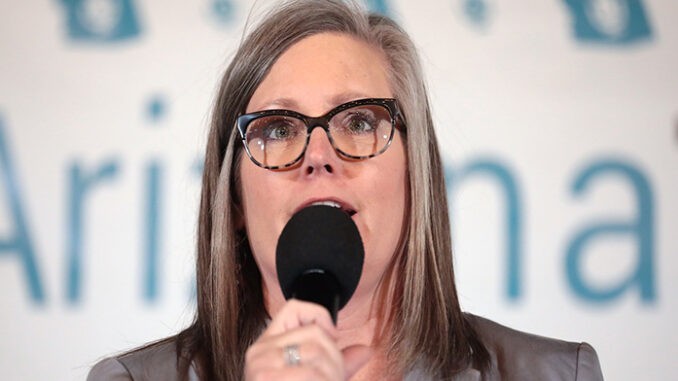
Arizona lawmakers are investigating Gov. Katie Hobbs’ administration for prioritizing state land for solar projects instead of housing amid the ongoing housing crisis.
The Joint Legislative Ad Hoc Committee on State Land Oversight held a hearing Tuesday on Arizona State Land Department (ASLD) state trust land leasing and sales in recent years under the current administration.
Under Hobbs, ASLD has auctioned leasing rights to more than 6,700 acres of state land trust for solar, yielding more than $52.6 million in revenue, and auctioned just over 300 acres of state land for residential development yielding more than $181.3 million in revenue.
ASLD Director Robyn Sahid testified during the committee hearing that the revenue yields between solar leases and residential sales weren’t comparable, and that the department anticipates a minimum revenue of $592 million from all active solar leases in the decades to come.
Solar leases last for 30 years and are required by statute to go to auction. The state has 22 active solar leases.
Sahid said ASLD views solar leasing as an “interim use of the land” pending jurisdictional ability to support residential housing. Several lawmakers pushed back on Sahid’s assessment, including Sen. David Gowan (R-LD19), but Sahid maintained that ASLD acts on the best use of the land.
“If there were a higher and better use ready to go, interest, all of that, we would certainly entertain it. I will always work with a local jurisdiction,” said Sahid. So if folks are out there and they’re upset, and they say we really think this is housing, we’re all ears. And we would work with them to determine if that’s realistic or not.”
Gowan said his community was “frustrat[ed]” by ASLD leasing land for solar rather than freeing it up for residential development. Gowan also contended that millions in revenue spread out over 30 years under solar leasing wasn’t as beneficial as millions in revenue immediately made available to the trust through sales for residential development.
ASLD maintains a “Solar Scores Map” to determine which parcels of state trust land would be best for solar projects. A significant portion of these parcels overlap with lands best positioned for residential housing development.
State Rep. Sylvia Allen (R-LD7) suggested in a press release following Tuesday’s hearing that ASLD address the lack of auction competition by opening them up to other industries.
“The pattern of single bidders on auctions the Department holds for utility-scale solar purposes raises questions about whether the Trust could have received more revenue had other industries — such as homebuilders — been allowed to compete,” said Allen. “Blanketing our state with 30-year leases of solar and wind will lead to unintended consequences that will hurt the Trust.”
State Rep. Gail Griffin (R-LD19), co-chair of the committee, questioned the prioritization of leasing of state land for solar. Griffin predicted that the continued preference for solar would result in further challenges to housing availability and affordability.
“I see a move to tie up land for 30 years with solar that prevents new home construction and drives up land and housing prices within the cities,” said Griffin. “The future of Arizona’s affordable standard of living and ability to start new families is on the line.”
Griffin noted that five of the seven solar leases issued were located in Maricopa County, where Hobbs issued a housing moratorium that has since been struck down in court. The moratorium impacted the development of nearly 162,000 homes in the Phoenix area planned for state trust land.
Sahid further testified during the hearing this week that the department had about 150 solar applications pending, of which 30 were moving through the approval process. Those 30 would represent another 30,000 acres of state land trust going to solar. ASLD also testified that it has 12 residential auctions planned — or, about 7,600 acres for residential development — in the upcoming fiscal year.
The state faces an estimated shortage of 56,000 housing units and an estimated long-term deficit of 110,000 to 121,000 homes according to analysis from the Common Sense Institute.
Data centers have also presented as a major concern for Arizonans. However, ASLD reportedly had only one applicant win an auction where the land went to a data center in the past decade. The department reportedly doesn’t have any applicants affiliated with data centers or intending to turn over the land for data center development pending at present.
The agency is currently facing a three-year backlog on applications. Over the past 30 years, the department has processed more than 62,000 applications. On average, ASLD reports receiving nearly 200 new applications per month.
Sahid testified that staffing is the main reason for the backlog. Sahid expressed optimism that implementing aspects of the continuation bill, including system updates creating automation capabilities, would help to reduce the backlog.
Be the first to comment