
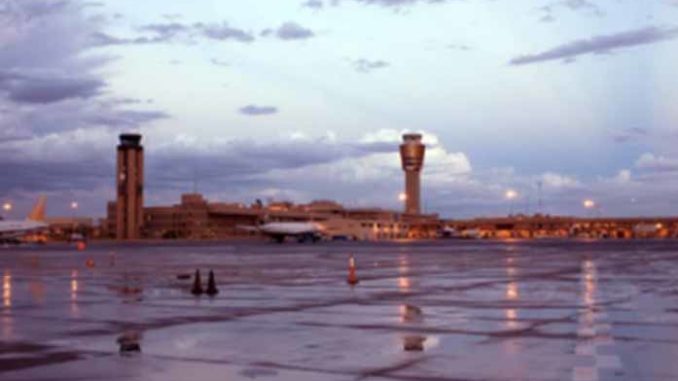
TUCSON – According to AI, but not verified by my own research, 3.7 million passengers go through Tucson International Airport every year. That’s noteworthy.
By contrast, 51.6 million go through Phoenix Sky Harbor International Airport. That’s astonishing.
Fifty years ago, about 4.4 million passengers went through Sky Harbor every year, or slightly more than the 3.7 million that go through Tucson International today. Back then, Phoenix was not the economic dynamo it is today and resembled Tucson in many respects.
An economic development textbook could be written on the growth of Phoenix. Sky Harbor is a major reason that the Phoenix metropolis became a boomtown and now has nearly five times the population of the Tucson metropolis. The airport was the result of good government, keen foresight, and commendable long-range planning.
Naturally, there are far more direct flights out of Sky Harbor than out of Tucson. That explains why many Tucsonans fly out of Sky Harbor, even though it takes 90 minutes to two hours to drive there, depending on where they live in metro Tucson and what time of day they leave. With a direct flight, they don’t have to worry about missing a connection or being stranded for a day if a flight is cancelled.
When I moved to Phoenix from Chicago in 1979, Terminal 3 had just opened. Two other terminals were already in existence at Sky Harbor. The small Terminal 1 had been built in 1952 for prop planes. Terminal 2 was built in 1962. It was larger than Terminal 1 but small by today’s standards. Both were later torn down.
After Terminal 3 opened, passenger traffic jumped from 4.4 million to 7 million and would grow to 11.6 million by 1985.
Terminal 3 was a trend-setter when it opened. It was 880,000 square feet and had 23 gates on two concourses. A multi-story parking garage was attached. In 2022, as part of Sky Harbor’s updated 20-year plan, approval was given to add a third concourse.
Having been a frequent business flyer out of the miserable Chicago O’Hare Airport for ten years, I felt that I had been transported to airport paradise when I began flying on business out of Sky Harbor in 1979. Weather delays were rare, deicing was never necessary, and Terminal 3 was modern, spotless and underutilized. It was a short walk to the terminal from the attached garage. No sloshing through dirty snow.
Tucson International is kind of like that but on a smaller scale. The parking garage isn’t attached to the terminal but is a short walk. It’s an easy airport, but again, the tradeoff is that there aren’t many direct flights.
Sky Harbor’s central location in metro Phoenix made for a short drive from my workplace and neighborhood, especially compared to the torture of getting to O’Hare from the Chicago Loop or getting to newer airports built in the boonies of other metropolises, such as Denver’s airport, which is 25 miles from downtown Denver.
Tucson International is an easy drive to and from most of Tucson, but, unfortunately, much of the drive is shabby and leaves a bad impression with visitors. They should be cautioned to stay alert, especially late at night. Unbeknownst to them, it’s common for deranged people to walk in front of cars or lie down in the middle of the road.
The short drive from Sky Harbor to downtown Phoenix also used to be an embarrassment. The route went through a tawdry and dangerous red-light district marked by seedy motels that rented rooms by the hour. It has since been redeveloped, and a light-rail line runs down it.
Sky Harbor’s Terminal 4 was opened in 1990. Costing $248 million, it was Phoenix’s largest capital improvement project for a structure. When opened, it encompassed five concourses and 44 gates.
Parking is no longer as easy and inexpensive as it was in 1979, but getting around is facilitated by the Sky Train that started service in 2013. It’s an automated train that connects to the nearby Valley Metro light rail system, the immense East Economy Parking lot and garage, the terminals, the 24th Street Economy Parking lot, and the Rental Car Center.
A new terminal, the West Terminal, is planned to be opened in 2033. It will be at the former site of Terminal 2. When it opens, American Airlines will move there from Terminal 4. American is the largest carrier at Sky Harbor, accounting for more than 20 million passengers at the airport.
Things have gone full-circle. America West, which was founded in 1981, had its hub at Sky Harbor and was headquartered in Tempe. It would grow to become the eighth-largest carrier in the US before merging with US Airways and then American Airlines, which is headquartered in Dallas. Key personnel from America West relocated to DFW Airport. No doubt, some of them subsequently moved back to Phoenix to staff American’s growing operations there.
The new terminal probably means that even more Tucsonans will be flying out of Sky Harbor and generating even more revenue for Phoenix.
Phoenicians are ingrates. They don’t reciprocate by flying out of Tucson.
Mr. Cantoni is an author, freelance writer and retired executive. Contact: [email protected].
airline prices and connecting flights(cheaper)
when one can fly direct our wheel hub v. spoke
my brother drives people to phoenix 2-3 times week
I appreciate the humor in your last sentence Mr. Cantoni but your commentary could have been so much shorter.
“Because Tucson is a krap hole” is the answer.