
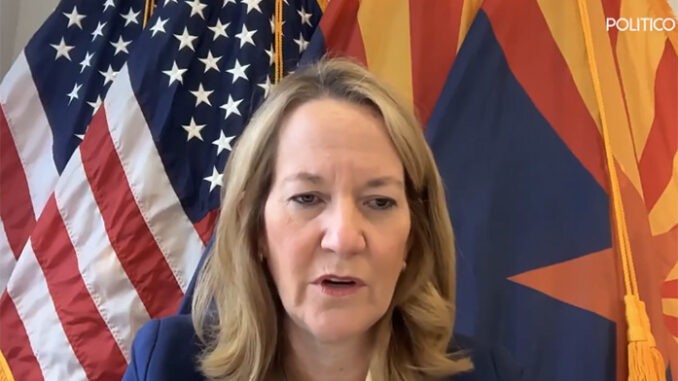
Republican attorney general candidate Warren Petersen criticized incumbent Kris Mayes over her suggestion that Arizona has too many golf courses, arguing that her comments targeted an industry supporting tourism, jobs, and small businesses.
Mayes has responded to criticism of the remarks by saying “nobody’s closing golf courses” and emphasizing her support for incentives to remove grass and collect rainwater.
“Kris Mayes thinks Arizona has too many golf courses. I think Arizona has too many radical politicians who believe government should dictate which industries get to thrive,” Petersen said in a campaign news release.
“Our golf courses support jobs, tourism, small businesses, and communities across this state. Instead of attacking an industry that contributes to our economy, the Attorney General should be focused on enforcing the law, protecting consumers, and defending Arizona families.”
Kris Mayes thinks we have too many golf courses. She raised our utility prices, lost the trust and support of law enforcement, wouldn't protect girls in sports, won't defend our border, and now golf?
End the insanity on November 3rd. Vote Warren Petersen for Attorney General. pic.twitter.com/gzfmKJ8wik
— Warren Petersen (@votewarren) October 27, 2026
Petersen’s campaign said responsible water management is essential to Arizona’s future and argued that the state should pursue practical solutions without targeting particular industries. The campaign also announced an advertisement highlighting Mayes’ comments.
The dispute stems from Mayes’ appearance on the Oct. 26 episode of POLITICO Energy, during which host Zack Colman asked about Arizona’s water supplies, conservation and industrial development.
Asked whether difficult options for addressing the state’s water imbalance were being left unexplored, Mayes criticized Republican lawmakers.
“Well, the Republican legislature out here has left everything off the table,” she said. “I mean, they really haven’t done anything when it comes to promoting conservation. We could do a hell of a lot more when it comes to conservation.”
Mayes proposed tax incentives for rainwater collection and grass removal before questioning the number of golf courses in Arizona.
“We have way too much grass in Arizona,” she said. “We probably, frankly — and I’m sure the golf industry is not going to like this when I say this — we probably have too many golf courses in Arizona right now.”
The comments circulated on X, where Brian Anderson characterized them as a pledge “to get rid of golf courses if re-elected.” Tyler Bowyer wrote, “She wants to get rid of GOLF COURSES.”
YIKES: @KrisMayes pledges to get rid of golf courses if re-elected:
"We have way, way too much grass in Arizona. We probably frankly — and I'm sure the golf industry is not going to like this when I say this — we probably have too many golf courses in Arizona right now." #AZAG pic.twitter.com/MjrQfFxUuu
— Brian Anderson (@AZBrianAnderson) October 27, 2026
In an Oct. 27 response on X, Mayes disputed the characterization.
“Relax, nobody’s closing golf courses,” she wrote. “My point is we need incentives to help all Arizonans and major industries swap thirsty grass and catch rainwater, especially if our water situation gets worse— while I take on the foreign mega-farms and data centers draining our water. My opponent is making up false claims.”
Her response did not retract her assessment of the number of golf courses in Arizona.
The interview exchange contained no proposal to close particular courses, prohibit new ones or use the Attorney General’s Office to reduce their number. Mayes’ specific proposals immediately preceding the remark concerned conservation incentives.
She outlined more specific restrictions when Colman shifted the discussion to data-center water use and asked whether lawmakers could address it.
“Yes, 100%,” Mayes replied. “And I think you’re going to see multiple pieces of legislation this next session to rein in data centers. There could be a ban proposed, like I have already proposed.”
She also raised the possibility of requiring developers to bring additional water supplies. Later in the discussion, she described her preferred approach as “a pause and a temporary ban.”
Mayes argued that data centers could increase Arizona’s water demands through electricity consumption, even when their cooling systems limit direct water use. She said additional electricity demand could require utilities to build power plants that also consume water.
When Colman pressed her on whether her position meant foregoing data-center development, Mayes responded, “Correct. You can build them in Mississippi.”
Colman questioned how that position fit Arizona’s efforts to become a technology hub. Mayes pointed to Taiwan Semiconductor Manufacturing Company’s expanding operations and argued that Arizona could accommodate semiconductor manufacturing without hosting additional data centers.
“You can be a tech hub and not build data centers,” she said.
Mayes said her staff had identified approximately 50 additional data centers planned or under construction in Arizona. She suggested Illinois and locations near the Great Lakes or Mississippi River as alternatives.
The attorney general also discussed a nuisance investigation involving a data center under construction in Ahwatukee, saying individual enforcement actions would need to be accompanied by broader state policy.
“But I will say, using nuisance law is a little bit like playing whack-a-mole,” Mayes said. “Again, we need a statewide plan.”
Be the first to comment