
WASHINGTON – Local analysts say diminished public approval of President Donald Trump led to sweeping Democratic midterm election wins across the state of Arizona, where some Republican candidates leaned into their MAGA affiliation, while others distanced themselves.
“I think it’s fair to say that the president, with his unpopularity, contributed significantly to the change in governance,” Stan Barnes, a political consultant and former Republican state lawmaker, said. “It’s a solid line. It’s not a dotted line.”
Tuesday’s election flipped control of both the U.S. House of Representatives and the Senate. In Arizona’s first and sixth congressional districts, both closely watched swing races, seats were on course to flip from Republican to Democrat Wednesday afternoon.
On Wednesday afternoon Congressional District 2 had not been called, as Republican incumbent Rep. Eli Crane and Democratic candidate Jonathan Nez competed with a razor-thin margin.
Democrats saw victories across Arizona state office races. Trump-endorsed Republicans lost to Democratic incumbents in the governor, attorney general and secretary of state offices.
Arizona Attorney General Kris Mayes, a Democrat, said that a Trump endorsement certainly did not help her opponent, Warren Peterson.
“That’s the same guy that is hurting Arizonans,” Mayes said about Trump to Cronkite News at an election party Tuesday night. “We’ve had to file 52 lawsuits against him, and we’ve won 83% of those lawsuits (and) saved Arizonans $2.3 billion. What Arizonans want is sanity. They want lawfulness.”
Eleven of Trump’s 22 gubernatorial endorsements have lost their races across the U.S., with Alaska undecided as of Wednesday morning.
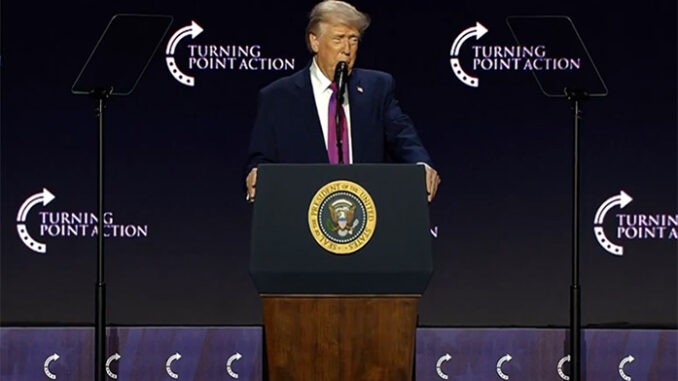
During an October rally in Bullhead City, Trump told a crowd of supporters to vote as if he were on the ballot.
Samara Klar, a professor at the University of Arizona School of Government and Public Policy, said his remarks probably didn’t help the Republican candidates he showed up to endorse.
She said in Arizona, a state with more registered Republicans than Democrats, Republicans should do fairly well, but still the state saw multiple Democratic victories over the past two years.
Klar said this phenomenon suggests that “Donald Trump, and the low approval rating in particular of Donald Trump, are dragging down Republican candidates.”
The party of the sitting president has lost seats in the House in all but three of the midterm elections from 1934 to 2022.
Trump drew attention to this trend in a speech at the Lincoln Memorial Reflecting Pool the day before the midterm election that flipped both the House and Senate.
“For some reason the sitting president doesn’t win the midterms, but we gave this a very strong shot,” he said.
In Trump’s first term, Republicans lost 41 seats in the House. During former President Barack Obama’s first term, Democrats lost 63.
“Voters will punish the party that they perceive to be in power if things aren’t going well. And for a number of voters, things are not going well,” said Barnes, an Arizona political consultant.
Democratic political consultant Stacy Pearson said Arizona voters have been watching the Trump administration’s treatment of immigrants. And in those counties with large veteran populations, they’ve been concerned with America’s war with Iran.
“The immigration enforcement we saw happening locally and nationally, was when the glass broke for Republican candidates,” Pearson said. “And then it shattered through the rest of this economic upheaval.”
The president had a near career-low approval rating at 32% in a Reuters/Ipsos November poll.
In the same poll, 50% of respondents said cost of living would be the single most important factor in deciding who to vote for in the congressional election.
Voters’ rebuke of Trump shows they “no longer see him as a quality candidate running a competent party,” she said.
In a post on X Wednesday morning, Vice President JD Vance dismissed any theories that the large Republican loss could be attributed to low voter turnout, and directly attributed the election results to the war on Iran.
“To the people who are pissed off and want to say, ‘I told you so’: you’re right, you did tell us so. Take that energy into electing Republicans who share your worldview,” Vance wrote.
Senate Minority Leader Chuck Schumer called out what he characterized as the Republicans’ missed opportunity to create the change voters asked for in 2024.
“Republican eyes were so glued to Trump’s Truth social feed that they missed the truth, staring them dead in the face. Americans hate the direction our country is going in right now,” Schumer said in a speech following the midterms.
In the Arizona gubernatorial primary, Republican candidate and U.S. Rep. David Schweikert cautioned that Biggs, a vocal Trump supporter, could not align with the Independent voters needed to take the primary.
In a primary debate, Schweikert, who lost the primary by a wide margin, said Biggs was “wholly owned by Turning Point,” the organization founded by the late Charlie Kirk.
KJZZ reported that Biggs’s campaign replaced “Trump endorsed” in a logo with the name of his running mate. A spokesperson told KJZZ the endorsement no longer fit in the logo when the campaign decided to add the running mate’s name.
Still, moving into the general election, Biggs kept Trump at the top of his list of endorsements on his campaign website, and spoke at the president’s rally in Bullhead City.
Jason Rose, a Republican political consultant in Arizona, said that for candidates with a long track record of MAGA messaging, it would not have been possible for them to sway voters by changing their tune ahead of election day.
“In a swing state like Arizona, losing your authenticity can be the … kiss of death,” Rose said.
Still, Rose said, in a wave year, candidates who remained consistent in their messaging will also get “washed out to shore” with the losing party.
Republican incumbent Rep. Juan Ciscomani in Arizona’s sixth congressional district was losing Wednesday afternoon, with 80% of votes counted according to the AP, showing that even positioning away from Trump was not enough for many voters.
Ciscomani branded himself as a bipartisan lawmaker throughout the election, and did not mention his Trump endorsement on his campaign website.
He was not among the candidates who attended Trump’s Bullhead City rally, and neither was Jay Feely, the Republican candidate in the first congressional district, a swing seat. Feely was losing by 7.2 points with 85% of votes counted on Wednesday afternoon, according to the AP’s estimates.
Political opponents and left-leaning interest groups campaigned hard against both candidates’ alignment with Trump and his policies.
JoAnna Mendoza, Ciscomani’s Democratic challenger, posted Friday on Facebook that Ciscomani and “his rubber-stamp friends have had every chance to stand up to this Administration, on healthcare, on SNAP, on the Iran war with no plan. They haven’t.”
Rose noted a football-themed ad attacking Feely, a former NFL player, which he said ran locally during sports broadcasts. One ad branded Feely as a “pro-MAGA” candidate who would “fight for Trump.”
Rose said this showed Feely’s opposition “trying to peel off the marginal voters,” among an audience that’s typically solidly red.
Gina Swoboda, who chaired the Arizona Republican party from January 2024 to January 2026 and lost the Republican primary for Arizona Secretary of State, told Politico Tuesday morning that the “coalition that we built under Trump” is nonexistent now.
Trump told the New York Times he would accept the results of the midterms, and said the blue wave was because he was not the one on ballots across the country.
Klar said the national political environment going into the midterms was bad for any Republican candidate.
“The war in Iran, tariffs, diesel prices, fertilizer prices, gas prices, grocery prices … These are the exact issues that the Republicans had said that they would help solve when they came to power in 2024,” Klar said.
Cronkite News reporter George Headley contributed to this reporting in Phoenix.
Be the first to comment