
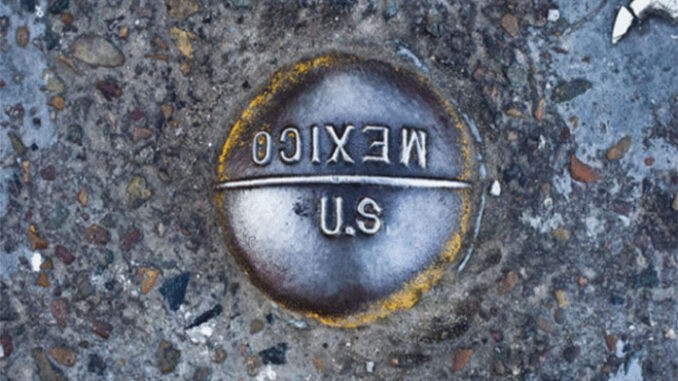
While the 2026 Arizona legislative session will not convene until January 12, under current rules, legislators have been free to introduce bills as early as November 15. One such bill is House Bill HM2002, which urges congress to withdraw the United States from the United States-Mexico-Canada-Agreement.
The United States-Mexico-Canada Agreement (USMCA) is a free trade agreement that took effect on July 1, 2020, replacing the North American Free Trade Agreement (NAFTA). It aims to create balanced trade, support high-paying jobs, and modernize trade rules among the three countries.
Historically, North American trade agreements have enjoyed bipartisan presidential support. NAFTA was supported by both Bill Clinton and his successor George H. W. Bush. Likewise, USMCA has had the blessings of both Joe Biden and Donald Trump.
HM2002 lists 13 reasons (Whereases) of why USMCA is such a rotten deal for the United States, followed by this request: “That the President and Congress of the United States withdraw from the USMCA and prevent any efforts to create an EU-style regional government in North America.”
Memorial bills (HMxxxx and SMxxxx) do not behave like regular bills. They do not have the power of law and if approved by both chambers do not go to the governor. Instead, they go to the Secretary of State with instructions that they be sent to the intended recipient(s), which in the case of HM2002 are the President and Congress.
Not everyone agrees that United States participation in the USMCA is tantamount to surrendering our sovereignty to a three-nation governing body like that of the European Union. In the November 24 edition of the Wall Street Journal (WSJ), commentator Mary Anastasia O’Grady wrote an opinion piece stating that, “The trade deal with Mexico and Canada works well, but there are problems to fix.”
Ms. O’Grady reminded her readers that, according to recently-released U.S. Census Bureau data, Mexico was the largest foreign buyer of U.S. goods during the first eight months of 2025 and Canada was a close second. The tenor of her piece is that major customers of American products and services, like Mexico and Canada, are worth keeping, although there are some issues that should be addressed.
The WSJ opinion piece went on to state that the opportunity to fix whatever is wrong with the USMCA will present itself in two stages. First, in December there will be hearings by the U.S. International Trade Commission in Washington. Then there is a mandated joint review scheduled for July 2026.
The tenor of this piece is that the problems encountered are not the result of deficiencies in the USMCA itself, but rather failures to comply with the terms of the agreement. Here are some examples cited.
United States. Failure to comply with a USMCA panel ruling in Mexico’s favor regarding regional content of auto parts:
Canada: Protectionism in banking and telecom
Mexico: In energy, discrimination in favor of state-owned companies, like Pemex
The WSJ piece ended with the following admonishment regarding the USMCA:
“Washington would be foolish to mess with it. But it would also be crazy not to use the review process to force compliance.”
Free trade is good. Maybe not so much for special interests and central planners who hide behind muh national intrests, but certainly for the consumer and for competitive businesses. I agree that subjugating American policy and interests to an EU-style governing body is a non-starter, though (D.C. hegemony is bad enough). As for “imbalances” in labor & material costs across the USMCA, that is symptomatic of _our_ over regulation and taxation regimen, regardless of other countries’ politics.
existence is about ‘pan-America’ the social state of ‘pan-amerika’ perhaps on the horizon – and may come close – as it does it will be viewed as nemesis to the status-quo social states ; america the dirty rat – and it will be ‘nuked’ by those other entities desiring such a demise of ‘US’ controlling them and they have the power and desire to ‘push the button’ – the US being a social-state will bring its demise. Mystery Babylon