
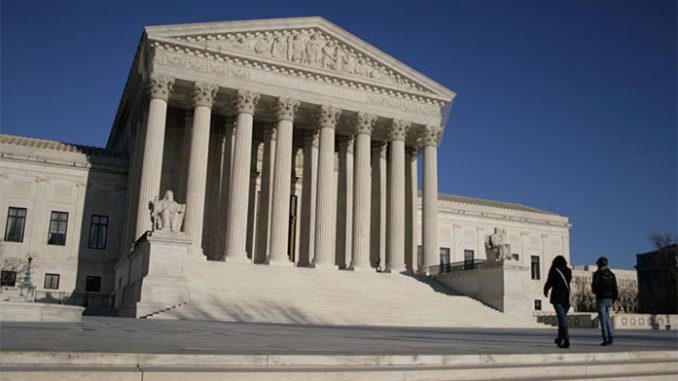
On December 5, the U.S. Supreme Court announced that it will hear a landmark dispute over the constitutionality of President Trump’s effort to modify birthright citizenship in this country. That effort is contained in executive order 14160, issued by President Trump in January, 2025. That order is on hold because it has been deemed unconstitutional by several lower courts. The supreme court ruling is expected by mid-2026.
If the U.S. Supreme Court rules in favor of Trump, the United States will be removed from the list of 36 countries that practice unrestricted birthright citizenship, and added to the list of 45 countries that offer it with some restrictions.
The controversy hinges around the interpretation of the 14th Amendment’s clause on birthright citizenship,
“All persons born or naturalized in the United States, and subject to the jurisdiction thereof, are citizens of the United States and of the State wherein they reside.”
Opponents of Trump’s order tend to focus on “born or naturalized in the United States”, while supporters point to the second qualification, “and subject to the jurisdiction thereof”. Most likely, the final decision by the supreme court will hinge on their interpretation of “subject to the jurisdiction thereof.”
Executive Order 14160 has often been characterized by its opponents as prohibiting birthright citizenship. The counter argument by supporters is that the order does not prohibit birthright citizenship but merely enforces the limiting provision that is already in the 14th Amendment. The best way for individuals to decide which is correct is to read order 14160, which may be done HERE. The two key provisions included in this order are:
- It applies only to individuals without a lawful presence.
Individuals born in the U.S. will not automatically receive citizenship if:
- Their mother was unlawfully present in the U.S. at the time of birth, and the father was neither a U.S. citizen nor a lawful permanent resident.
- Their mother was in the U.S. on a temporary basis (e.g., student visa, tourist visa) and the father was not a U.S. citizen or lawful permanent resident.
- It is not retroactive.
The provisions apply only to individuals born 30 days after the order’s signing, meaning it would affect births from February 19, 2025, onward, had it not been blocked by courts. It does not affect births that happened prior to that effective date.
Most likely, the impetus for Executive Order 14160 was the perception that two types of actions are abuses of the 14th Amendment.
- Maternity Tourism. This is the practice by pregnant, wealthy, foreign women to obtain tourist visas to travel to the United States timed to coincide with the expected date of birth. Once the babies are born, they return to their countries with a very lucrative bundle of joy. The main practitioners of this scheme have been Asian women, as reported as early as August, 2015 in a Los Angeles Times article
- Illegal Immigration. This is the same scheme, with the same results, except that instead of being practiced by the misuse of tourist visas, it is done by crossing our border illegally.
One way to put in perspective this issue of birthright citizenship is to consider how other countries are handling it. The United Nations recognizes 195 countries in the world. According to the World Population Review, 36 countries have unrestricted birthright citizenship and 45 allow birthright citizenship with some restrictions. This means that a total of 81 countries allow some sort of birthright citizenship. The other 114 do not.
Countries without restrictions:
Antigua and Barbuda, Argentina, Barbados, Belize, Bolivia, Brazil, Canada, Chad, Chile, Costa Rica, Cuba, Dominica, Ecuador, El Salvador, Fiji, Grenada, Guatemala, Guyana, Honduras, Jamaica, Lesotho, Mexico, Nicaragua, Pakistan, Panama, Paraguay, Peru, Saint Kitts and Nevis, Saint Lucia, Saint Vincent and the Grenadines, Tanzania, Trinidad and Tobago, Tuvalu, United States, Uruguay, and Venezuela.
Countries with restrictions:
American Samoa, Australia, Azerbaijan, Bahrain, Belgium, Cambodia, China, Colombia, Cyprus, Dominican Republic, Egypt, Finland, France, Germany, Greece, Hong Kong, India, Indonesia, Iran, Ireland, Israel, Italy, Japan, Latvia, Luxembourg, Macau, Malaysia, Malta, Mongolia, Morocco, Namibia, Netherlands, New Zealand, Portugal, Sao Tome and Principe, Singapore, South Africa, Spain, Sudan, Sweden, Taiwan, Thailand, Tunisia, Ukraine, and United Kingdom.
All countries that have restrictions include among their restrictions a requirement that at least one parent be a citizen or have a permanent lawful presence. Some have additional restrictions with varying degrees of severity.
If Trump’s executive order is upheld, the United States would still allow birthright citizenship. It would simply move from the ranks of unrestricted to the ranks of those with some restrictions.
This strikes me as largely a “straw-man” argument. Why should the US care how other countries define citizenship? As recent news of our new Somali “citizens” clearly demonstrates, the US government’s benevolence has led to incontrovertible corruption. Most of the countries listed above, with their unrestricted birthright citizenship, are welcome to these grifters. We have enough of our own problems.
All good points however,even if it is overturned as soon as Dems were in power they would pass laws overriding that decision and give amnesty to those who are here.
True if a eo only. If the sc rule on it it then
will take that option from them. So that is another
Reason to nrver vote for the democraps.