
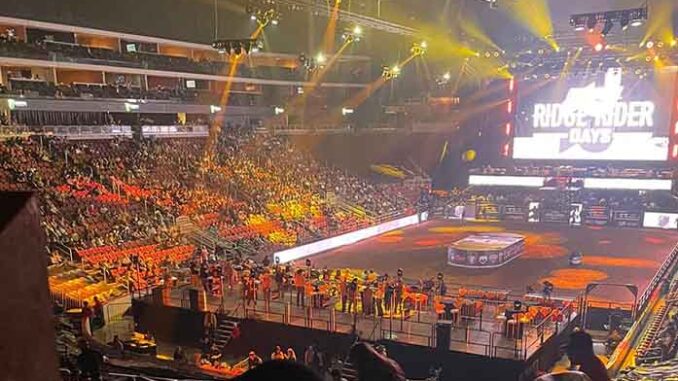
The dirt moves before the crowd stirs. A low tremor rolls beneath the chutes as a 1,500-pound bull slams its shoulder into steel, dust lifting in thin sheets under the desert lights.
Cowboys lean quietly along the arena rails. Leather creaks. Rosin snaps. One rider bows his head in prayer. Another tests the flex in his glove. Eight seconds at a time, a sport once rooted in ranch work now unfolds beneath LED scoreboards, national TV cameras and sold-out crowds – and Arizona has become one of its brightest stages.
“Arizona has a deep history in Western sports,” said Casey Lane, general manager of the Arizona Ridge Riders, one of 10 city-based teams in the Professional Bull Riders’ rapidly growing league. “It’s a place where all the cultures that contribute to bull riding come together.”
The 2025 Ridge Riders roster reflected that mix: riders from Brazil, Canada, Utah and Colorado, alongside one Arizona native — JaCauy Hale, a 22-year-old from Ganado whose Indian National Finals Rodeo title launched him into PBR. Team captain Eduardo Aparecido, a veteran from Gouvelândia, Brazil, anchors a lineup that includes Keyshawn Whitehorse, a Navajo rider who earned PBR Rookie of the Year in 2018.
For many Indigenous athletes, the arena feels familiar.
“Our lifestyle involves animals,” Whitehorse said. “Anywhere on the reservation, you’re going to find horses or livestock. I try to keep that same foundation at the professional level — not forget who I am.”
‘We’ve always been around horses’
Lane relies on Mo Brings Plenty, the team’s director of culture, to help blend backgrounds and personalities into a functioning team — something new in a sport built on individual performance.
“Bull riding’s always been an individual sport,” Lane said. “Mo’s role is about creating an environment where the guys feel supported, listened to and connected.”
Brings Plenty, a Lakota horseman known for his acting role on the TV series “Yellowstone,” said the Southwest feels like home turf. Arizona’s concentration of tribal communities and ranching traditions creates a natural gathering point.
“They love the Western lifestyle,” he said. “They’re country folks. That’s what makes it so much different than anywhere else in the country.”
For Brings Plenty, everything begins with the horse.
“As American Indian people, we’ve always had a great connection with horses — not just physically but spiritually,” he said. “A lot of our people don’t see them as a tool. They’re a part of us.”
His horse Zorro may appear on “Yellowstone,” but Brings Plenty said the animal also has the gentleness to carry an infant.
“That connection and bond — it’s beautiful,” he said.
A team sport in cowboy country
Bull riding as a stand-alone sport dates to 1993, when 20 riders split from traditional rodeo to form PBR. For nearly 30 years, the sport operated as a touring individual circuit. Teams bull riding — five-on-five contests between city-based squads — didn’t exist until four years ago.
“When we were selecting where to have a franchise, Arizona really stood out,” Lane said. “You have Hispanic culture, Native American culture and traditional cowboy culture all in one place.”
Fans have responded. Lane said Ridge Riders Days in Glendale draws roughly 30,000 spectators each year, with preseason events bringing thousands more.
National numbers have grown, too, Andrew Giangola, PBR’s vice president of strategic communications said. PBR’s Game of the Week on CBS has repeatedly out-rated other major sports. A 2025 PBR Teams game on CBS drew 2.707 million average viewers, which was the most-watched PBR telecast ever on the network.
“Some Sundays, outside of the NFL and college football, bull riding is the most watched sport,” Giangola said.
Training for a sport where ‘it’s not if, it’s when’
The spectacle masks the risk. Giangola said roughly one in 15 rides results in an injury — an extremely high rate compared with mainstream sports.
“The cowboys know they’re going to get hurt,” he said. “It’s not if, it’s when.”
To prepare, Ridge Riders athletes spend much of the week training under Renan Camilo, a Brazilian athletic trainer who oversees strength work, conditioning and recovery.
“We usually strength train at least two or three times mid-season,” Whitehorse said. “Then we work the fundamentals — the barrel, practice bulls, slowing things down.”
Competition-day routine is sacred: pray, lay out gear, prepare the bull rope, tape up, warm up.
“I try to keep the process the same,” Whitehorse said. “That keeps my mind right.”
Bulls as partners, not villains
Outside the arena, PBR frequently pushes back against myths that bulls are shocked or otherwise abused to make them buck.
“There’s no sport without the bull,” Giangola said. “You can’t force a 1,800-pound animal to do anything it doesn’t want to do.”
PBR bulls are bred specifically for bucking, trained with a flank rope tied loosely around the haunches and a 60-pound dummy. Hot shots are banned. Spurs are dulled and inspected.
“Our bulls live four to six times longer than commercial cattle,” Giangola said. “They’re treated like rock stars.”
Brings Plenty sees that relationship in quiet moments behind the scenes.
“There’s a video of Eduardo just scratching his bull’s back before a ride,” he said. “We pray for the riders — and for the bulls. They are their dancing partners.”
Arizona as a proving ground
Arizona’s team is becoming part of PBR’s future, Lane said, with youth camps and rider-development efforts planned in the state.
“We want athletes in other sports to see this as an option,” Giangola said. “There’s a clear path to a professional career riding bulls.”
For fans, the connection is simpler: a sport rooted in the landscape outside the arena walls.
“Bull riding — and the Ridge Riders — give people a way to express pride in Arizona and the Western lifestyle,” Giangola said.
When the gate swings open, Whitehorse says the noise falls away.
“When that gate opens, everything slows down,” he said. “That’s what we live for — that one moment.”
In Arizona, those eight seconds carry generations of horsemanship, the prayers of elders and the futures of young athletes hoping to climb into the chute one day — all in a desert arena where bull riding is reinventing itself for the next generation.