
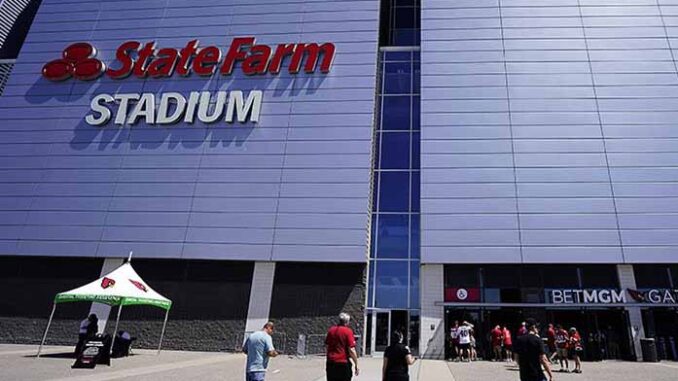
The last time the Valley hosted a Super Bowl, the points were so prolific, it felt as if the State Farm Stadium scoreboard might explode.
Philadelphia Eagles quarterback Jalen Hurts lit up the Glendale night on Feb. 12, 2023, rushing for three touchdowns and throwing for another, setting a record for total points scored by a player in the big game. Despite the magic from Hurts, a 27-yard kick from Harrison Butker sealed a 38-35 victory for Kansas City, securing the third championship in franchise history.
It is safe to say Arizona has had its fair share of iconic Super Bowl moments, but when will the Valley get a chance to do it all again?
“The competition is increasing,” president and CEO of the Arizona Super Bowl Host Committee Jay Parry said. “We need to be aware of that, we need to be very mindful. We need to ensure that all of our collective stakeholders in the state are staying on our front foot and remaining very, very competitive.”
When the Seattle Seahawks and New England Patriots meet in Super Bowl LX on Sunday afternoon in Santa Clara, California, it will mark the second time the teams have met in a Super Bowl, and the second time Levi’s Stadium has hosted the game since opening in 2014.
Next season, the Super Bowl will stay in California but will move six hours south to one of football’s newer crown jewels, SoFi Stadium in Inglewood. It will be the second time in five years that the Los Angeles metro area has hosted a Super Bowl since SoFi opened in 2020.
Allegiant Stadium in Las Vegas, which also opened in 2020, joined SoFi in breaking the Valley’s monopoly over the western half of the country in terms of hosting Super Bowls. The 2016 Super Bowl (at Levi’s) was the first and only outside of Phoenix and west of Arlington, Texas, from 2004 to 2022.
In terms of Super Bowl history, the Valley certainly offers a great résumé.
In 1996, Dallas’ Larry Brown, a 12th-round draft pick who was still grieving the death of his infant son two and a half months earlier, became the first cornerback to be named Super Bowl MVP by recording two interceptions in the second half of the Cowboys’ 27-17 win against the Steelers at Sun Devil Stadium.
In 2014, a 10-point fourth-quarter comeback led by New England Patriots quarterback Tom Brady was looking like it was about to go out the window at then-University of Phoenix Stadium. An improbable catch by Seattle Seahawks wide receiver Jermaine Kearse put the Seahawks in position to become the first team to repeat as champs since the 2004-2005 Patriots.
Until they weren’t. In what many consider one of the most controversial play calls in NFL history, Seahawks quarterback Russell Wilson threw an interception on the 1-yard line to Patriots undrafted rookie cornerback Malcolm Butler, securing New England’s 28-24 win.
If you don’t consider the Butler interception as the most iconic play in Super Bowl history, there’s a strong chance you wouldn’t have to leave Arizona to find it.
Entering the game hoping to be the first team to finish undefeated since the 1972 Dolphins, the New England Patriots marched into University of Phoenix Stadium against the underdog New York Giants.
David Tyree’s infamous “helmet catch” gave the Giants life, eventually leading to a go-ahead touchdown to Plaxico Burress with 35 seconds left in a 17-14 win that ended the Patriots’ hope at going 19-0.
And then there was the entertainment portion of the games.
In 2023, Rihanna, a Barbadian singer and actress, used a floating stage built high above the field to turn in a culturally significant performance that was one of the most watched halftime shows ever, reaching 118.7 million viewers – all while she was pregnant.
In 2015, singer Katy Perry’s performance of “Firework” featured her floating over the University of Phoenix Stadium field on a star-shaped platform, on what was a postcard-perfect night in the Valley with the stadium roof open. The iconic moment occurred at the end of her 12-minute set, which was infamously accompanied by out-of-sync “Left Shark.”
Tom Petty & The Heartbreakers performed a memorable set at the 2008 Super Bowl that included the songs: “American Girl,” “I Won’t Back Down,” “Free Fallin’,” and “Runnin’ Down a Dream”, and Diana Ross headlined the halftime show in 1996.
Parry and the Arizona Super Bowl Host Committee would like to create more of those memories, but Las Vegas and Los Angeles aren’t the only cities that have or will raise the competition level. Nashville is one of several cities that are adding an indoor stadium within the next five to six years.
Nashville was ranked No. 6 “Best City to Visit” by U.S News Travel, offering plenty of hotels and more than enough entertainment. Downtown Nashville, known for its country music scene, is right across the Cumberland River from where the new Nissan Stadium will stand upon its completion before the 2027 season.
Since 2006, when State Farm Stadium opened, every new stadium built has hosted a Super Bowl within four years. This includes New York, where the “no cold weather” rule was thrown out the window. Fortunately for just about everyone involved, the game between the Seahawks and Broncos in 2014 dodged a snowstorm by six hours, and players were able to play in a manageable 49 degrees.
History points to the possibility of Buffalo breaking the streak when the Bills’ new stadium opens later this year. Buffalo would be the smallest city to ever host a Super Bowl. In addition, the 2,000 hotel rooms located in the Buffalo metropolitan area, according to mathhotels.com, would likely not even be enough for teams and media, much less the tens to hundreds of thousands of fans.
Which raises the question: What amenities does a city need to host a Super Bowl?
Securing a Super Bowl bid is no easy process, one that can take over a year to complete. Starting with the 2023 Super Bowl, which the Valley hosted, the NFL changed the process of determining a host city.
Until 2017, cities battled it out with bids. Now, the NFL contacts the cities directly and, if there is interest, a bid is made, and terms are negotiated. Parry confirmed that the NFL works directly with the owners for any major NFL event, whether it be for the Super Bowl, the Pro Bowl or the NFL Draft.
In terms of city requirements, most fall inside one broad category: infrastructure. This includes a suitable stadium, travel accommodations, adequate hotel space, an extra set of facilities for one team to hold practice and, most importantly, city support.
“It really takes the entire community,” Parry said. “We call it team Arizona, to pull together and host a Super Bowl at the highest level as we’ve done the past four times we hosted.”
State Farm Stadium has hosted numerous major events, including three Super Bowls, two Final Fours, three college football national championship games, and the Fiesta Bowl for 19 years, proving it can handle major events.
Phoenix’s Sky Harbor International Airport was ranked as the nation’s best in 2023 by the Wall Street Journal, and the city has 72,000 hotel rooms, according to visitphoenix.com. The Chiefs used Arizona State’s facilities, which will also be getting an upgrade in the near future, according to ASU Athletic Director Graham Rossini.
All of this comes together to position Arizona “very, very well,” to stand up to the competition from other cities, Parry said.
In the most recent rendition, th 2023 Super Bowl, the Valley broke the record for economic impact via a Super Bowl with a staggering $1.3 billion. The record still stands heading into Sunday’s Super Bowl.
“We did a phenomenal job from Super Bowl LVII,” Parry said. “Got great feedback from the NFL, commissioner (Roger) Goodell, and others.”
The NFL has typically announced host cities three to five years in advance but, barring any news within the next couple of days, it will only be two years out at the conclusion of Sunday’s Super Bowl 60.
As for the Valley hosting the big game and any current plans, Parry said the committee is “very focused” on hosting the Women’s Final Four in April. They’re “not quite there yet” in terms of being in the active bidding process for another Super Bowl.
how about sending the Cardinals back to where they came from..
Send it to a barrio or ghetto.