
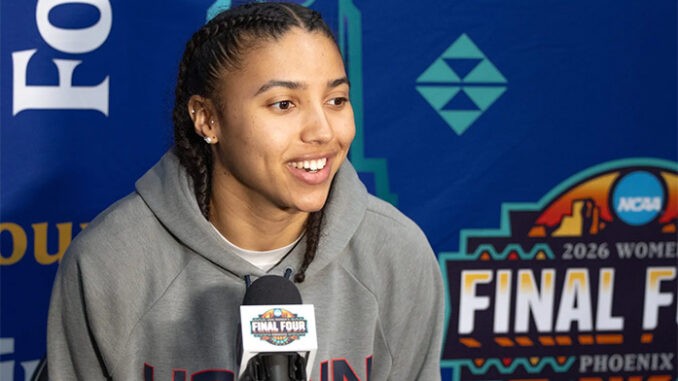
Azzi Fudd, this year’s projected No. 1 WNBA draft pick, has dominated in every fashion for the Connecticut Huskies. From becoming the first high school sophomore to win Gatorade National Girls’ Basketball Player of the Year to scoring 24 points in the NCAA national championship game, Fudd’s story extends way beyond basketball, and begins and ends with family.
It also sends a powerful message about foster care, one embraced by many in that community.
“It gives (foster youths) hope,” said Yasaman Tabrizi, director of outreach at The Foster Alliance in Phoenix. “And it gives organizations like ours hope, too, that the work we’re doing to support these families ensures that they are able to grow up in a loving, stable home just as any child would deserve.”
When Fudd was a toddler, she was adopted by Tim Fudd, who was married to Katie Smrcka-Duffy, a single mom. Tim’s mother, Georgia Hecker, often fostered kids at her home outside Atlanta. Hecker was fostering two boys, Jon and Jose, until she died in 2011 due to lung cancer. Smrcka-Duffy and Tim brought in the two boys, ages 7 and 5, after navigating the foster system.
Suddenly, Fudd was no longer an only child. She was a sister sharing a bunk bed with two brothers navigating their own uncertain beginnings.
That bond has only strengthened over time. Jon and Jose quickly became “professional rebounders,” spending hours on the court with Azzi, rebounding her shots and passing the ball back to her for more reps.
Before UConn’s NCAA Tournament run last year, Fudd left practice as soon as she could and drove 40 minutes to watch her brother Jose play in a Division III Sweet 16 game for the University of Mary Washington. The moment reflected a relationship built not just on proximity, but on choice, showing up again and again.
Tabrizi emphasized the importance of that choice.
“You always wanted someone to show up for you and maybe that didn’t happen, so you want to make sure that somebody’s showing up for your sibling. And you want to be that person,” she said.
Tabrizi’s Foster Alliance is one of the largest providers of essentials for foster families in Arizona, supplying everything from beds and clothing to shoes and diapers. The organization is often the first place children turn after being removed from their homes, many arriving with nothing more than the clothes on their backs. The Foster Alliance works quickly to meet those immediate needs, ensuring children have the basic necessities as they enter a new and uncertain chapter.
“As a community, we just need to be aware that foster care exists, and we shouldn’t stigmatize it,” Tabrizi said. “We should help celebrate these families and uplift them and do what we can to make sure that they can grow together and take in these kids. Because at the end of the day, it’s our community and our kids. We want to make sure that they’re all thriving as best as we can.”
In a February statement, Kathryn Ptak, the director of the Arizona Department of Child Safety, said that in the past year, more than 3,000 children were safely reunified with their families, 1,300 were adopted and hundreds more achieved permanency or received support transitioning to adulthood. Additionally, DCS licensed 534 new foster homes, increased payments to caregivers of older youth and reduced the number of youth missing from care by 40%.
Behind those numbers are foster parents like the Valley’s Monique Kirkland, who has spent the past seven years opening her home to children in need.
“(Foster care) has its rewards. It definitely takes patience,” Kirkland said.“As a foster mom, I try my hardest to give them what my kids would’ve had. I treat them like my own, of course”
The first child placed with Kirkland arrived when she was just one day old, a placement that ultimately became permanent through adoption. Today, Kirkland cares for four foster children at a time, alongside her biological son and adopted daughter.
Like Fudd, whose upbringing was shaped by the addition of foster siblings and a stable support system, Kirkland sees firsthand how consistency and care can shape a child’s future. While not every story unfolds on a national stage, she supported the same foundation – that feeling supported, valued and at home can open the door to success for children in foster care.
“It helps show that children in foster care can still be successful,” Kirkland said. “There’s this stigma that foster kids have a hard time and people don’t see that they can still make it out of foster care and be successful. It will hopefully help people want to get involved.”
UConn has routed every team in its path on the way to the Final Four during this year’s NCAA Tournament. The reigning champions picked up their 54th consecutive win against Notre Dame in the Elite Eight and will aim to cut down the nets for the second year in a row – this time in Phoenix.
For Fudd, the next step is already in sight. The WNBA Draft is set for April 13, where she is projected to go No. 1 and potentially reunite with her former Huskies teammate Paige Bueckers on the Dallas Wings.
But long before draft night, Fudd’s story was shaped by the people who showed up for her – the same kind of support foster families across Arizona are working to provide every day.