
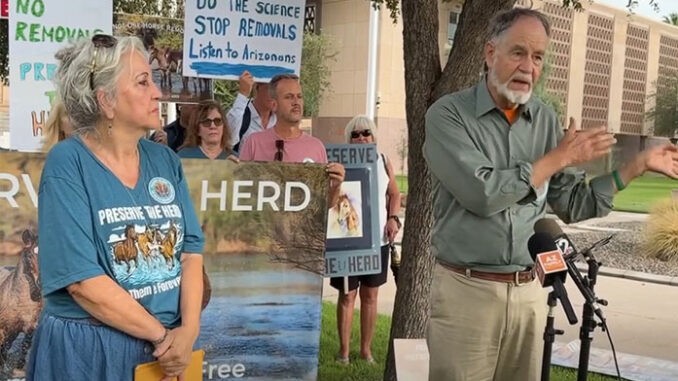
PHOENIX — Wild horse advocates gathered at the Arizona State Capitol Wednesday morning to call on Governor Katie Hobbs to halt planned removals of Salt River wild horses until the state can demonstrate through independent science that the remaining herd will be genetically healthy and self-sustaining.
Approximately 100 people attended the Preserve the Herd — Follow the Science Rally, where speakers challenged the Arizona Department of Agriculture’s plan to reduce the herd from approximately 271 horses to roughly 120 to 125 by the end of 2030.
“Today was not about opposing responsible management,” said Susie Bell of Friends of the Salt River Wild Horses. “It was about demanding that irreversible decisions be supported by credible, independent science. Arizona should not remove a single healthy horse until the public is shown that the remaining herd will be genetically viable.”
Wildlife ecologist and author Craig C. Downer, who has studied the Salt River herd and its habitat, warned that the proposed target could leave the population too small to remain healthy, adaptable and naturally self-sustaining.
“It would be a big mistake for Arizona to reduce this herd to 120 horses without independent science showing that the population can remain genetically healthy and self-sustaining,” Downer said. “The total number of horses does not necessarily reflect the herd’s true reproductive strength. Managers must consider how many unrelated breeding animals would remain, whether family lines are adequately represented, the herd’s age and sex distribution, foal recruitment and the continuing effects of fertility control.
“Once genetic diversity is lost, it can be extremely difficult — if not impossible — to restore. Before any removals begin, Arizona should require an independent, transparent scientific review demonstrating that the proposed population target will preserve the herd for generations, rather than merely keeping a small number of horses on the landscape.”
Dr. E. Gus Cothran, a nationally recognized equine population geneticist and professor emeritus at Texas A&M University, has stated that 150 to 200 horses are generally considered a minimum population for protecting long-term genetic health.
When asked specifically about the Salt River wild horses, Cothran also cautioned that no single number guarantees a herd’s survival. Viability depends on genetic diversity, age and sex structure, the number of breeding animals and mortality.
Rally participants called for herd-specific genetic testing, a population viability analysis and an independent scientific review before any permanent removals begin.
The Salt River herd has already declined by more than 40% during the past five years, falling from approximately 450 horses to about 271 through fertility control and natural attrition.
Advocates maintain that continuing the existing management approach could reduce the herd to approximately 165 to 168 horses over the next five years without removing healthy horses, breaking apart family bands or reducing the population below the expert-recommended range.
“There is no emergency that justifies abandoning a management program that is already working,” Bell said. “The herd is declining, fertility control is working and natural mortality is occurring. Why would Arizona choose removals before completing the science?”
Public records have also raised questions about how the population target was selected. Requested documents indicate that the original proposal to reduce the herd to approximately 100 horses emerged from a straw poll rather than an independent scientific population study. The number was later negotiated upward, but no independent scientific justification for the final target has been released.
“You should not manage a protected Arizona treasure through a straw poll conducted among cattlemen and other interests within AZDA,” Bell said. “A negotiated number is not a scientific number.
Public support for protecting the herd remains strong. A 2023 Public Policy Polling survey found that 78% of Arizonans opposed removing the Salt River horses from their habitat, even when respondents were asked to consider environmental concerns. Other horse-protection organizations have cited polling showing support for protecting the herd as high as 88%.
The horses were protected under the Salt River Horse Act, HB 2340, which passed the Arizona House 53–3 and was signed into law in 2016. Hobbs voted for the legislation while serving in the Arizona Senate.
The law states that a person shall not “interfere with, take, chase, capture or euthanize” a Salt River horse without written authorization and provides that authorization may be issued “only for humane purposes.” It also clarifies that the horses are not stray livestock subject to ordinary livestock-removal statutes.
Friends of the Salt River Wild Horses is asking Governor Hobbs to:
· Pause permanent removals.
· Order an independent genetic study and population viability analysis.
· Require AZDA to release the data supporting the 120-to-125-horse target.
· Evaluate continued fertility control as an alternative to removals.
· Allow independent experts to review the findings.
As for the release date, Governor Hobbs’ office had not responded to advocates’ requests for a meeting or a pause in the planned removals. At the rally, advocates displayed more than 50 written requests from individuals who had sought meetings or assistance, along with the rejection letters they received, as evidence of the administration’s repeated refusal to engage.
Representative Cody Reim, who originated SB 1199, was also on hand, fresh from his primary victory the night before. Reim pledged to introduce new legislation requiring science-based protection for the herd.
“The Salt River Horse Act was never intended to justify removing these horses,” Reim said. “It was enacted to protect the herd and prevent exactly this from happening.”
Supporters of the horse say that a temporary pause would not end responsible management of the herd. They say it would ensure that irreversible decisions are based on credible evidence, transparency and long-term genetic viability.
Supporters argue that the Salt River wild horses attract visitors, photographers, recreationists and families to the Lower Salt River. The horses live in recognizable family bands and have become part of Arizona’s identity and natural heritage.
One of America’s greatest treasures is in desperate need of being heard and protected.
America’s horses have been part of our nation’s history since its earliest days. Horses have helped build this country through their strength and endurance. They carried pioneers across the frontier, assisted farmers with their work, served bravely alongside our military in times of war, and continue to symbolize the freedom and spirit of this country.
Today, these iconic animals are facing a heartbreaking reality. Many are chased by helicopters, separated from their families, removed from the lands they have called home for generations, confined to holding facilities, and transported across borders where they face slaughter.
Our horses deserve to be treated with dignity, compassion, and respect. They have given so much to our country, and they deserve our protection in return.
To the haters claiming the Salt River wild horses are a taxpayer burden or out of control: they’re managed through natural attrition and proven birth control, paid for entirely by private donations. Zero public money. The herd has already been reduced humanely without roundups or removals. Your complaints ignore the facts and the thousands of Arizonans who actually care for these horses.
The Salt River Wild Horses are big part of our AZ Heritage. They are they are an important part of the Ecological health of The Salt River. They help reduce the risk of wildfires in the area. They have been historically documented as being at The at The Salt River area since the 1800’s. They are currently Protected by AZ Statute A.R.S 3-1491 which clearly states no removals shall be done,except for humane reasons. There is no humane reasons, they are, and have been being Humanley managed since 2015,which has reduced the herd by 40% already,by fertility control and natural attrition, that program will continue through 2030,reducing the herd even more,without the need for any removals. Governor Hobbs,and the AZDA are violating The Salt River Horses ACT by planning to remove half of the Salties with no humane reasons to remove them. The Salt River Wild Horses are healthy,and thriving in their natural habitat that they have lived on for centuries. 80% of Arizonans want them protected and preserved for future generations. The Salt River wikd horses are the only Wild horse herd in the world that snorkel under water to eat eel grass. This historical herd brings on visitors from all over the world, just to catch a glimpse of our beautiful Salties. They are good for the environment,and the river,they increase Eco-tourism, They captivate thousands of Kayakers,Photographers,Tubers, Hikers,Fishermen,and Arizonans each and every day, Year round. Please stop the planned removals, Allow the Scientific study First, before one horse is removed. Don’t decimate our treasured Salt River Wild Horses to Extinction. Protect and Preserve the Herd for future generations. It’s what 80% of your constituents want.
Save our Salt River Wild Horses NOW. Not one horse removed until Scientifc studies are done.
Those beautiful horses deserve to be left alone to live and die free. What are people so of? It’s not costing taxpayers anything. Do the study and allow the science to speak. They are a benefit to the land, not a destroyer of it. They bring in tourists who spend money here who enjoy seeing the horses so much. Arizonans love those horses. Gov. Hobbs voted for the Horses Act before. Why not now? There’s a lot riding on this decision of hers for both her and the horses!
Attrition is working to reduce the herd without compromising their genetic viability. The herd was reduced from 463 in 2019 to 271 now in 2026 through natural causes alone. There’s no reason to remove any horses.
The Salt River horses are an absolute treasure and are Arizona’s living history. People come from around the world to see the only horses in the world that snorkel for their food. They spend an enormous amount of money here, all revenue for the State of Arizona. The horses cost the public absolutely nothing, and yet they give so much. By snorkeling, they clear the river of eel grass for the thousands that paddle the river every day. Their manure spreads mesquite seeds through the forest, and they naturally abate forest fires by eating the dead grass. Governor Hobbs helped pass the law that protects this herd. However, now she is ignoring it! She has denied myself along with many others to meet with her to discuss this situation. 80% of the people polled are in favor of the wild horses. Imagine Governor, if those 80% decided not to vote for you. Halt the removals, listen to the science.
They are some of the most beautiful creatures on this planet.
They are sentient beings. They are connected to the land. Don’t be fooled by the propaganda from cattle groups who want them out of their way. The horses grazing habits are protective not destructive.
Terrifying them and forcing them from their home with helicopter roundups Is just plain cruel not management.
They deserve a better.
I’m begging you to leave the Salt River Wild Horses be. They don’t belong to you or anyone to dispose of as you wish. They are God’s precious creatures and meant to live and thrive on the land that they were born on and are living on. Please leave them alone!
Both the Salt River and Heber wild horses don’t need to be removed. If you removed the wild horses you will loose a lot of tourism as I know people who come from all over the world to see them. With the tourist brings money to your local economy.
The Salt River horses are managed by a management group and they assume all financial responsibility and the public donates money to them. The taxpayers don’t pay anything.
The Heber horses have a lot of land they can roam on. You blame them for there being no grass but there is a drought going on right now plus they are grazing cattle out there as well. From my understanding the cattle do more damage then horses. Horses reseed the area by their manure containing seeds that replant the area where cattle do not.
Wild horses cut down the fire danger as well.
Please don’t remove any wild horses.
Please support saving these majestic animals in their natural habitat. They are our connection to this state’s earliest beginnings. They deserve to be free. Please, Governor Hobbs, make this a priority as you near this next election. These beautiful horses are a piece of Arizona’s historical legacy that needs to be protected and held as a valuable part of our history. Please allow them to be. They are incredible.
I have been out asking the public how they feel about the
SALT RIVER HORSES, I’ve not run into anyone that does not want them to stay. They have been a staple for so many decades, they have earned the right to stay in the area that has been legally designated for them to live.
I have been out there listening to and asking the public about the Salt River Horses. It is very clear to me that Arizonians want these horses to stay as is, on this land.
These magnificent animals should be managed and protected as they have been, getting their numbers down with fertility control and attrition, not by removing healthy horses from the only home they have ever known. They are a symbol of the West and a huge tourist draw. It makes my day whenever I see them on the river. They are important to the majority of Arizonans and Americans. Most humane people want humane management of these horses. They have been protected and managed since 2016 when Governor Ducey signed a law (and then Senator Hobbs voted for herself). But due to a loophole in the law, they are now slated for removals starting in September. We are asking Governor Hobbs to uphold the law and make an executive order to do a science-based study, before irreparable damage is done to the future of the herd.
Wow, nothing brings out the Phx based housewives like a discussion on feral horses!
Wow . Nothing brings unemployed men to comment on a news article because their feelings are hurt by “housewives”. Have the day you deserve.
Actually, if you do your homework, for those of you that refuse to address them by what they are “Wild Horses”!
Do your homework they were here tons of thousands of years ago
Our horses have evolved and have lived and survived for centuries
They should be respected and honored and deserve the land they roam partially free.
Why do cattle game priority on our public land???
Why should individuals like ranchers get rich on profits made by using US TAXPAYERS public land????
The BLM, USFS, Dept of AG should be entirely dismantled!
Then restructured with a balance of educated individuals in all the fields of science, and not one having any interest in the cattle industry PERIOD!
And don’t give me any crap about horses do the damage in cattle don’t! Again, do your own research quit being a sheep, following the herd that wants you to believe their BS!!!
I’d share both articles, but I’m unable to here
This is one of the hottest topics in Arizona right now. The groups that are inflicting their force of opinion and money are the environmentalists and biodiversity advocates. Whether you like it or not, these particular wild horses that live in the lower Salt River, are an absolute treasure to thousands of people around the world. Literally. They come to our incredible state just to see the magic of this band of horses. We live in an over paved, over developed world, so why can’t we just have a few places in the country like this, where people can enjoy wildlife like these beautiful and extremely healthy horses. It costs nothing to the state government because individuals donate time and money when needed to the groups who are contracted to manage the health and well being of our Salties. In the last 2 years alone, 4 colts and 2 older horses have succumbed to the laws of nature and with the birth control darts, there are very few replacement horses. We need to keep all the Salt River horses wild and free. Let them be!
The vast majority of Arizonan’s love the Salt River wild horses and want to see them living wild and free in the home they have inhabited for over a century. Thank you to the two unbiased experts that are quoted in this article for explaining the science behind the herd size, which has already been reduced over 40% through humane birth control and natural attrition.
LET THEM ALL BE FOREVER FREE!
The Salt River Wild Horses are an important part of Arizona and many people enjoy seeing them. They are not hurting anyone or the environment. They deserve to stay and not be removed.
Hobbs can stop this now. Do the science first. She has ignored everything on this matter. Humans cause more damage than the wild horses. If she continues to ignore this she will see the effects come November
Please leave these beautiful horses wild & free! Demand that Gov. Hobbs follow current AZ law (the Salt River Wild Horses Act) and demand scientific studies be done before any removals! It’s estimated that over 80% of Arizonans want these horses to remain wild & free! They belong there just as much as any other wild life. They graze grasses that contribute to wild fires. They do no harm to their environment. They are healthy and happy–just look at the photos and you can clearly see that!
The Salt River Wild Horses are part of Arizona natural wildlife and every one of the horses deserve to remain wild & free in the Tonto National Forest! We are asking to halt any removals until scientific data is done. We are asking for the Salt River Wild Horse Act to be upheld  as passed in 2016. Arizonans and visitors from all over come to enjoy the horses and their families and it must remain that way!
💜💪🏻🐴💪🏻💜
I paddle the Salt River every weekend if possible. The horses are wild just like the coyotes, Javelina, and the Bob cats that live in the same area. I don’t see anyone seeking to remove the Bob cats, coyotes, and Javelina. Leave the horses alone… they hurt no one and actually spread nutrients from eating the eel grass throughout the salt river!! Can you say fertilizer??? The horses politely watch 1000s of humans paddle through the river without harming them… Katie Hobbs, o something… or I hope your days are numbered!!!! Leave the horses alone!! Wild and free just like all of the other animals that are wild. Only difference is, the horses aren’t predators!!!!
They are NOT feral horses-they are Wild Horses and a part of the American West and all of our heritage. How would you “haters” like it if YOU were dispossessed of your home? Would you be agreeable to hurting these creatures if you knew someone would come and take your home and you could do nothing about it? Would you be so agreeable if they were taking away your children, grand children, your business or totally way of life citing that you are a Feral Human and a bother to others?
The SRWH are an important part of Arizona’s history. They deserve our protection and respect. Governor Hobbs helped pass a bill to protect them and now she is turning her back on them. They play an important role on the Salt River
, not to mention the millions of dollars they bring in in tourism revenue. Governor Hobbs needs to look at the science and she also needs to meet with The SRWH Management Group and listen to what they have to say. They need to remain wild and free!
The majority of Arizonians who want these horses protected. This is where they belong. They are not hurting the environment people are guilty of that. They are loved by many and bring in a lot of revenue to this state. Let them stay wild and free
WILD HORSES ARE “ECOSYSTEM ENGINEERS”
Those who have the Governor’s attention regarding our beloved Salties are using an all too common excuse to remove them and that is that horses are damaging the environment they live in. It is used by the BLM and Forest Service for wild horses all over the West. Yet, these same people have NOTHING to say about the tremendous damage that cattle grazing on public lands does to degrade the environment.
The truth is that countries all over the world are re-wilding horses into public/protected land areas because they actually ARE “ecosystem engineers” that mimic the roles of extinct native herbivores. Countries like Spain, France, Portugal, Poland, the Netherlands, Croatia, Ukraine, Bulgaria and others are pursing this new strategy to address environmental degradation, climate challenges and wildlife management issues. Why? Here are some basics on that exciting development.
ECOLOGICAL RESTORATION & BIODIVERSITY ENHANCEMENT – Wild horses promote healthier grasslands and diverse habitats through natural grazing, trampling and movement, which counteract overgrowth, invasive species and soil compaction from human activities.
Their selective grazing favors native, boosts species richness, and heterogeneity in vegetation. They disperse seeds via dung, improve soil aeration and nutrient cycling with their hooves and manure and create micro-habitats like wallows and trails that benefit pollinators, birds, and small mammals.
In the US, on some Bureau of Land Management (BLM) rangelands, rewilding aims to restore 25% of grasslands, which horses originated from 4-4.5 million years ago and lived here in North America until just over 5,000 years ago. Studies indicate they reduce woody encroachment and enhance carbon sequestration by building humus layers of soil.
CLIMATE RESILIENCE AND WILDFIRE MITIGATION – The grasslands of the West and the Sonoran Desert in Arizona are fire-prone, now more than ever before. The horses help by reducing fuel loads and improving soil water retention, all of this aligning with global efforts to combat climate change. Grazing creates heterogenous landscapes that lower fire intensity. Their dung promotes deeper root systems in wild grasses, increasing drought resistance. They also emit less methane than cattle, making them a lower-impact grazer for carbon-neutral restoration.
The idea of re-wilding is relatively new but gaining traction. It requires a shift of mindsets, particularly when dealing with the financial interests of ranchers. But it’s time to view wild horses as allies in healing degraded lands amid biodiversity loss (down 68% since 1970). So, instead of spending $100 million annually to hold 62,000 wild horses in holding pens, a proposal is out there to relocate them to underused public lands under the management of the BLM. This would halt helicopter roundups and prevent slaughter (a risk highlighted in the 2026 federal budget). This could help to restore habitats lost to livestock (cattle). These habitats occupied by cattle are down (severely degraded) by 50% since 1971.
So, let’s talk briefly about cattle vs wild horses. Wild horses on public range lands are far better for ecosystems than cattle simply due to the differences in population scale, foraging behavior and management practices. Recent analyses of U.S. Bureau of Land Management (BLM) highlight cattle as the primary driver of range land degradation.
HORSES VS. CATTLE – WHY HORSES ARE BETTER OPTIONS FOR THE LAND –
Lower Population Numbers: Approximately 1.5 million cattle graze BLM lands, which is about 20 times the population of wild horses and burros (around 73,500). This sheer volume amplifies cattle’s impact, making them responsible for roughly two-thirds of the 57 million acres of public rangeland failing BLM’s Land Health Standards (which assess soil, vegetation, and water quality). In contrast, wild horses occupy less than 1 million acres, or under 1% of the total. Surely, this nation can provide that small percentage of land to the remaining 73,500 wild horses and burros!
Wider Foraging Range: Wild horses travel much farther—up to 20 miles from water sources—distributing their grazing pressure more evenly across larger areas and reducing localized overgrazing. They tend to be more selective grazers while cattle are more opportunistic, typically remaining within 2 miles of water, leading to concentrated damage near riparian zones and water points, which exacerbates erosion and vegetation loss.
Management Disparities: BLM aggressively rounds up and removes wild horses to control populations, but rarely reduces cattle herds even on degraded lands, a bias often called “cow blindness.” This results in sustained overgrazing by livestock on vast allotments, while horse impacts are more actively mitigated. Those who support removals because of the “land” don’t utter a word about cattle. Ever. It’s not really about the land. It’s about disdain for wild horses.
Biodiversity Enhancement: Wild horses help maintain diverse plant communities by selectively grazing on grasses and forbs, which encourages the growth of flowering plants and supports pollinators like bees and butterflies.
Wildfire Risk Reduction: The opposition tries repeatedly to claim that wild horses increase the risk of wildfires but the evidence does NOT support that at all! In fact, just the opposite. By consuming excess grasses, shrubs, and brush—especially in drier western range lands—horses lower fuel loads that could otherwise lead to intense wildfires. There is a reason that countries are rewilding HORSES, not cattle, in areas of concern for wildfires.
Soil and Water Conservation: Overall, cattle contribute more to long-term soil degradation on range lands due to their weight and herd density. Erosion potential is higher with cattle due to increased bare ground from compaction, exacerbating sediment loss in riparian zones.
Habitat Creation and Ecosystem Resilience: As natural fertilizers via manure, wild horses enrich soils, and their seed-dispersal through hooves and fur promotes plant spread. In multi-species grazing systems, horses complement other herbivores by targeting different vegetation layers, enhancing overall range land resilience to stressors like drought. Contrary to what some try to claim, the foraging of the wild horses rarely overlaps with that of other wildlife along the river. Wild horses also tend to increase plant species richness whereas cattle often reduce plant diversity and alter the composition of plant life more severely, particularly in arid environments. Horses generally support more resilient plant communities than cattle.
Ranchers: They often claim that wild horses get in the way of their financial viability when it comes to grazing cattle on federal lands. Federal grazing is a subsidized program for a tiny fraction of operators (2.7% hold permits), with less than 2% of U.S. beef forage from public lands; most ranch income is off-farm, and declines stem from corporate consolidation, not equines. Eliminating subsidies would barely dent Western employment (0.1% loss), while reallocating forage to wildlife—including wild horses—could sustain ecosystems better.
These narratives, amplified by industry lobbies, have led to aggressive roundups (18,000-20,000 annually planned) despite public opposition and fertility control alternatives like PZP vaccines, which stabilize populations humanely. Data shows the conflict is more about subsidized grazing rights than equine “lies.” Frankly, we have millions upon millions of federally owned acres to accommodate the remaining wild horses without impacting the ranchers subsidized program.
When you hear arguments to the contrary on these issues, remember, their goal is to rationalize the removal of wild horses right down to the very last one. The opposition we face uses whatever angle they can to convince YOU that the Salt River Wild Horses should be removed. While cattle interests are not the primary issue with the Salties, it certainly is with the wild horses throughout the West. But even here in Arizona, the claims of environmental damage simply do not ring true. The truth of the matter is that these people do not care about wild horses. Anyone who DOES would NEVER propose cruel roundups and disappearing them forever, especially with such enthusiasm. It is also important to understand that the one single environmental assessment done on the range of the Salties at all was commissioned by the Center for BioDiversity, whose goal is to eradicate the Salties altogether.
So, I’m going to add this for balance.
Wildlife ecologist Craig C. Downer came to the Salt River to assess the overall health and population of the wild horses. He observed the Salties snorkeling and eating eelgrass from the river bottom. He noted the glossy coats and good condition of the horses as they ate a variety of vegetation in addition to the eelgrass in the river. In his report he saw the eelgrass grazing as a highly positive ecological contribution that allowed for better water flow and less clogging of the river. He took note of the riparian shoreline and the extensive wildlife present. He also noted a “variety of seedlings” sprouting from the horses’ droppings. When they ate from the trees, it was more of a pruning effect that kept areas open and prevented the trees from overcrowding the area with extensive low-hanging branches.
Now, it’s important to note that he came to positive conclusions about the effects of the wild horses on the environment when there was an even higher population of horses! So, his conclusions are even MORE relevant today as we have a smaller population in the herd.
These are some of his most important conclusions –
“This ecological contribution by the horses is quite major and serves to increase the diversity of plant and animal species in many ways (See Downer, Ch. 2). I have done detailed studies of this sort and could so again given adequate support. From what I saw of the river and its riparian habitat, the wild horses are not over-populating, but are at a numerical level that is in balance with the other species and well-spaced. Their removal or major reduction would have a dis-equilibrating effect upon the Salt River ecosystem.”
“Rather than removing or greatly reducing the modest population of wild horses here, Tonto National Forest officials should focus on clearing up all the garbage that has accumulated for many years in and around the Salt River, and prevent its further accumulation. Officials should also restrict recreational vehicles, such as ATV’s and motorcycles, as well as certain river craft, that are having damaging effects on the stream banks and other riparian areas, or upon the river itself.”
“An important aspect of a Salt River wild horse band’s year-round life is its occupation of the upland Sonoran desert habitat. The band trails I followed led into the surrounding upland ravines and mountains, some with spectacular red sandstone formations. This indicates that the wild horses are being true to their ancient, semi-nomadic nature. They are distributing their grazing and browsing pressure over very large areas involving hundreds of square miles, thus minimizing their impacts on any given part of their home range and allowing this to regenerate.”
“The wild horses’ daily visits to the river significantly aid in more thoroughly circulating its waters. Also, by wading or swimming through and eating the river vegetation and then moving inland to deposit their feces in drier uplands (which build their soils), the horses assist in preventing eutrophication and keep the ecosystem more open for deer and other animals to circulate. They aid in the aeration of the waters. The wild horses maintain and even enhance the ecological health of the river and its riparian habitat, as well as that of the adjacent Sonoran desert, with all its amazing variety of cacti, mesquite, succulents, herbs, grasses, forbs, bushes, and trees that have adapted to the hot and arid conditions here. Acting on the river bottoms, their hoof action serves to aerate stagnant areas and prevent toxic anaerobic conditions from developing. (See Downer, Chapter II.)”
And “when allowed to resume their natural life in accord with their age-old instincts and traditions, those returned North American native species: the horses truly serve to resuscitate the Salt River ecosystem. They were here for many millions of years, in this land of their evolutionary origin and long-standing evolution (see Chapter I of my book). They are refilling a vacant ecological niche only quite briefly dis-occupied. They have deeper roots than just about any group of mammals one can name, much deeper than even the autochthonous pronghorn, and it is absurd to call them “misfits”. “
“This tribute to the value of the horse in restoring and maintaining ecological diversity by preventing takeover of brush, etc., is directly applicable to the Salt River ecosystem. Salt River’s wild horses are positive assets. They should not be removed but rather allowed to fill their ancient niche within their ancestral lands in North America. They are post-gastric digesters who complement ruminant digesters, help build the soils, disperse intact seeds capable of germination for many valuable plant species, prevent catastrophic wildfires, and maintain productive and bio-diverse riparian habitats, among other habitat types.”
LET THEM ALL BE FOREVER FREE!
so well said. Thank you!!!
this is very well written. Please send it to BLM as they are taking comments for a few more days. Excellent info.
WILD Horses – NOT Feral –
The wild horse adversaries love to call our beloved Salt River Wild Horses, and all wild horses, “feral” rather than wild. This is a deliberate choice of language that reveals exactly what they actually think of wild horses. Always understand that this is the language of removal and disappearing them forever.
In the Salt River Horses Act, it specifically says these are not to be considered as “stray” animals. In the 1971 Wild and Free-Roaming Horses and Burros Act (WFRHBA), not only does it call them wild but it states that they are “living symbols of the historic and pioneer spirit of the West”. In the Act, the language calls them wild horses. So, both state and federal government legislation refers to them either as NOT strays or as actually WILD.
NOWHERE are they referred to as “feral”. Yet, that is how the opposition to wild horses choose to portray them, for obvious reasons. They will use any term that gives them more of a perceived “excuse” to rob these iconic symbols of their freedom. Language is important, most of all when you are trying to do something that you know the majority of people would strongly object to!
When you hear someone calling them other than WILD, understand exactly where they are coming from and what motivates them on the subject of wild horses. Once you understand that, you are better prepared to speak up on behalf of these magnificent icons of the West.
Frankly, in my opinion, no one who has that attitude towards wild horses should oversee them, manage them, or be responsible for them in any way. From the BLM to the Forest Service to those advising Governor Hobbs! Not EVER! The wild horses of this nation deserve better. The people demanded better with the passage of the original 1971 Wild and Free-Roaming Horses and Burros Act (WFRHBA). And our beloved Salties certainly deserve MUCH better than what Governor Hobbs is about to do! Arizonans demanded THAT with the passage of the Salt River Horses Act which she voted for. That’s an inconvenient truth she would rather forget. It is OUR job to remind her of that every single day! Arizonans love these wild horses and want them to stay that way – EVERY. SINGLE. ONE.
The Salt River Wild Horses are free spirits with wild hearts and they ALL deserve to remain so!
LET THEM ALL BE FOREVER FREE!
removing wrong ones
we need to remove 10,000 horses up in heber/overgaard from Rodeo Chediski fire when locals opened gates from fire and now they over eat and create problems for REAL wildlife
NO HORSES SHOULD BE REMOVED EVER – REMOVE YOUR CATTLE
PAID FOR BY US AND REMOVE YOUR FRACKING- BOTH DESTROY LANDS..
HORSES BUILT THIS COUNTRY AND WILLINGLY FRIENDED US
THEY DESERVE BETTER THAN THE GREEDY DUMB SMALL MINDED TREATMENT THEY ARE GETTING
I agree with Danielle. There should be no horses removed. Take the cattle out of there.
Where did you learn how to speak?
Are you one of the murderers?
Regardless of a few horses escaped. They adapted to the wild and lived in the wild and reproduce in the wild that makes them wild.
Look at the history and the evolution of horses!!! They were here millions of years before they died off from climate and over hunting, Read “The Long Journey of Wild Horses back to North America after 10,000 years”!! it’s educational and proof that cattle ranchers, horse haters and wranglers, those like JH wanting to profit and steal taxpayers $$$$. Then taking to auction’s, reselling to sanctuaries that are trying to save the horses from slaughter!!
With “KILL BUYERS” wait. $25 a horse, loaded on the road to hell!
But you only need to Google what does more harm to our environment, cattle or horse?
You’ll get your answer
They evolved from their original ancestors, the “equas”
Feral horses. They were abandoned.
Continuation in perpetuity is not in Mother Nature’s playbook.
100 non-related horses should be a sufficiently diverse gene pool to let nature run her course. As an example, 31 wolves were introduced into Yellowstone Nat’l Park between 1995 and 1996, and now they and their offspring number between 90 and 110 (Greater Yellowstone Coalition).
If these horses are in fact wild and not free-range pets then we have to let nature take it’s unforgiving course, wherever that may lead. Alternately, these activists can establish a private unsubsidized organization that will assume stewardship.
There already is a non-profit group that oversees them for the state. It does not cost taxpayers a single dime!
RIDICULOUS COMMENT
The Hobbs legacy, in a word: incompetent.
Agreed, but feral horses do not belong on public lands.
NO THEY ARE NOT FERAL – THEY WERE OWNED AND ABANDONED –
THEY DESTROY NOTHING
BUT YOUR CATTLE AND FRACKING SURE DO
AND ON OUR TAX DOLLAR
THAT IS WHAT DOES NOT BELONG ON PUBLIC LAND
independent science – where’s Fauci when you need him
Ignorant comment but then again people like you only know 1 thing.