
Arizona is likely in its final months of school choice after one Republican successfully worked against efforts to save it.
The rest of Republican leadership is stuck without a solution to the threat to school choice, because the last pathway to preserve any remainder of universal school choice came to a crashing halt after a judge struck a legislative referral, HCR 2048, from the ballot on Wednesday. That measure would have invalidated any ballot measures that would strip military families of their school choice funding, to include one currently heading from teachers unions to voters.
Last year, following months of negative media coverage on the Empowerment School Choice (ESA) program — mainly by one mainstream reporter recruited from California with the specific purpose of churning out about 70 articles on ESA program demerits in a matter of months — the political environment was primed for Arizona’s largest teachers union, the Arizona Education Association (AEA) to act.
Their initial effort to stop universalization more than four years ago, when the ESA program had first been expanded to all students, had been underbaked and rushed. That AEA-backed initiative was rejected for an overwhelming lack of valid signatures.
Come last fall, however, 65% of voters signaled they were ready to accept whatever proposals for ESA spending guardrails came their way. By comparison, 10% of voters said they believed that parents should have unrestricted flexibility to spend ESA funds. Only 9% expressed confidence in the ESA program working as intended.
AEA moved to be the first and loudest in proposing those guardrails — and much more. The Protect Education Act emerged in February, representing the most significant rollback of school choice in the country. With voter approval, the ESA program would restrict enrollment based on income and discourage private school participation by imposing extensive regulations and compliance mandates.
The American Federation for Children launched their own ballot initiative, Fortify AZ, to counter the Protect Education Act.
The Republican-led legislature recognized the likelihood of voters approving the AEA-backed ballot initiative, and responded almost as quickly.
Lawmakers passed HCRs 2007 and 2040, which would have respectively required at least 60% of school districts’ operational budget to cover direct instructional expenses and would have impacted teachers unions’ negotiations and dues-collection mechanisms.
House Speaker Steve Montenegro also directed legislative staff to find a negotiations pathway that would end the ballot initiative.
Over the span of several weeks from early to mid-June, staff came to an agreement with AEA President Marisol Garcia outlined in HB 2142 to end their ballot initiative in exchange for termination of the Fortify AZ ballot initiative, legislative passage of a targeted ESA reform package, and an end to HCRs 2007 and 2040.
Guardrails would not have included the income limitations and new burdens on private schools. Instead, the ESA program would have received additional restrictions to prevent luxury-item purchases and caps on unused balances.
Montenegro worked with Senate President Warren Petersen to bring HB 2142 to a vote in the Senate.
Some within the pro-school choice world caught wind of the negotiations and mobilized constituents as they vocalized their opposition to the deal.
Nearly all Republicans understood the deal for what it was: manageable reforms that would preserve the universality and accessibility of school choice. All that was, except for one.
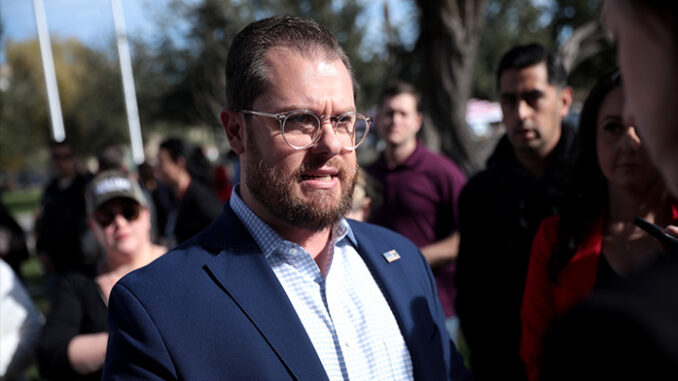
Sen. Jake Hoffman decided to try his hand at bipartisanship, successfully joining with his Democratic colleagues to kill the reform legislation 14-15. (Petersen also was registered as a “no” vote, though it was indicated this was to preserve the potential for reconsideration of the bill, which would require a motion from a member who’d cast a prevailing vote).
Reform talks were reattempted throughout the end of June to early July, with even school choice opponent Gov. Katie Hobbs attempting to salvage the deal, but Hoffman and the Democrats wouldn’t budge, the former disavowing the proposed changes and the latter demanding additional requirements of mandatory testing for students and ending rollovers of unused ESA fund balances in favor of sweeps.
Without that pathway to defeat the Protect Education Act, Republican leadership was forced to come up with an alternative: HCR 2048. As of a court ruling on Wednesday, however, that pathway is also now gone.
The AEA-backed initiative filed more than 420,000 signatures with the secretary of state’s office earlier this month — well beyond the 256,000 threshold to make the ballot. It is likely they will make the ballot.
Should voter sentiments remain consistent to last fall’s polling, by this November it will likely mean that voters will approve their only presented option for ESA guardrails, at the cost of universal admission and private school participation.
Again….Republicans are outsmarted and outmaneuvered by a bunch of open borders, LGBTQ loving psychopaths with the help of one turncoat Republican. Hoffman needs to go!
So, let all the kids be stupid…? They could all turn out like Hoffman.
Well thats what unions do for themselves, the people/kids be damned. TUSD is a prime example of why there needs to be an ESA program. Kids do ot learn anything at a majority of the schools they are provided basically an ATTENDANCE DIPLOMA, Which is to show they sat in a chair for the time limits required to say they are ‘educated’. Many cannot read at grade level or do simple math, science is going to the ua observatory or the local zoo. EAST LA is no different but I dont live up there to really know. I do know when my daughter lied up there she and her husband had to go to the school and tell them what she expected the school to teach. This is a shame and rino’s need to be ID’d and voted out just like the democraps. Their goal is self fulfillment and basically they dont care for anyone/thing but themselves. I guess this will be taken as another ad for the hobbit who claims she single handedly balanced the state budget and made things better. I guess she thinks vetoing over 400 bills is the answer. If you see her ads its never about real accomplishments but dirt throwing against the other guy, same for mazzie she has not had a positive ad on the tube yet and has done nothing for the people of this state. Vote wisely and dont be a gullible traveler.
Jake Hoffman , Randy Kendrick and her minion 😉 own this . People need to start holding those responsible accountable. After the diamondbacks get a massive Tax payer handout for their baseball team , the Kendrick’s throw the finger back at everyone by funding the same people responsible for this!!! Shame on the Kendricks .
Proud to proclaim his is not my senator.
Anywho, ain’t it funny how Democrats are all against “monopolies”, except when a monopoly benefits their ̶v̶o̶t̶i̶n̶g̶ ̶b̶l̶o̶c̶k̶ campaign contributors? Isn’t that something?
Jake’s plan could have worked and he could have made a $#*&load off of the campaign, but once again he got outsmarted. The guy is a grifting loser. Hubris always causes idiots to lose in the end.
Nowhere has School Choice better proven effective and beneficial than Arizona. This false notion of GUARDRAILS is pure hogwash.
This clown is not a real Republican. He’s a RINO and I hope he’s primaried in the next election cycle if he hasn’t been already. I wonder how much the Democrats paid him to join the cause?
You’re no Republican.