
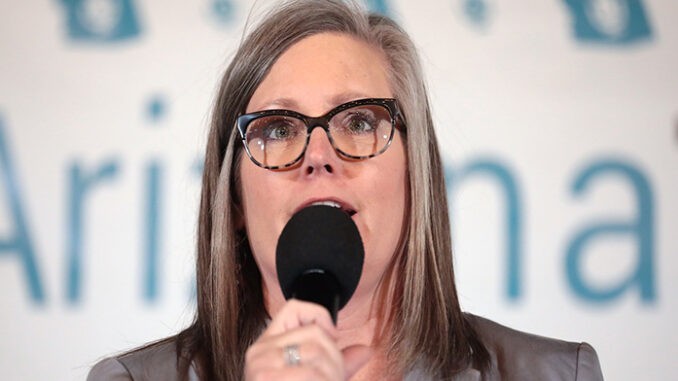
Arizona Gov. Katie Hobbs should debate her Republican opponent, Andy Biggs.
I also understand why she won’t.
Four years ago, Hobbs refused to debate Republican Kari Lake during their race for governor. She took plenty of criticism for it. Reporters repeatedly pressed her to reconsider. Hobbs argued that appearing onstage with Lake would produce a spectacle rather than a useful discussion of the issues.
Then Hobbs won.
The lesson was hard to miss: refusing to debate might generate some bad headlines, but voters may not care enough to punish you for it.
Now Hobbs is running for reelection, and her campaign has announced that she will not debate Biggs. Her campaign says face-to-face interaction with Arizonans is more useful than participating in a forum built around short soundbites and political theater.
There is an awkward wrinkle.
Before the Republican primary was over, Hobbs’s political operation criticized Biggs for skipping a Republican-organized primary debate. At the time, Hobbs herself would not commit to debating the eventual Republican nominee.
That is difficult to square. If Biggs owed Republican voters a debate during the primary, why does Hobbs not owe Arizona voters one during the general election?
But the more important issue is not Hobbs. It is the incentive her decision exposes.
Why debate if voters do not care whether they do?
Politicians respond to incentives, and increasingly those incentives favor staying off the debate stage.
Donald Trump made essentially the same decision during the 2024 Republican presidential primaries. He was the dominant candidate and skipped every debate. His opponents stood onstage arguing with one another while the candidate leading them all decided there was little reason to participate.
He went on to win the Republican nomination easily.
The calculation is simple. A strong debate performance may help a little, an average one may change nothing, and a terrible one can damage a campaign overnight.
The upside is limited. The downside can be enormous.
So why take the risk?
That may sound cynical, but campaign professionals are paid to win elections, not to preserve political traditions.
There is evidence that debates have been disappearing for years. A Brookings Institution analysis of the five most competitive U.S. Senate races found 17 debates in 2010. By 2020, there were seven. In 2022, only six had been held or scheduled when the analysis was published.
If campaigns conclude that debates offer little reward and plenty of risk, fewer debates will happen.
Which raises a harder question: If we really believe debates are important, why do we make refusing them so easy?
We routinely say debates are important. Editorial boards say it. Political opponents say it. Voters say it. Then a candidate refuses, the election arrives, and many of us vote exactly as we would have voted if the debate had taken place.
Campaigns notice.
No one should be expected to vote for a candidate they strongly oppose simply because that candidate agreed to debate. Few voters are going to abandon their views on taxes, abortion, immigration or education over a debate invitation.
But refusing to debate should carry some political cost.
Supporters can object. Editorial boards can make the refusal part of their evaluation. Reporters can keep asking why a candidate seeking public office will not stand next to an opponent and answer the same questions. There has to be something more than a day or two of bad press that everyone knows will soon disappear.
Without that pressure, debates stop being an expected part of running for office and become just another campaign tactic: participate when the potential reward outweighs the risk and decline when it does not.
That is bad for voters.
Campaign appearances are controlled. Advertisements are scripted. Social media posts are polished. Politicians can choose friendly settings and spend much of a campaign talking about the subjects they would prefer to discuss.
A debate takes some of that control away.
For an hour or two, the opponents have to occupy the same space. One can challenge something the other just said. A moderator can press for an answer. Voters can compare not only their policies but how they respond when someone disagrees with them.
Debates are hardly perfect. They can become theatrical. Candidates dodge questions. Moderators sometimes focus on moments that generate attention rather than illuminate policy.
Hobbs made essentially that argument in 2022 when she said a debate with Lake would become a circus.
Perhaps she was right about Lake.
But that cannot become a blanket excuse to decide that an opponent is too theatrical, too dishonest, too extreme or simply not worth debating. If everyone running for office gets to make that decision, the tradition will not survive for long.
No one is entitled to a debate stage.
Voters deserve the chance to see the people asking for their votes challenged in public.
Katie Hobbs should debate Andy Biggs. But if she refuses, I understand the political calculation. She tried it four years ago, and she won.
The uncomfortable truth is that politicians may keep refusing debates for as long as voters keep showing them that they can.
David Falls is a retired Microsoft engineering program manager. His commentary has appeared in the Washington Examiner, RealClearScience, The Space Review, The Humanist, and other publications.
Y’all are so spot on Hobb’s is a weak excuse even for the Dumbocrats! How sad that are young people except people like her unfortunately they are the ones who will lose ultimately because they have so many more years to live with nothing very positive when it comes to property, family, finances and ultimately they’re souls! I hope they wake up before November and vote for the truth!
“That is difficult to square.”
Once you’ve convinced yourself a circle can be a square if that’s how it feels, no volume or pellucidity of cognitive dissonance can ever sour your righteous indignation.
Janet Napolitano debated Len Muncil and got hammered. She subsequently suspended future debates, because she could. The media, of course, was solidly behind her. Hobbs is a weak candidate. She is inarticulate and sounds like a Minnie Mouse Valley Girl. Whether Fontes and the Maricopa Board of Supervisors will deliver for her again is a question. Meanwhile she is counting on advertising and lots of it. Her claim to “meet the people” is BS and we know it. She hides behind the same friendly media that covers for all Democrats.
Candidates need to be taught that no debate means not winning the seat.
Why debate if you think the fix is in
The queen of veto is not smart enough to debate Biggs.
Hobbs won? Hobbs as Secretary of State oversaw a very tainted election then declared herself the winner
Exactly.
It is all the voters’ fault. They should demand debates and should reject those that decline to debate. In Hobb’s part declining to debate is a reflection of her abilities and lack of confidence. She cannot speak, she cannot argue, she is quite dumb and cannot defend her record.
If you know you don’t want the voters to discover what you are all about, you don’t debate.