
By Zachery Schmidt
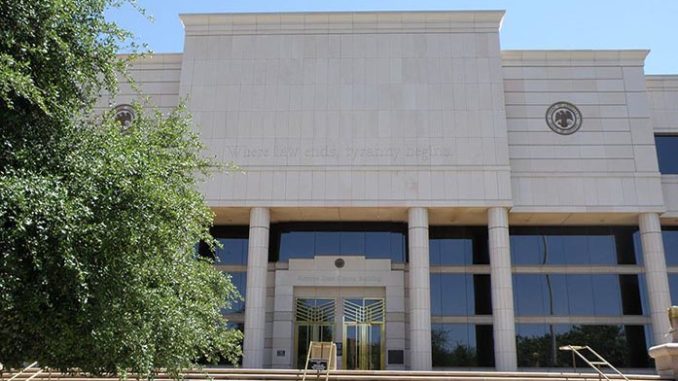
The Arizona Supreme Court will hear a case seeking to determine who qualifies as an engineer in the state.
On March 10, the state Supreme Court will hear arguments in the case of Greg Mills, et al. v. State of Arizona.
Mills has over 30 years of engineering experience and started his own engineering consulting firm, Southwest Engineering Concepts LLC, in 2008.
After Mills operated his company for more than a decade, the Arizona Board of Technical Registration began an investigation into Mills and his company following a customer complaint, court documents said.
According to its website, the board regulates applicants to determine who qualifies as an engineer and other professions.
In May 2019, the ABTR said Mills and his company violated Arizona law by “engaging in ‘engineering practices’ and by advertising their services as ‘engineers’ without first registering” with ABTR, court documents noted.
In an attempt to resolve the conflict, ABTR sent Mills a proposed consent agreement three months later that would have required Mills to pay a “$3,000 fine, assessed investigation costs” and stop his work until he registered with ABTR, court documents stated.
Mills said he and his company did not need to register with the board, so he did not sign the consent agreement, according to court documents.
In October 2019, Mills chose not to meet with ABTR to review the investigation. Thus, ABTR voted to offer Mills another consent agreement with the same terms, except that the fine was doubled to $6,000, court documents noted. Again, Mills refused to sign the consent agreement.
Two months later, Mills, being represented by the Institute for Justice, sued the ABTR, alleging the board’s ruling violated his right to “earn an honest living free from unreasonable, arbitrary, oppressive or monopolistic regulations” guaranteed by the Arizona Constitution.
Mills’ lawsuit reached the state Supreme Court in 2022, which ruled that three of the four constitutional challenges he raised were legally determinable by a court.
Mills refiled the lawsuit and switched the defendant from the ABTR to the state of Arizona.
An Arizona superior court granted the state’s motion to dismiss Mills’ lawsuit, which was then appealed. The Arizona Court of Appeals also ruled against Mills.
After losing at the appeals court level, Mills and his legal team filed an appeal with the state Supreme Court.
The Goldwater Institute filed an amicus brief in support of Mills.
Tim Sandefur, the vice president for the conservative Phoenix think tank’s legal affairs, said Mills’ case is important because the court has indicated it is “thinking about reconsidering old precedents and declaring economic freedom is as important a constitutional right as the freedom of speech or freedom of religion.”
If the Arizona Supreme Court did this, it would “make a big difference because that would mean that wealth creators in our society would have the ability to defend themselves in court,” Sandefur told The Center Square.
Sandefur said the Goldwater Institute’s brief argued the “right to earn a living is a very old right that traces back hundreds of years.”
“There are cases from the 1600s on this exact issue of whether the government can use licensing laws to take away your economic freedom,” Sandefur said.
“ The founding fathers, both of the United States and of Arizona, believed that everybody has this fundamental right to earn a living without unreasonable interference from the government,” he added.
Up until recently, Sandefur said courts have “forgotten about that fact.”
The Goldwater Institute is “urging the justices to remember that and to enforce this as a matter of Arizona state constitutional law,” he said. “Economic liberty is an essential part, if not the definitive part, of what we call the American dream.”
According to the vice president of legal affairs, the issue is that America’s legal system “tends to ignore the rights of business owners and entrepreneurs and people who are trying to earn a living.”
Thus, business owners have a hard time defending themselves in court “when government bureaucracy goes off the rails,” Sandefur told The Center Square.
If a government infringes on people’s First Amendment rights, the court system takes that “very seriously,” Sandefur said. But he added the court tends to look the other way on economic rights.
In America, people should have the “ability to start whatever business” their skills enable, Sandefur said.
“It’s really none of the government’s business to tell people who is and isn’t allowed to practice this trade,” he said. “That should be up to consumers to decide.”
The problem is licensing boards become corrupt and tyrannical.
I believe licensing has a place to establish basic competency which protects society from unqualified practitioners. If anyone can claim professional status, what happens to that protection? Consumers need protection also. Perhaps there should be a status for engineer practitioner – awarded after a review of projects performed.
I am not sure what they are saying in this lawsuit. However, if they are saying the government can’t verify that people in skilled occupations actually have the skills that they claim to have, that’s a problem for me. For instance, I don’t want a plumber who can’t plumb. I don’t want and engineer who can do calculus and build bridges. I don’t want to hire someone who claims these skills but doesn’t have them. That’s fraud. I do want the state to regulate this. I don’t wnat to go to court after they built a bad bridge, They plumbed the coldwater to hot (it happened to my mom, LOL). Etc Etc.
Private associations/firms/universities can do this. Technically, since most of these certifications are either industry standards or the exams are curated by contractors, they already are. All gov does is add multiple layers of unaccountable/unaddressable/mercurial bureaucracy. I could see where, maybe, gov would say this level of profession ‘x’ must pass this test, this level this test, etc., then set forth the standards of those tests and even validate the test templates, but private companies should develop and administer said tests with no further gov interference. Having an insouciant indifferent functionary – in the service of shiftless opportunistic vainglorious politicians – is no guaranty of competent craftsmanship; it’s merely an exercise in paper shuffling and an invitation to corruption.
One complaint?! In other words you pissed off the wrong customer…if that is all it takes without looking at the history of service to all other customers, that’s atrocious! Sounds like someone wanted revenge badly!
“… economic freedom is as important a constitutional right as the freedom of speech or freedom of religion.”
We hold these truths to be self-evident.
Next do freedom of association (in the private sector of course, since no one – not even the Amish – gets to opt-out of associating with the gooberment).
Should be a good test of this newly [realized] legal doctrine.