
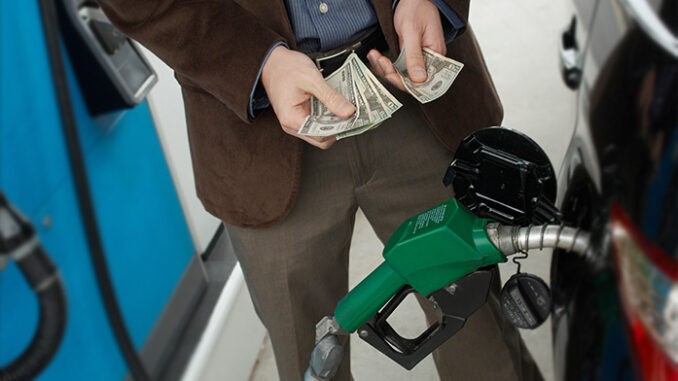
The inflation numbers for April were released by the BLS (Bureau of Labor Statistics) on May 12. Most economists had predicted an increase to 3.7%, but the actual rate was slightly higher at 3.8%. This is the highest increase since May, 2023.
The Producer Price Index, which is an indicator of future inflation also experienced a rise higher than expected, at 1.4%.
The core inflation rate, which excludes volatile items food and energy, was also higher, but only at 2.8%. The food index rise was a modest 3.2%, but the energy index was a whopping 17.9%. This should not come as a surprise to anyone who has put gas in their vehicle’s fuel tank. The cost of a barrel of oil is around $102, an increase of about 78% since January.
| MONTH | ANNUAL RATE OF INFLATION, AL ITEMS | ANNUAL RATE OF INFLATION, EXCLUDING FOOD AND ENERGY | ANNUAL PRODUCER PRICE INDEX |
| APRIL | 3.8 % | 2.8 % | 1.4 % |
| MARCH | 3.3 % | 2.6 % | 0.7 % |
| FEBRUARY | 2.4 % | 2.6 % | 0.6 % |
| JANUARY | 2.5 % | 2.4 % | 0.6 % |
Source: U. S. Bureau of Labor Statistics
Tariffs appear to be having a lesser-than-anticipated effect on inflation, but they are having some effect.
Since the dual role of the Federal Reserve System (FED) is to promote full employment and keep annual inflation as close to 2.0% as possible, it would be fair to ask what the FED is likely to do about the current high inflation rate. The answer is that most likely nothing. The main reason for this is the nature of the current inflationary pressure.
Under normal circumstances, the FED is inclined to lower rates to promote full employment, and to raise rates to slow down the economy and reduce inflation. But these are not normal times.
The spike in the inflation rate that we are seeing is the result of what is commonly referred as “supply shock”. Our economy is suffering from a large, rapid reduction in the supply of oil, resulting from the war in Iran. Most observers agree that the oil supply issue will be temporary and applying the normal inflation remedy, increasing interest rates, will cause more harm than good.
This is the reason why the Bureau of Labor Statistics publishes a second set of inflation figures, the “core inflation” numbers. Core inflation excludes food and energy prices, which are considered volatile and temporary, in favor of a long-term trend. It is this long-term trend that the Fed looks at when determining whether to apply brakes (raise rates), or acceleration (lower rates) to the economy.
Currently, the core inflation rates indicate that the best course of action for the Fed is to do mothing.
That may change by the time the FED’s Federal Open Market Committee (FMOC) meets June 15-16, five days after the May inflation numbers are released. That meeting will occur under the leadership of Kevin Wersh, who took over as Chairman on May 15 when Jerome Powell’s term expired.
That’s not inflation. Inflation is a change in the amount of money in the money supply. Too much money in circulation then the value of money falls. These are indicators. If the indicators have a change in one thing like oil prices, then it affects other items. It doesn’t necessarily affect the money supply. So these are measures, a way to gauge prices and try to determine the inflation rate. blindly looking at these figures and say, well that’s the inflation rate, doesn’t really make sense. BTW: I learned this in a freshman level econ course in college 40 years ago.