
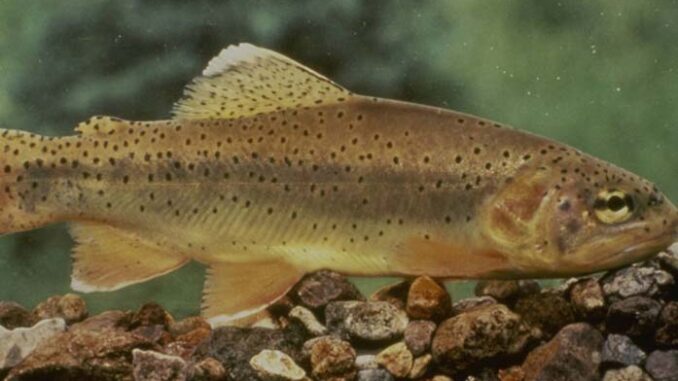
PHOENIX – Five minutes after stepping into a beaver pond on the Little Colorado River, Chase Newlon realized Arizona wasn’t the fishing desert about which he had been warned. The water was cold, the creek was alive and the first fish he pulled from the shadows was an 8‑inch Apache trout, a native species still listed as threatened at the time.
“It was so dumb that I’m freaking out over an 8‑inch fish,” the Phoenix resident said. “But I thought it was the coolest thing… something so rare.”
That moment is exactly what Arizona Game and Fish is trying to replicate this summer – minus the threatened species on the hook, of course – as the high summer temperatures slow down fishing in the Valley and agencies push for anglers to head north.
By July, most Phoenix anglers know the routine as community lakes warm to bathtub temperatures, stocking pauses and trout retreat into survival mode. But even as triple‑digit heat settles over the metro area, Arizona Game and Fish is encouraging residents to get out and fish anyway, just not where they usually do.
“It is a little more difficult, especially in the Valley, to fish,” said Alec Young, Arizona Game and Fish’s angling engagement manager and Trout Unlimited’s angling (R3) manager and coordinator. “Right now, I don’t believe they’re currently stocking anything just because of how hot it is.”
That reality is the starting point for the agency’s summer strategy, which is to redirect anglers out of the Valley and into the state’s Rim Country and even Flagstaff area waters, where cooler temperatures, restored streams and expanded access make fishing not only possible, but often better.
A statewide push to escape the heat
This summer, Game and Fish is leaning heavily on its new Fish 250 Challenge, a statewide initiative tied to the nation’s 250th anniversary. The challenge requires anglers to fish two community waters and five non‑community waters, a structure intentionally designed to push people north.
“Those five are gonna really force you to get out of the Valley,” Young said. “A byproduct of that is to try to see some new spots.”
Once Arizona anglers fish the required waters and submit photos, they receive a limited‑edition commemorative sticker. The challenge runs through August, and Young said submissions have been steady despite the heat.
Other programs, including the Arizona Trout Challenge and Arizona Bass Challenge, also encourage anglers to explore the state’s cold‑water and warm‑water fisheries. Meanwhile, Game and Fish’s FishAZ Network, part of its R3 (recruit, retain, reactivate) initiative, hosts workshops, clinics and partner events statewide, making it easier for new anglers to learn skills and find places to fish.
Young said the rise of social media has also accelerated participation among Arizona youth.
“The generation that grew up with social media is at the age where they’re able to fish on their own, make YouTube channels,” he said. “It’s giving people a way to get fishing information specific to Arizona.”
Conservation work makes summer fishing possible
The push north isn’t just about cooler temperatures and unique fishing opportunities. It’s also about water. In Arizona, water depends on conservation work that most anglers never see.
“We’re in the water savings, water quality, water business,” said Nate Rees, Trout Unlimited’s Arizona state lead. “And then a byproduct is it also makes good fishing habitat.”
Trout Unlimited’s restoration projects focus on reconnecting streams to their floodplains through a process that slows water, raises water tables and allows meadows to act like sponges. During winter and spring runoff, restored meadows absorb water and release it slowly through the dry months, providing more consistent flows in May, June and early July.
“We slow down the water, we raise the water table up, and then we reconnect it to the floodplain,” Rees said. “It releases slower throughout the calendar year.”
The work is a response to long‑term damage caused by the 2011 Wallow Fire, a wildfire that started in the White Mountains near Alpine on May 29, 2011, consuming 538,049 acres. The aftermath resulted in many high‑country streams becoming deeply channelized, filled with sediment and disconnected from their floodplains, which in turn caused trout habitats to collapse.
TU’s projects, including wood‑jam structures, beaver‑dam analogs, sod plugs, riparian plantings and elk‑exclosure fencing, aim to rebuild those systems. A recent culvert‑replacement project on White Mountain Apache tribal lands replaced three undersized, perched culverts with bottomless aluminum arches, reconnecting 9.3 miles of trout habitat and allowing fish to move upstream into colder water during the summer.
“That was a big problem,” Rees said. “Trout were trying to swim up during these hotter, drier months to colder water and they would hit these barriers.”
TU’s work also benefits the Valley as many of the restored streams feed the Salt River watershed, which supplies Phoenix’s water. The organization’s youth programs add another aspect to the statewide effort. Their Trout in the Classroom program places tanks and curriculum in 40 schools, allowing students to raise trout from eggs while learning about water chemistry and habitat science. They also host weeklong fish camps, which teach fly casting, fly tying, entomology and water‑quality testing.
“They learn everything… the life cycle, the food cycle, the habitat fish need,” Rees said.
Anglers adapt to discover a different Arizona
For anglers such as Newlon, who moved from Colorado in 2022, Arizona’s fishing scene is far more diverse than outsiders expect.
“No one ever really talks about Arizona’s high country,” he said. “We have a lot of high-elevation cold water… a lot more trout species than I ever expected. It’s enough of a drive to get you out of Phoenix, but not too much to where you’re spending all day in a car.”
Newlon, who works part‑time at AZ Fly Shop, said he’s watched the fishing community grow steadily.
“It surprises me how many people come into the shop… always new people coming in,” he said. “I think the trout challenge is an awesome challenge. It gives people a good starting point.”
But summer requires adaptation, and when high‑country trout begin to stress, Newlon shifts to warm‑water species.
“I kind of give the trout a little bit of a break,” he said. “I switch my target more to bass, and I actually love to fly fish for carp.”
Carp in the Valley’s SRP canals and community fishing waters offer a uniquely Arizona experience.
“There’s not very many places where you can drive 10 minutes from your house and go catch a 40‑pound fish,” he said.
Newlon also volunteers on habitat projects and has backpacked Gila and Apache trout into remote creeks, contributing not only to recreation but also to the restoration of the state’s fishing scene.
The limits and the opportunity
Arizona will never have abundant water. Stocking will always be seasonal and summer fishing in the Valley will always be tough.
“My only complaint is… there’s not more water,” Newlon said. “But that’s the reality of living in the desert.”
Still, the combination of statewide challenges, conservation work and angler adaptation has created a summer fishing season that looks different than it did a decade ago.
In the Valley, summer fishing stalls out. But in the Rim Country and Flagstaff area creeks, meadows and restored streams that feed Arizona’s rivers, anglers keep finding cold water, wild trout and a reason to escape the heat.