
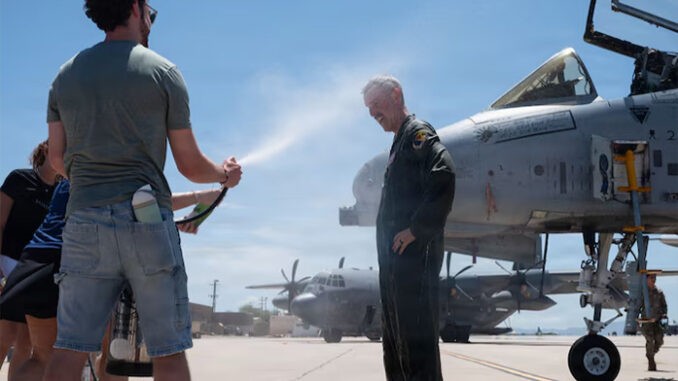
Just days before A-10s took their fini flight at Davis-Monthan AFB, Arizona Congressman Abe Hamadeh introduced the bipartisan Bolstering Recognition, Resurgence, Retention, and Remembrance of the Thunderbolt (BRRRRT) Act, legislation aimed at preserving the A-10 Thunderbolt II mission.
Hamadeh’s legislation aims to ensure that U.S. warriors who serve on the front lines have the most lethal close air support until a certified replacement is operational.
The BRRRRT Act, named after the “Brrrrrrrrt,” sound the aircraft makes when striking enemy forces while providing close air support (CAS), requires the U.S. Air Force to maintain the aircraft through Fiscal Year 2033.
RELATED ARTICLE:
A-10: The most terrifying yet beautiful sound I have ever heard
According to Hamadeh, the A-10 Thunderbolt II has served as the backbone of the U.S. Air Force’s close air support mission for more than four decades, earning a reputation as a trusted platform for protecting American troops on the battlefield.
In April 2026, at the request of President Donald Trump and Defense Secretary Pete Hegseth, the Secretary of the Air Force announced that the Air Force will keep the A-10 Thunderbolt II flying through 2030.
According to the military, the Air Force “plans to extend two squadrons of A-10s to 2030, one active-duty squadron at Moody AFB and one reserve squadron at Whiteman AFB.”
While the Air Force has committed to maintaining the aircraft through Fiscal Year 2030, current plans risk reducing critical training and maintenance capacity before a certified replacement capability is available.
On July 29, Airmen and local civic leaders gathered at Davis-Monthan Air Force Base to witness the aircraft’s final flight, marking the end of nearly five decades of A-10 operations at the installation.
The flight served as both a celebration and a farewell, honoring an aircraft that became synonymous with the 355th Wing and its close air support mission.
“The reason the A-10 flies, and the reason why our enemies are afraid of that, is because of the level of support every single Airman in all career fields gives to make sure that platform departs and comes back safely,” Anderson said.
For nearly five decades, the A-10 has provided support to ground forces in some of the most austere operational environments in the world.
“We’ve always had A-10s on the ramp; for the last 50 years they’ve been on the ramp,” said Lt. Col. Rodney Dwyer, 355th Operations Group commander. “To see the sunshades get torn down, to see the jets divest, fewer and fewer A-10s out there … it’s definitely bittersweet.”
The Warthog’s mission at Davis-Monthan had ended. Still, the legacy created by the Airmen who flew, maintained and supported the aircraft will remain woven into the history of the base and the Tucson community for generations to come, say supporters.
“I got out of the aircraft and went over to him [Dwyer] and told him, ‘I don’t want to do this, man. I don’t want to,'” Lt. Col. Ryan Rutter, 357th Fighter Squadron commander, said. “It’s tough, and I think a lot of it is you’ve just spent years being part of this team and flying this aircraft all over the world and building friends and relationships in the community. So, when you shut down the jet for the last time, it’s that realization that some of that will change, some of that will go away.”
“The A-10 has repeatedly proven itself on the battlefield, saving American lives and delivering unmatched close air support when our troops need it most,” said Congressman Hamadeh. “The BRRRRT Act ensures we do not retire a proven weapons system before a certified replacement exists. This is about common sense, national security, and keeping faith with the men and women who depend on the A-10 in combat.”
Best bill name, ever. 😀
Special Forces units are coming in numbers
If they are going to decommission theses beasts do you think the possibility of allowing it into civilian hands or even possibly for law emforcement use might be possible? Seems like a waste to put these things out to pasture.
Civilian? Yes. For LE? That’s literally insane. To be clear, I totally support the death penalty, just not _before_ the trial.
One aspect that our Leader overlook is the possibility of an Israel October 7th style Terrorist Attack.
The use of armed Drones for Military strikes has proven to take advantage of current military strategies that have no plans on dealing with armed Drones or Ultralight Aircraft. A Patriot-style Anti-Aircraft defense system cannot eliminate a slow moving Drone or Aircraft.
Currently the U.S. has ZERO Law Enforcement Aircraft on the Border that has ANY Armament, (with the exception of the USCG HITRON Helicopters stationed in Florida).
In the event of a repeat of an Oct 7th style armed border invasion it’ll take the Military over 1 hour to respond by Air. By then the armed invasion will be well inland and will take many lives.
We need A-10 aircraft to remain in Arizona so that Arizona has the ability of a Rapid Aviation Response to an armed border invasion.
Its just a matter of time that the U.S. will have to deal ared Drones/Ultralight Aircraft during an Oct. 7th-style armed invasion.
Lets keep our A-10’s at the ready to protect our Borders.
Hamadeh is now the troops’ best friend.
Only the scum generals who stand to make money in the defense industry have heartburn with the warthog.
It’s a shame these planes are retiring. Nothing in our current arsenal as struck fear in the hearts of our enemies like the A-10 and we have nothing to replace it that can do he job the A-10’a did.
I remember as a boy my mm Datong one of the pilots when they first arrived and he used to joke the A-10’s were he only plane n the air that took bird strikes from the rear. I’m going to miss seeing them fly over head and can’t help but feel he US s a little less safe with their retiring
what replaces the A-10 ?
What happen to the TUCCONO platform they once touted as the prop version ?
I’ve seen some wings come and go living near the base.. will DM phase out? Perhaps not the bone yard – but I don’t see another mission coming..