
Mesa Sign Shop owner and Gilbert councilman Jim Torgeson is defending his decision to refuse a sign order from a controversial political organization, saying he will not allow his business to be associated with messaging he believes promotes hatred.
Torgeson, widely known throughout Arizona political circles as the “Sign King,” has built a reputation for producing campaign signs for candidates and political organizations across the political spectrum. However, a recent dispute with Republicans United LLC has placed the longtime sign maker at the center of a controversy over free speech, business rights and the limits of political messaging.
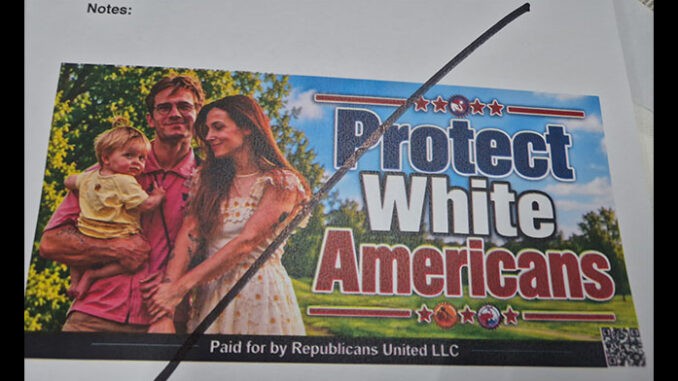
The dispute began when Republicans United LLC attempted to purchase signs featuring the words “Protect White Americans” alongside an image of what appears to be a white family of three.
Unlike traditional campaign signs, the proposed signs made no reference to a candidate, ballot proposition, bond measure, or override appearing on Arizona ballots. Instead, they featured a broad racial message with no apparent connection to the upcoming election.
Torgeson declined to produce the signs, explaining that he was unwilling to associate his business with messaging he believed could promote hatred or target people based on their identity.
That decision prompted criticism from Kevin Decuyp, who is associated with Republicans United LLC and threatened on social media to file a complaint against Torgeson.
Decuyp also posted a negative review on Yelp, accusing Mesa Sign Shop of accepting payment for the order and failing to communicate its objections for more than three weeks.
“After over 3 weeks since paying for a sign order I have finally received communication from this business,” Decuyp wrote.
According to Decuyp, Torgeson claimed that information had been omitted from the original order, an assertion Decuyp disputed. He maintained that the artwork had been submitted in both PNG and PDF formats and questioned why the business had not raised concerns earlier.
Decuyp also suggested he would be willing to change the wording to simply read “Protect Americans” in an effort to resolve the dispute.
Torgeson, who also serves on the Gilbert Town Council, responded publicly, disputing Decuyp’s account and explaining the sequence of events.
“This review leaves out an important part of what occurred,” Torgeson wrote. “You requested an invoice and chose to pay it before providing us with the artwork for the signs.”
Torgeson said the business did not have an opportunity to evaluate the message until after the artwork was submitted.
“Once the artwork was submitted, we reviewed the actual content and determined that we were not comfortable producing or associating Mesa Sign Shop with that message,” he explained. “It would also open us up to be a target by associating ourselves with your message.”
He emphasized that Mesa Sign Shop routinely serves candidates and organizations with differing political beliefs and does not require customers to share his personal views.
However, he said the business reserves the right to reject material it considers objectionable.
“We don’t require customers to share our personal or political views. However, there are lines we are not willing to cross, and we reserve the right to decline work containing messaging that we believe promotes hatred or attacks people based on who they are.”
Torgeson also disputed suggestions that the business had improperly retained payment. He said a refund check was mailed to the address provided after the order was rejected, although problems with the customer’s contact information complicated the process.
“Declining to print material we fundamentally object to is a business decision I stand behind,” Torgeson wrote. “Your payment was returned, and no signs were produced.”
He concluded with an unequivocal defense of his decision.
“I wish you well, but Mesa Sign Shop will not knowingly put its name, equipment, or employees behind messaging we believe promotes hate.”
The dispute raises questions about the distinction between political expression and a private business owner’s right to determine what messages the business will produce.
“To any objective observer, these signs are not campaign signs, and Torgeson has every right to refuse business,” one attorney told the Arizona Daily Independent.
Republicans United LLC has generated controversy within Arizona Republican politics. The organization has been described by critics as a fringe operation, with some drawing comparisons to the rhetoric associated with former Ku Klux Klan leader David Duke.
Its founder, Jennifer Harrison, has faced controversy of her own. Harrison was arrested in 2022 following an incident involving protesters in Tempe, where she was accused of spraying demonstrators with pepper spray or bear spray. The incident resulted in allegations of disorderly conduct and assault.
Despite its attempt at Republican branding, the organization has no official affiliation with the Republican Party in Arizona and is not invited to participate in any of the Party’s work.
According to one GOP consultant, the group seeks publicity via outrageous messaging, and Torgeson did both a smart thing and the right thing by not participating. “This crew wants to be inflammatory so they can get publicity, and they want to do damage to the GOP brand, so what better time to start racist garbage than right when ballots are coming out? The media would pile on, Republicans would get smeared, and these losers would be high-fiving each other in their mom’s basement. I say well done, Jim Torgeson, for refusing to profit from divisive and hateful garbage.”
For Torgeson, the issue is considerably simpler: Running a business that produces political signs does not mean surrendering the right to reject messages he believes cross a line.
His position is that political organizations remain free to express their views, but that freedom does not automatically obligate a private sign maker to reproduce them.
And for Arizona’s “Sign King,” that is a business decision he is prepared to defend.
Be the first to comment