
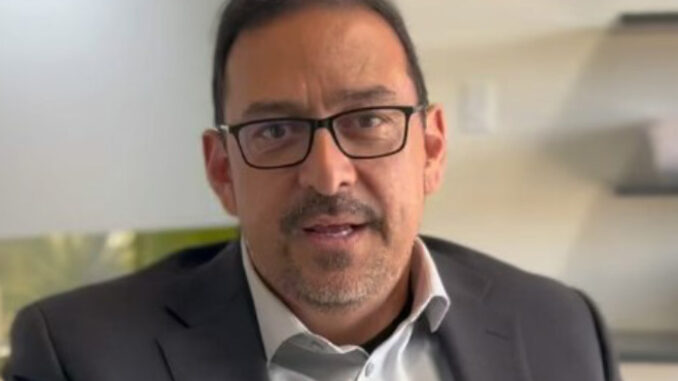
Secretary of State Adrian Fontes will not be giving the Department of Justice (DOJ) the state’s complete voter registration database.
On Tuesday, Fontes announced he was denying the DOJ’s request on the basis of concerns that the Trump administration cannot securely handle voter registration data.
“It’s my job to ensure Arizona’s elections are safe and secure,” said Fontes. “That includes protecting the sensitive personal data of our 4.5 million registered voters.”
It’s my job to ensure Arizona's elections are safe and secure. That includes protecting the sensitive personal data of our 4.5 million registered voters.https://t.co/hE2v2cRY3b
— Arizona Secretary of State (@AZSecretary) September 2, 2025
“We’re going to fight as far as we have to against this,” said Fontes. “I’m not going to give up the personal identifying information of my voters. It’s just not going to happen.”
Fontes’ handling of voter data has come under scrutiny in recent months.
Earlier this summer, the secretary of state’s office sustained a data breach to its candidate campaign portal believed to have been carried out by Iranian hackers. The Arizona Department of Homeland Security is investigating the cyberattack, which occurred several days after the U.S. bombed Iran. Per Fontes, the voter registration database was not compromised by the attack, although candidates’ sensitive personal data may have been accessed.
The cyberattack resulted in the change of multiple candidate profile photos to display the Iranian revolutionary and Islamic republic leader Ayatollah Ruhollah Khomeini. State cybersecurity officials disclosed that hackers attempted to gain entry to other Arizona agencies without success.
Fontes’ office blamed the attack on a lack of funding for modernizing security features.
In that instance as well, Fontes refused to contact the Trump administration.
This more recent refusal of the Trump administration came about a month after the DOJ initially sent their request letter to the state.
This most recent letter was preceded by an earlier, separate letter in May from the DOJ warning the state to comply with voter identity verification law (the Help America Vote Act of 2002) by accepting a partial Social Security number only from individuals who lack a driver’s license number or nonoperating license number. That same letter asked Fontes to cross-reference all registered voters in the voter registration database who provided the last four of their Social Security number on their voter registration application against Arizona Department of Transportation Motor Vehicle Division database information to identify noncitizens.
Fontes submitted a response letter to the DOJ in June declaring the state already complies with HAVA requirements, implying they would not be conducting a database cross-reference and submitting a report within 90 days as requested.
The DOJ outreach aligns with President Donald Trump’s executive order given in March to ensure elections were protected from noncitizen voting. In that order, Trump directed the DOJ to enter into information-sharing agreements with each state’s chief election official or agency. As part of these agreements, the DOJ would obtain information on violators of election laws.
Per the executive order, states unwilling to enter such an information-sharing agreement would be subject to DOJ enforcement actions and withholding of grants and other funds.
On Saturday, Trump announced he plans to issue an executive order requiring voter ID and severely restricting mail-in ballots.