
The July 5th edition of the Wall Street Journal had an article on Santa Monica, California, titled, “On the California Coast, a Picture-Perfect City Falls on Hard Times.”
Tucson could learn some lessons from the article.
First, a personal note: Decades ago, I used to love visiting Santa Monica, other parts of Southern California, and San Francisco. I even proposed to Kim at Ghirardelli Square in S.F.
I was in awe of California’s climate, natural beauty and even the spotless freeways with their ivy-covered shoulders. That was especially the case when I lived and worked in Chicago and then metro New York and would travel to the Golden State for business and pleasure.
At the time, New York City was still a dystopia and hadn’t yet been cleaned up by Mayor Giuliani. As such, there was a sharp contrast between it and L.A and S.F.
However, as NYC was subsequently cleaned up, the California cities started going downhill rapidly. Their positive contrast with NYC began diminishing and eventually reversed.
Back to the WSJ article: It claimed that Santa Monica’s troubles are due to restaurants and bars closing during Covid, to the 3rd Street Promenade no longer being trendy, to the nearby Palisades fire, and to Trump’s policies hurting tourism.
Readers disagreed, especially those who live in Santa Monica. In the comments section following the article, they said that the city suffers from a one-party government that has allowed and even encouraged the festering problems of homelessness, vagrancy, public disorder, seediness, and littered streets and public places.
In other words, a pretty natural setting can’t overcome a bad government, a bad image, and bad upkeep.
In case Tucson’s leaders don’t believe it, comments by readers of the WSJ article might convince them otherwise. Below are representative comments. My closing thoughts follow the comments.
Jacob B
The homeless issue is massive here yet it only gets one sentence. Here and Venice they’ve taken overRamin Amirnovin
There’s nothing nice about having a homeless person pee in front of your children while you’re on vacation. And I live here.Ken Smotrys
Started with Covid??? How ‘bout over 4 decades ago.Michael Bomya
Who would have ever thought that allowing public lawlessness would affect tourism?Robert Papp
Santa Monica is one of the most beautiful places on the planet, beaches, perfect weather. It takes epic gross mismanagement to screw it up, but the city leaders have managed such a feat. Congrats!LR Center
I left CA for Orlando in May. It’s wonderful here. It’s clean. No graffiti. No open-air drug use. No weeds. No vagrants. No potholes. Great restaurants. Nice people. And FL provides basic municipal services for vastly less cost than CA. And BTW NO STATE TAX. So if you are in CA consider FL.Scott Davis
The reporter’s bias is obvious. International tourists haven’t stopped coming because of Trump; rather, they stopped coming because they kept getting shot.Soheil Younai
I have been going to SM pier on a regular basis for the last 4 years. the Issue is the trash, homeless, and lawlessness. The police and public workers are not allowed to move or do anything. The problem is the SM city and its board members that don’t value public safety and economic revival. As long as there is rampant homelessness in SM there will be no change.Brad Z
Bums, bums, and more bums. That’s why businesses and tourists have stayed away.David Lim
Santa Monica and San Francisco are prime examples of what happens when the liberals decide crime and theft is acceptable. The woke belief that open drug use is humane and homelessness is a human right will not attract tourists or residents. CA needs to suffer the consequences.Robert Krantz
Yes, pretty much self-inflicted. And likely to be repeated.JOHN JEFFS
Emblematic of LA in general. Nothing to see anymore, just garbage, homeless, and corrupt government.Marion W
Don’t forget fires set by homeless people.CYNTHIA H
I was a sixty-year resident of Los Angeles and spent several years living adjacent to Santa Monica, commonly known in L.A. as “the people’s republic of Santa Monica”. Santa Monica had been for decades a mixture of monied hippies, social-security dependent elderly and homeless. Santa Monica was also rent-controlled for decades, so housing was scarce. I lived in a dump of an apartment near Santa Monica because it was all I could afford. No one ever moved because landlords could not raise the rent. SM passed all sorts of super progressive laws before it became “fashionable.” Smoking was banned in SM but open drug use is not. Homelessness became an overwhelming issue because SM council did nothing to curtail it or clean it up. Begging and sleeping on pedestrian sidewalks is commonplace. One puts his or her life on the line just walking down the street. SM is dirty and crime ridden. I fully understand why retail has left. And by the way, the beaches which were my haven in my youth are full of dangerous homeless. I can’t foresee a comeback in the near future.Peter Wolf
Anyone who has been visiting Santa Monica steadily since the late 1970’s knows perfectly well what ails the city. It’s the same thing afflicting many California coastal cities. Transients. Transients by the tens of thousands. Whacked out druggies. Homeless encampments everywhere. These problems long predate Covid or the Palisades fires.Look at Long Beach. A city with a terrific beach and waterfront and aquarium, etc. No tourism. Why? Because of the transients everywhere. Same problem along the beaches in Santa Barbara, Laguna Beach, etc. In fact, luxury hotels south of Laguna warn their guests not to visit Laguna because of the mobs of homeless.
So if these cities want to restore their economies then sweep the transients out!!
JOHN ERICKSON
Wow! Who ever thought that public safety and pro-business policies might be related to prosperity? What a concept!Dr Water
Santa Monica should be one of the most attractive public spaces in Southern California. The ocean views, walkability, and climate are extraordinary. But the experience on the ground has deteriorated badly. Large parts of the area now feel dominated by homelessness, unregulated street vending, loud portable speakers, and a general lack of civic order.The result is a place that should feel welcoming but often feels chaotic and unpleasant. Visitors can still appreciate the natural beauty, but it is increasingly hard to ignore how much the public environment has declined. Santa Monica’s problem is not a lack of scenery; it is a failure of basic governance, enforcement, and stewardship.
Paul McMurry
Visited a friend in LA last year and I was shocked by the amount of litter absolutely everywhere.Thomas Martin
Single Party System of Govt. Oh let me guess it’s someone else’s fault.
If the foregoing comments aren’t enough to convince Tucson’s leaders of the importance of good government, image and upkeep, they should take one of the drives that visitors from out of town take from the Tucson airport to their hotel.
A particularly educational drive would be the one from the airport to the Loews Ventana Canyon Resort, which is in the Foothills and is where many corporate conferences are held. The route is a fair representation of Tucson, because it doesn’t go through the worst part of town or the best part of town
The quickest and most direct route from the airport to the resort is to take Valencia east to Golf Links, Golf Links east to Alvernon, Alvernon north to 22nd St., 22nd St. east to Craycroft, Craycroft north to where it becomes Kolb, and Kolb to the resort.
Seventy-five percent of the 19-mile drive varies from ugly to forlorn to shabby to seedy to dystopian.
Many parts are also extremely dangerous, due to a deadly mix of impaired drivers exceeding the speed limit, stoned pedestrians ignoring crosswalks, crazed motorcyclists without helmets zigzagging in traffic, people with a death wish riding on the shoulder in motorized wheelchairs and motor bikes, and panhandlers standing in medians and on corners, sometimes with a suffering pet dog panting in the heat.
Fortunately, the 100-acre shantytown on Golf Links has finally been cleared of the homeless and the corresponding tons of debris, trash, and human and pet waste.
Where did the former residents of the shantytown go? They probably took a free ride on a Tucson bus to other popular hangouts of the homeless, such as Craycroft and Broadway, Craycroft and Speedway, and Craycroft and Grant next to the Tucson Medical Center.
Craycroft and the Rillito River is also a popular spot, because many homeless live in the dry river bottom or along the Loop bike/walk path. Some even live in a culvert across from an attractive shopping center anchored by a Whole Foods, at Craycroft and River Rd.
It is not known if the homeless are noticed by the petite bleached-blonde women with Botox lips who drive their humongous Land Rovers and lips to Whole Foods.
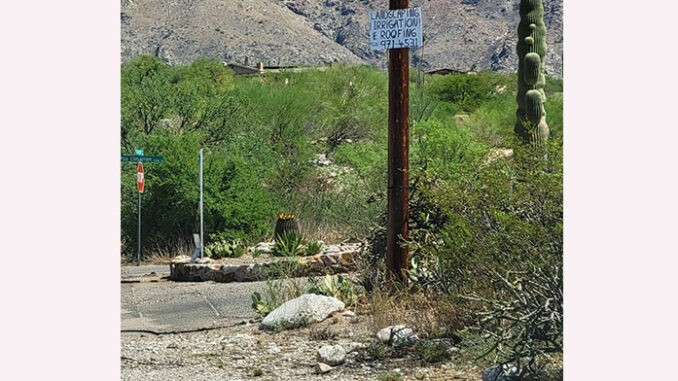
By this point in the journey to the resort, one begins to wonder if there are ordinances in Tucson that prohibit the beautification of streets and private property, the installation of attractive commercial signage, and the removal of weeds, trash, litter, and tacky advertising signs lashed to traffic signs or planted on the roadside.
The sights and scenery improve as Craycroft climbs into the Foothills. There are not any commercial eyesores, and the Catalina mountains are pretty. Even the city looks pretty from that distance and elevation, especially at night. But streetscaping and street maintenance are not aesthetically pleasing. To wit.
At least the last two miles to the resort are kept clean of litter, trash and illegal signs. That’s because Kim and I keep it that way.
One time, a local resident gave us a disapproving look and asked why we bother. Fortunately for him, my testosterone level has diminished with age. Instead of responding as I would’ve in my youth, I smiled and calmly said, “Because neither the county nor anyone else will.”
If I’m asked again, I’ll respond, “Because I don’t want Tucson to go the way of Santa Monica.”
Mr. Cantoni is an author, activist and retired executive. Contact: [email protected].
I lived in Tucson for 50 years from 1967. It has turned into a total dump. I left as a ‘political refugee’ from the communist Grijalvalistas. About once per year I do visit and stay at the Lodge at Ventana Canyon and do everything I can not to drive into the city.
What are you doing to make Tucson better, Craig. So far I just see complaining from your foothills suburban home. Remember, you chose to live here.
Hey Hank857 at least Trump didnt take Graft and Bribes like Hunter and Joe. Trrump is an International Businessman who is also THE FIRST PRESIDENT NOT TO TAKE A PRESIDENTIAL SALARY. Liberals ignore this fact
The DOJ even let them keep all the illegal money without paying any federal tax.
Id suggest you do a little factual research about Trump and not listen to the Fake News.
All Americans have to do is use a the Stock Market as the Thermometer of how each political party is performing. Track the performance of the Stock Market and 401(k) account balances will tell you if the Politicians in power are doing well for the People.
Historically almost every time the Democrats have a President since 1968 the Stock Market and 401(k) Accounts CRASH and retirement accounts lose badly.
We have a successful Businessman as the current President of the USA. This is not a popularity contest, its a job to make America Strong and its Economy wealthy. But the Liberals hate our President and hate our Country.
Liberalism should be a diagnosis of Mental Illness. Any Political Party that advocates and supports the mutilation of children’s’ genitalia, supports Antifa destroying Cities are proof of a prima facia Mental Illness.
American needs to build a strong society. Lets bring back the Military Draft. A mandatory 2 year stint in the Military (as several other Countries require) at 18 will teach Kids how to stand on their own two feet; Be self sufficient; Learn. Skill/Trade and; have VA Benefits for Life.
Some Kids just turn out as Strong Americans and others might like the Military Life and make it a 20 year career.
I left the Ghetto at 18, leaving the Violence,the Drugs behind and then spent 20+ years in government service. I traveled the World, which taught me a fine appreciation of what we have in America.
I owe a debt to America, as they helped make the God-fearing Productive American I am today.
We don’t need mandatory military service to “make good citizens” out of people, by then it’s too late. The military doesn’t want draftees, they just continue their dysfunctional behavior until they get a less then honorable discharge. The military doesn’t teach a skilled trade, they teach you how to be a soldier.
We need educational reform, not a larger military.
yes we have problems and there are more things involved. The single party gov’t is a prime issue but the low ignorant voters that rely on the government just keep them in power. I think the letter writer has a high sense of self worth, Ive been up where he is implying that things are nicer. Yes some small sections are clean but many are just like the rest of tucson. The foothills are always referenced with aw, but look close and like his beloed snotsdale there are places in the high $$ that resemble the rest of the area. I have lived in kalif my dad was stationed at hamilton AFB we were there for 3-4 years, we like to go to laganitas and out to buy fresh oysters but them I went back for a visit in 1970 and it was on the downhill slide. Ashbury was nothing but a drug area and a hookers paradise. The army sent me to school at USC and that area of LA was getting much like all the other supposed ‘beautiful’ cities. Best thing I remember was at ft macarther when I saw a Beautiful SPECILIST 4 crossing the street. We have gone back on trips enjoyed being away from the cities but that has all changed now also.
No tucson will never improve with the crap that is allowed, he complains about people on the streets, panhandling, and a lot is due to the same issue of lack of enforcement of things. I think tucson still may have a ruling on panhandlers having to wear safety vests, not sure but cops roll by without even looking. traffic laws are not enforced and nightly we hear the street racers sometimes followed by sirens for fire trucks ambulances. They didnt clean the homeless camp on golflinks they just shut it down for ‘improvements’ yet nothing other than signs has been done. The city has large open spaces so if homelessness is such an issue with them they can use the land to shelter them. Get the cargo containers that were on the border set them up spry on insulation add some central coolers and the portable restrooms like the feds have and that the local frys had when doing restroom R&R in the store. A 40 ft container could be divided into rooms and made available and the ‘homeless’ put to work keeping the streets and areas clean. In korea I saw people working to make enough to eat daily. 3 man shovel teams but like everything else our way of life got rid of that life. Then there is the newscum issue, it always someone elses problem. but he is still a despised MILLIONAIRE who is only trying to get richer as a FEDERAL politician.
Liberals ruin everything, they can’t see past their short sighted intentions.