
A Chicago gym, a basketball and a young Charlie Kirk were quite the triad.
Whether it was catching a skip pass to the corner and letting it fly in coverage or flashing to the elbow on a side-out-of-bounds play, Kirk was cash off the pull-up. He could even hit from the block while falling away.
Kirk was a promising athlete with a love for politics from the Chicago suburbs.
Sociable and smart, the student could have chosen a handful of careers, but just after high school, he helped launch Turning Point USA, a nonprofit organization that advocates for conservative politics.
Seven years later, he relocated it to Phoenix, established a campus and settled in. He made the city a TPUSA hub.
What he didn’t know, though, was that his nonprofit would spread to more than 3,500 school campuses, and that he’d travel around the country hosting “Prove Me Wrong,” a debate-style conversation where he would speak to anyone at the microphone. Kirk and his influence were also credited by many with playing a major role in the recent election of President Donald Trump.
But Kirk’s more than a decade-long journey with TPUSA ended quicker than expected. He was assassinated during a “Prove Me Wrong” debate on his American Comeback Tour while at Utah Valley University on Sept. 10, 2025. Later that month, his memorial at State Farm Stadium in Glendale, Arizona, hit capacity with 200,000 people in attendance. In that crowd were major conservative and political figures including President Trump, Vice President JD Vance and Speaker of the House Mike Johnson.
But his death didn’t just shake his conservative colleagues; it impacted many corners of the world.
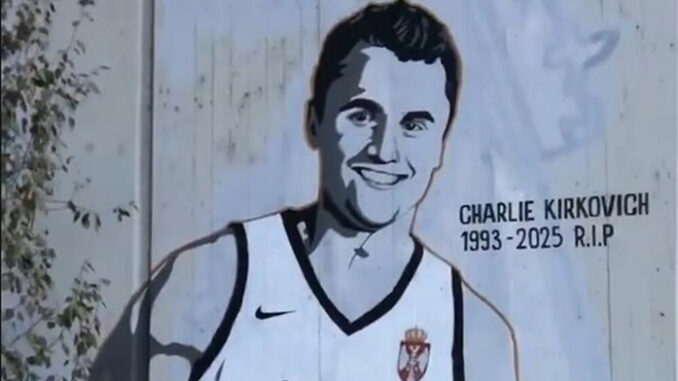
One of those corners was 6,000 miles away in Belgrade, the capital of Serbia, a country that has historically sat at a cultural crossroads. An artist, upon hearing the news, decided to paint a mural of Kirk. The controversial conservative kingmaker was depicted in an Illinois White Eagles basketball uniform.
“I grew up with a lot of Serbs in Chicago, I have a soft spot for Serbs, they’re awesome,” Kirk said on his podcast, “The Charlie Kirk Show.” “I played on a Serbian basketball team, actually, my name was Ševa Kurković, I kid you not, I have a jersey that says Kurković.”
Although the exact spelling is unclear, the nickname reflects his connection to the community.
His assassination – and its resonance on the other side of the globe – brought back memories for thousands who fled ethnic violence in a brutal civil war. The refugee program that brought them from the former Yugoslavia to Phoenix provided them a second chance, and those who decided to stay have built a home in the desert.
Fleeing the former republic also taught them valuable lessons for a country that is going through, as Kirk’s assassination showed, uncomfortable levels of polarization and political violence.
Phoenix, and Arizona as a whole, have several ties to that region, especially in the state’s storied mining industry – but from the 1990s to the mid-2000s, the city became a haven for people fleeing genocide and ethnic cleansing in the former Yugoslavia.
The Arizona Refugee Resettlement Program ferried thousands of refugees to safety in the Valley through its partner Local Resettlement Agencies.
The portrait under a Bridge in Belgrade
Kirk’s team’s mascot, a White Eagle, pays tribute to the coat of arms of Serbia, which is centered around a double-headed white eagle. For Danko Šipka, a professor of Slavic languages and applied linguistics at ASU, it’s no real surprise that the mural was painted in Belgrade.
But shortly after it was painted, it was vandalized. That was no shock either. It’s a city with a very “active” mural scene, he said.
It’s common for residents to express their emotions and ideas through mural work, he said. It seems to be just as common that those works are covered or vandalized by someone with opposing views.
Like Kirk, other political figures, such as Russian President Vladimir Putin or former Serbian generals, have murals painted of them. Those are sometimes vandalized, too. Often, the work depicts an artist’s favorite sports team, which vandals, often a fan of the team’s rival, then deface.
“It gives a certain touch and feel to the city,” he said. “These murals that are very diversified, as I noted, some of them might have prevalence in political disputes, but many of them do not have that problem. They’re just artistic expressions of something.”
Šipka said it is no surprise Kirk was depicted in a basketball jersey in the basketball-crazed country. Kirk grew up in Chicago, one of the largest Serbian hubs in North America. He was beloved by his teammates of Serbian origin, partly for his silky jumpshot, but also for his sense of camaraderie.
Serbia, the former Yugoslavia and Europe as a whole have produced many of the best basketball players on the planet. Arguably the best player in the world, though, three-time MVP Nikola Jokić, is from Serbia. Some actually argue that the fall of the former Yugoslavia was beneficial for the resume of the United States’ coveted Dream Team.
That shared passion left many Serbians feeling that Kirk’s death was “within the family,” Nada Petković, an instructional professor of Bosnian/Croatian/Serbian in the Department of Slavic Languages & Literatures at the University of Chicago, said in a written statement.
“He grew up around Serbian families, socialized with them,” she said. “Although he was not Serbian, his participation – and the fact that his teammates gave him a playful Serbian nickname, Ševa Kurković – reflected genuine friendship and closeness.”
His recognition of the Serbian community made it so that he was warmly recognized by the group after his death. Šipka said that people associated with Republican or conservative American politics are more popular in Serbia.
He attributed that popularity to NATO’s bombing of the country in an attempt to stop ethnic cleansing against the Kosovar Albanians in 1999. At the time, President Bill Clinton, a Democrat, was in office.
“People in Serbia feel the Republican Party, whoever in the Republican Party, will not pursue what they see as aggressive policy, like the Democratic Party does,” Šipka said. “Those who immigrated to the United States legally, they climb the economic ladder with their own work, and so on and so forth. So they’re also traditionally voting Republican.”
The fall of the former Yugoslavia led to the Arizona Refugee Resettlement Program resettling 6,439 Bosnian refugees, 484 Croatian refugees and 30 Serbian refugees through its partner Local Resettlement Agencies.
These thousands couldn’t just hop on the next plane to Phoenix Sky Harbor International Airport.
A mother and her family
Zlata Filipovic, an ASU faculty associate of the School of International Letters and Cultures, was one of the thousands who fled the war. In 1994, she watched as her country was ripping itself apart. She watched as the people of her hometown, Kakanj, Bosnia, started to divide along ethnic lines, organizing themselves by ancient hatreds.
She knew she had to get out. Home, the place she should feel most safe, was no longer the right choice for her family. The former Yugoslavia was disintegrating, and she saw a future for her family outside of Bosnian borders.
It was 1994, and the country was ablaze. Throats were slit, women were raped and villages were bombarded. Filipovic, though, was in Kakanj, about 30 miles northwest of Sarajevo, the country’s capital.
At the time, the town was still controlled by Bosnia, which kept the Filipovic family insulated from much of the physical violence. But the ferocity from the surrounding countries wasn’t the only thing pushing her away: It was how community was divided.
Filipovic, a high school teacher, had a Catholic mother and a Muslim father, but she said she grew up an atheist.
Food got harder to come by. During Ramadan, a principal from another school offered Filipovic canned food that was left by the city’s mayor. Her Croatian and Serbian coworkers weren’t so fortunate.
Filipovic offered it to a refugee from eastern Bosnia, one of her students. All the student needed to do was use Filipovic’s ID to pick up the cans.
“I gave my ID to that student and he did what I told him to do – take that package to his family,” she said in a written statement.
When the Bosnian Army and the Croatian HVO, the military of Croats in Bosnia, started fighting, she encountered the same student. He spat at her.
“So, I realized that my life principles and my position in my dearest Bosnia have issues,” she said. “I just didn’t want my son, who was nine at that time, nine years old, to belong to one group and hate two other groups. That was my goal, leave, leave, leave.”
She couldn’t just leave.
She had a young son. She had a husband. She had a career. She couldn’t just pack her life into a suitcase and walk away.
In a time of war, it’s tough to escape – especially without ample documentation. The right documentation could mean survival, the wrong ones could mean detention, or worse. Proving your ethnicity could be the difference between life and death.
She had her Yugoslavian passport, but the country was crumbling around her, so that identification was useless. She asked her principal to sign off on a ruse, letting her leave work legally to head to Croatia, but also promising to return – even though she had no intention to.
He said no, forcing her to look for another way out.
“Then, I decided to go with the Catholic nuns,” she said.
She loved to paint, so she’d help decorate the church in exchange for a small bag of wheat or pasta, or a can of meat, which was all her family had at the time.
Her job as a high school teacher paid very little, and her husband was laid off. He and Filipovic’s younger brother collected used wax from the Orthodox church candles to make and sell new ones. They didn’t have electricity at the time.
Even though she was an atheist, the relationship she built with the Catholic church made life better, so she decided to be baptized.
Eventually, when it came time to leave, the nuns helped her escape.
She had to leave her son and husband behind, knowing she’d find a way to help them eventually flee. So, squeezed between an order of nuns, with a priest at the wheel, they went west toward a Croatian-controlled Bosnian town, Vitez.
On arrival, she was surrounded by nuns, officers and strangers. Her future was at stake, and she needed to get to Croatia, but for that to happen, she needed to fill out more documentation.
That wasn’t without scrutiny, though. Surrounding officials’ eyes seemed to be magnetized to Filipovic’s papers. One saw her scratch down her father’s Muslim name.
“What is that?” they asked.
One of the nuns caught the interaction and informed the official that Filipovic was with them. They told her she’d have to use her mother’s name moving forward.
Not only did the nun vouch for the hopeful mother, but she also provided a place to stay as she waited for a bus over the border.
“The bus didn’t show up,” she said. “Someone came and asked me, ‘Are you waiting for the bus that will go to Split?’ which is in Croatia. I said, ‘Yes.’ He said, ‘Oh, don’t wait today. Someone killed the bus driver.’”
She eventually got on the bus with only a backpack, which she’d sewn herself. Soldiers manning checkpoints stopped the bus over and over in territories controlled by Bosnians, Serbians and Croats. Every escapee was questioned by men with guns looking for people to seize.
It was a game of chance. Every time the bus driver, if they hadn’t been killed yet, shifted into park, each rider was rolling the dice.
Nothing was predictable; the odds were stacked against them.
But Filipovic understood the odds. Every time the bus stopped, she’d survey her surroundings, and depending on where she was, she would play the part.
If it were safer to be Muslim, she’d hand over documents with her father’s name; if it were safer to be Catholic, she’d show documents with her mother’s name.
Some, though, were denied crossing.
At the Croatian border a mother and her two young kids were chosen to be checked, and Filipovic watched as the border patrol guard ripped into her.
“He started yelling at her, ‘Go out, go out, I told you, you cannot pass the border,’” Filipovic said. “She would cry as she said, ‘I just need to go to Germany, my husband is there.”
Her plea didn’t work.
“I am so ashamed that I didn’t go with her,” Filipovic said as she began to choke up. “I know I could not help her, but I could help her being with her, waiting for something. I regret that all these years.”
Filipovic made it over the border, eventually reuniting with her family and coming to Arizona through Caritas, the Episcopal Church. The fate of the other young family is still a mystery to her.
She still thinks about them to this day.
Reconnecting and staying with family
To the 19-year-old, Jasmina Colburn, the scenery out the window of her train car on the ride to her aunt’s in Serbia did not look like a country falling to its knees. It passed by as if it were normal day, a beautiful one at that. It was home. Her family had sent her away.
It was 1991, and the railcar was speeding away from her hometown of Brčko, Bosnia, away from unimaginable dangers.
She thought it was just temporary and she’d be on the same train back home pretty soon.
She was using landlines to talk to her family, but the conversations seemed artificial, too good to be true. She started to suspect that her words were being listened to by more than just her loved ones.
She then began to see many Serbians around her, who were Greek Orthodox, wearing black, a sign of mourning.
It began to dawn on her, she was living through a war.
Her family sent her away to avoid being raped, or potentially worse, by enemy soldiers, a common occurrence at the time. According to srebrenica.org, anywhere from 20,000 to 50,000 women were raped during the war in Bosnia.
Originally, her family had felt comfortable staying at home because, despite her father being Muslim, her mother was Bosnian Greek Orthodox and ethnically aligned with the Serbians. But once her hometown was under Serbian control, her father no longer felt comfortable, especially as an influential Muslim in town.
They tried to stay as long as possible. Colburn said that even local Serbians trying to help took shifts guarding their house to make sure nobody would take her father.
Despite the protection, Serbians still found him, ripped up his passport, and told him he couldn’t leave. But that didn’t stop him.
“He was lucky,” she said. “Him and mom decided that him and my brother need to leave, and she will stay behind because she is Serb, she’s Greek Orthodox. She should be fine just to keep our house and everything else, because if you leave (your) house, everything you have is gone, and people just move in.”
So two months after Colburn left for Serbia, she met her brother and father at the Hungarian border of the former Yugoslavia, and they made their way to Norway for refuge.
They arrived and rubbed shoulders with others hoping for asylum away from the Balkan Peninsula.
For the refugees, a new life was one interview away. They had to prove to Norwegian officials they had something to offer to the country.
She, her father and nine year old brother did the interview. Then, they were separated into separate lines.
She passed the test. They did not.
“I keep asking why they are going over there, and I’m coming here?” she said.
Losing them wasn’t an option, especially while her mom was still in Bosnia.
“They keep pushing in opposite directions, and I jumped the line and got in fight with border patrol and end up in a jail for 24 hours,” she said.
They took her brother and father and put them on a ship to Poland. Luckily, when she was released, they sent her on a boat trailing her family, and she found them at the port.
“They didn’t know where to go, what to do,” she said.
Colburn began writing letters to her mother. She pleaded with her to flee.
“I will write and give it to Red Cross, and you never knew when she was going to get that letter,” she said. “Is she going to get the letter? I never knew if she was dead or she’s alive, or what’s going on.”
Bosnia was a warzone, and being Greek Orthodox or Serbian didn’t offer complete protection.
“Bombs are bombs, and they don’t pick and choose who they’re going to kill,” she said. “There is no food, there is no medication, people are breaking in. I mean, no matter what, war is awful things every possible angle.”
Across the street from Colburn’s home in Brčko was a kitchen for military personnel. Her mother, along with some neighbors, would ask for leftovers to feed their pets. But the food never went to their pets; it was their food. Her mother was surviving on scraps.
Her mother finally decided to leave, and when she arrived at the border, she told the officers that she was visiting her sister in Serbia. All she had was a grocery bag of her things.
If she were honest about her intentions, she’d be a traitor.
“Serbians are holding the city, she is Serb,” Colburn said. “She should be supporting and being there, everything is hunky dory, but it’s not.”
It was nine months later when they were finally reunited. She still lives in Poland today.
Hard lessons learned for a new home
Both Filipovic and Colburn ended up in Arizona in the late 1990s. Filipovic came from Germany, and Colburn from Poland.
Filipovic continued her career as an educator, and Colburn, now retired, became a correctional officer.
The two said they are worried they are living through another stage of political violence in their new home, Kirk’s assassination just one sign of a nation on the brink. They are not alone. A study done by the Pew Research Center in October 2025 found that 85% of Americans believe politically motivated violence in the U.S. is increasing. But unlike most Americans, they have already survived, and thrived, through one of the darkest corners of brutality this world has seen in recent memory.
The horrors they survived led to insights they said apply to their American lives today.
“I’m alive,” Filipovic said. “It’s painful, but sometimes I think I like what I went through; otherwise, I would not be able to understand someone in a similar (situation).”
In a country living through political violence, people cannot forget the rules and principles that their home operates on, Filipovic said.
Everyone should embrace their roots and beginnings, but be able to do that while balancing the structure of American life, she said.
People should also be exercising those same principles, she said. She used Kirk as an example. Although she didn’t agree with everything he said, she appreciated his willingness to speak his opinion and exercise his First Amendment rights.
The U.S. is a place where you can choose your destiny, she said.
“This is country of opportunities,” she said. “This is country where you have to work hard, you have to work hard.”
But what Filipovic “always” says is that the U.S. is a “country of mix.”
“Only if people from all over the world create this country, (it) will survive,” she said. “Otherwise, it will be like any other country.”
Colburn described the U.S. as a country divided by race and said that people use that to learn to hate each other. But like Filipovic, Colburn wants a diverse country where one sees another as a person, not a skin color.
Though she doesn’t think the structure of the U.S. will allow for anything as violent as the fall of the former Yugoslavia, it’s still important to understand that ultimately, we are people first.
“If you will have a Black person and white person sit down and write what they want from the life, they will write the same thing,” she said. “You want health, you want stability, you want good future for your kids.”
Rather than race, she said religion was the divider during the conflict she survived.
“That’s what I’m learning, and that’s where I’m growing parallel between what happened to us and what’s happening in the United States regarding political violence and people being divided,” she said.
Colburn’s son, Alexander Warthen, a 2023 ASU grad, echoed these notions, drawing the same parallels.
“What happens whenever you try to create too much divide between differences of people,” he said. “Religion being one of them, but also like ethnicity and race.”
He worries that the same deep divisions that fractured the former Yugoslavia are taking shape here.
“I think that region and the conflict that they went through, and it continues to go through, is an acceleration of what could happen here in the quote Western world if we don’t get our act together and learn to embrace other people,” Warthen said.
The refugee program rescued 6,439 Bosnian refugees, 484 Croatian refugees, and 30 Serbian refugees, according to Brett Bezio, the Arizona Department of Economic Security’s public relations chief.
Benzio recommended that Cronkite News reach out to the U.S. Department of State, Bureau of Population, Refugees, and Migration, and the U.S. Department of Health and Human Services, Office of Refugee Resettlement, for more details about the refugee program.
Neither of those agencies responded to a request for comment.
As of January 2025, the Trump Administration has suspended the U.S. Refugee Admissions Program. Just four days later, the U.S. Department of State, Bureau of Population, Refugees, and Migration, ordered resettlement agencies to stop work supporting resettled refugees through the Reception & Placement Program.
The suspension in its entirety has made it so programs like the Jesuit Refugee Service had to shut down a majority of its cooperative agreements with PRM.
The executive order suspending USRAP claims that refugees entering the country via the program “would be detrimental to the interests of the United States.”
For the fiscal year 2026, the administration is allowing admissions of up to 7,500 refugees – just about the same number saved during the war.
One picture Filipovic has kept in her collection before fleeing her war-ravaged home shows her son Andrej, still just a boy, playing with his best friend in the front yard. It’s hard to imagine looking at the picture that so much violence on the horizon. There are echoes of that looking at Kirk’s old basketball highlights. Watching him doing something synonymous with innocence — playing a game — to know that an assassin’s bullet waited for a dozen years later.