
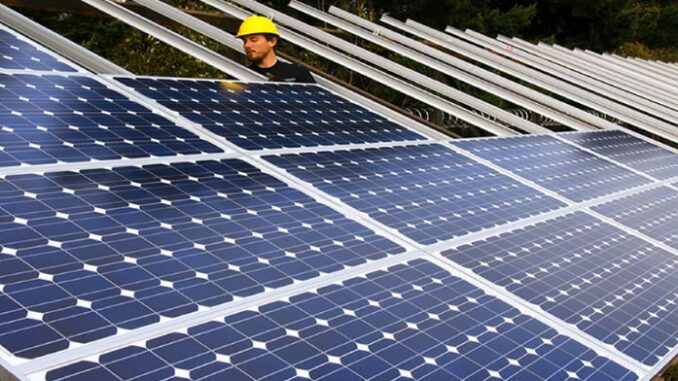
For five generations, the Murph family worked the lands allotted to them by the state in Navajo County.
Gov. Katie Hobbs believes the 4,000 acres would be better suited to advancing the Green New Deal while squeezing out more dollars for public schools.
After over 120 years, Casey Murph may be the last rancher to graze on those northern Arizona lands. Orsted, a green energy company based out of Denmark, is poised to take it for an industrial solar farm with the help and encouragement of the Hobbs administration.
Murph, who operates the H-Y Cattle Company based out of Holbrook, has warned against this project — not just for the sake of his family, but for its contribution to the forced extinction of American ranchers. As American sourcing for beef dwindles, increased pricing prompts a greater reliance on cheaper imported beef.
“Folks should know, things like this have directly contributed to the high cost of retail beef in stores,” said Murph.
I just received a notification that @Orsted has made a move to evict my cattle from several sections of land within our AZ state allotment. The installation will likely look much like the one in Pinal county here on Orsted's post. Pemanantly barren and lifeless. If it happens… https://t.co/ES5hEZdL7Z
— Casey Murph (@caseymurph1) April 28, 2026
Arizona Congressman Eli Crane (R-02) called the Orsted project bad news.
Do you think this is a good thing, @orsted?
I sure don’t. https://t.co/8ykTtjBkVJ
— Rep. Eli Crane (@RepEliCrane) May 2, 2026
Republican gubernatorial candidate Andy Biggs, a congressman looking to unseat Hobbs, promised the Murph family that he would support Arizona ranches and wildlife habitats over renewable energy projects for state lands.
We have heard from the Biggs campaign and we are told that as governor he will use his authority to support Arizona ranches and wildlife habitat over foreign wind/solar installations on AZ state lands.
Therefore, we support Biggs for Governor. https://t.co/cdd4oUcuOF— Casey Murph (@caseymurph1) May 7, 2026
Murph told The Regenaissance podcast last fall that the loss of their state land allotment would prevent him from making a living for his family. Murph said that the planned solar farm would destroy the natural habitat on his and surrounding lands.
“It will basically be an 11,000-acre parking lot with solar panels,” said Murph.
Renewable energy companies enjoy different standards than ranchers when handling native species and antiquities.
“If I disturb endangered species or bulldoze a native antiquity site I lose the lease and get charged with a crime,” said Murph. “Solar conglomerates bulldoze everything on [Arizona] state lands with impunity.”
On my AZ state grazing allotment I am very restricted. If I disturb endangered species or bulldoze a native antiquity site I lose the lease and get charged with a crime. Solar conglomerates bulldoze everything on AZ state lands with impunity.
— Casey Murph (@caseymurph1) May 14, 2026
Orsted was behind the Eleven Mile Solar Center in Pinal County near Coolidge: about 857,000 solar panels promised to produce enough electricity to power 65,000 homes and contribute over $80 million in property taxes to the area over the course of 30 years.
What Orsted is applying to do to farms and ranches in Navajo County. pic.twitter.com/Yj6KWbceTc
— Jaguar Roper (@JaguarRoper) May 15, 2026
Murph, a writer for Range Magazine, was also the one to resist the National Park Service’s policy changes that have hindered the historic tradition of Grand Canyon mule rides.
Murph’s land is leased from the state, part of the nine million acres in state trust land managed by the Arizona State Land Department (ASLD). By law, ASLD must prioritize the highest bidder on state lands for the sake of maximizing revenues for public school funding.
The appraised minimum bid for one upcoming solar operation ($26 million) is about eight times greater than the entirety of the state’s grazing revenue in the 2024 fiscal year, as Beef News first reported.
Last September, Gov. Hobbs ordered ASLD to prioritize renewable energy leases on state lands. Hobbs’ executive order established a dedicated task force to cut red tape on the lease, sale, or other use of state lands to streamline deployment of renewable energy projects.
ASLD was also required to issue a report to Hobbs outlining opportunities and administrative proposals to expedite renewable energy infrastructure on state lands.
Under these directives from Hobbs, it is likely Murph’s family ranch will likely go the way of a neighboring ranch operated by the DeSpain family.
Like the Murphs, the DeSpains had ranched on state land for over 100 years until ASLD gave over their land to a solar project by Invenergy in 2024. The DeSpains lost a lawsuit and were made to sign a nondisclosure agreement that prevents them from talking about the taking of their allotted land.
The green energy is a joke and only jokers (aka the
hobbit) want to use. Green is so good that a couple
of the set ups on Davis-monthan afb have been
removed ! So this should tell ya something. The
hobbit needs to be replaced and most of her
vetos revoked but when the majority only
vote party this is what results
This is appalling. “Renewable” energy is terrible for the environment. It makes land useless and kills wildlife. It is intermittent, unreliable, and is easily destroyed by major weather events. It has to be backed up by reliable energy sources like coal, natural gas or nuclear. It makes electricity more expensive because it is an unreliable energy system that utilities pay for on top of reliable energy systems. What’s really infuriating is that “green” energy companies are not held to any of the environmental standards that everyone else is held to. They can slaughter endangered species, bulldoze ancient cultural sites, and make the land useless with no repercussions. Oh, and they can destroy generations-old companies and ways of life. It is unequal application of the law, which is harmful and entirely unjust.
That 4000 acres is used by more than just cattle for grazing. So, let’s just hurt the native wildlife population in the name of environmentalism. In the words of mother Gump, “Stupid is as stupid does.”
The underbite woke queen strikes again.
The election and rein of the Hobbit is reflective of the AZ voter population. They support her and her policies. Only a few of us grumble here, there is groundswell of opposition to her. And by the way, who is Biggs? What campaign? Is there a campaign? He is a talking head on conservative shows, that is all.
People need to eat more than they need a foreign companies silar power. I wonder how much Veto Katie is getting for this take over when there are so many other places it could go in the state?