
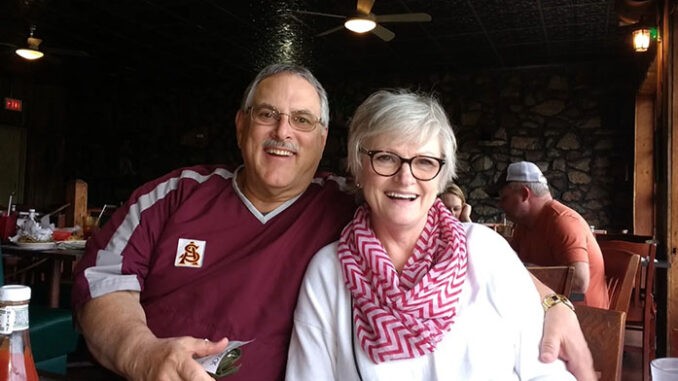
Dave Rasley never forgot his roots. He grew up in poverty in Alaska and spent long summers toiling on the oil pipelines there to pay for his education at Arizona State.
So years later, after Rasley graduated and went on to spend more time on those pipelines before embarking on a career in education, he had no desire to hoard his money.
He wanted to share it.
“Well, we feel like we grew up really poor. I mean, really poor,” said Rasley, an ASU baseball “superfan” for decades. “My dad had a bunch of medical problems and couldn’t work. Like, we didn’t have any money when we were growing up.”
So in 2018 Rasley, a 1978 ASU graduate, started working on establishing the Rasley Family Baseball Scholarship. He paid the last installment in January, completing an $750,000 endowment that reflects his unwavering fandom.
Each year, the Rasley scholarship will pay for an ASU player’s tuition, room, board and meals.
“Dave’s just been a really, really good baseball fan,” said Tom Collins, ASU’s assistant athletics director for development. “I almost thought, like, I’d say, a super fan.”
Attending games, practices and all types of events for decades helped foster deep relationships that made Rasley the resident expert for all things ASU baseball.
“I mean, I rely on him,” Collins said. “I go to lunch to find out, ‘OK, how’d we do in fall ball?’ You know, ‘Who’s doing this? Who’s doing that?’”
Rasley’s unwavering fandom started as an ASU student whose passion for baseball was groomed watching summer baseball in Alaska.
“I came here in 1972, and I wanted to play baseball,” Rasley said.
So, Rasley gave baseball his best shot. Back when the program was separated between varsity, junior varsity and freshman teams, he made it to the final cut for the freshman team before legendary coach Jim Brock cut him.
“He (Brock) calls me and he goes, ‘Well, you know, you can hit pretty good, but you got an average arm, and I can’t teach you to run any faster,’” Rasley said.
While this may have marked the end of his playing career, Rasley’s time around Arizona State baseball was just getting started.
He would spend his spring watching ASU baseball and the summer working on the oil pipelines in his home state to pay for his schooling. This continued every year until he graduated with a bachelor’s degree in physical education in 1978 and moved back to Alaska to work on the same oil pipelines.
Rasley worked in Alaska until 1984, with the money earned laying the foundation for his philanthropic efforts.
“And that’s one of the reasons why I have money enough to be able to do the scholarship, because I invested it, and, you know, saved money,” Rasley said of his time grinding away in Alaska.
Over time, business in Alaska slowed down and Rasley explored the possibility of moving back to Arizona.
“I moved here permanently in 1984, and then I got tickets over at Packard (Stadium) again,” Rasley said, “because I never missed a game when I was a student.”
Thus started a nearly uninterrupted stretch of fandom spanning more than 40 years.
During this time Rasley worked as a sales associate for the Arizona Outlaws of the United States Football League before starting his career at Tempe High School, where he worked for 23 years in various roles including in-school suspension supervisor, dropout prevention coordinator and student council adviser.
Through it all, he never wavered in his support of ASU baseball.
“The coaches all appreciate Dave and see him, and he watches batting practice, gets there early,” Collins said about Rasley’s dedication to the team. “I would say – I don’t know – 90% of the home games he’s probably there when they’re doing batting practice two hours in advance.”
Simply being a dedicated fan is not enough for Rasley. He consistently finds ways to spread his passion to other fans.
He can often be seen giving lollipops to the fans surrounding his 14 season tickets behind the Sun Devils’ dugout or giving away tickets to new fans
“Overall I probably give away about 120 (tickets) each season,” Rasley said. “I also buy an extra parking pass to give away with tickets.”
He even shares his ASU baseball fandom on his drive home from Phoenix Municipal Stadium, where the Sun Devils now play.
“I wait to hear his horn because every night after an ASU win he honks his horn twice as he drives by my house,” said Karl Pagel, Rasley’s neighbor and a former major league first baseman.
Whether it be two short honks on a drive home or a deep bag of free lollipops at home games, Rasley elevates the experience of his fellow fans. For Rasley, the focus is less on what he does for others, but rather on what those people did to deserve his generosity.
“I sent a note to Tracy Smith, you know, our former coach, because I got to be really close to him and his staff when he was here, and he did a lot of really good things for me, personally, when I had a lot of medical issues,” Rasley said. “I told him, I said, ‘You know, you’re one of the reasons why I decided to give back.’”
Rasley gives back in a variety of ways. It is not just about endowing a scholarship, it is donating to make sure the team has fruit cups in the clubhouse on game day, it is supporting Hunter Bishop, former Sun Devil outfielder and first-round pick by the San Francisco Giants in the 2019 MLB Draft, when his mom was diagnosed with early onset Alzheimer’s.
“I was lucky enough to be close where I could sort of help them if they needed it,” Rasley said of Bishop’s family.
Rasley’s mother was also diagnosed with Alzheimer’s disease, and he used his experience to provide advice to Bishop’s family.
There are countless other examples of his selflessness and philanthropic nature, but none stand taller than the Rasley Family Baseball Scholarship.
“I mean, it costs $750,000 to fully fund that scholarship,” Rasley said. “I could have a big house in Scottsdale for that, but I don’t need that.”
How often does somebody pass up a big house in one of the most luxurious cities in the United States?
When considering how an endowment works, the decision becomes less surprising, although still shocking to an average person.
“So when it gets to a certain number, I mean, the corpus, the main portion of the endowment will stay there, and then we’ll pull off the interest from that year to year,” Collins said.
Essentially, the Rasley Family Baseball Scholarship will be awarded to a baseball player every year, market permitting. The $750,000 endowment gets invested, and the scholarship funds are pulled strictly from the gains, guaranteeing that the endowment never dips below the principal amount.
If the market does not perform well enough to fund the scholarship without dipping into the principal, then the scholarship is not paid out that year.
Despite such a large donation, Rasley does not control who receives the scholarship each year. However, that is not an issue for him.
Regarding his preference for the scholarship recipient, Rasley said, “Mine’s more of financial … mainly … if somebody is in need.”
This preference comes from Rasley’s personal experience of growing up with his own share of financial hardship. Rasley hopes this endowment will serve players with similar financial needs.
The current recipient of the Rasley Family Baseball Scholarship is team captain and bullpen pitcher Sean Fitzpatrick, who is a native of Spring, Texas, just north of Houston.
Collins expressed his gratitude for Rasley’s contributions saying, “If I could clone him, I’d love to have three or four more donors just like him.”
Needy ? If you can play ball!! At the ASU level.. you’ are probably getting paid more than I am by the school semi-pro system.