
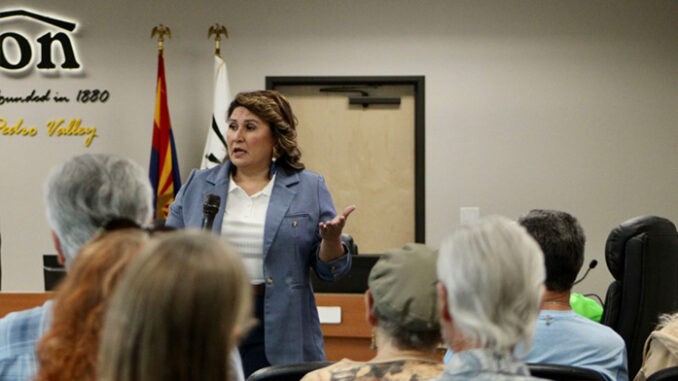
Recovered footage revealed that Democratic candidate for Arizona’s 6th congressional district JoAnna Mendoza supports forcing transgender acceptance into single-sex sports and bathrooms.
Mendoza is challenging incumbent Rep. Juan Ciscomani, a Republican. The Marine veteran who characterizes herself as “a queer single mother” had her last attempt at elected office in 2020 end in the loss of a state senate seat.
Mendoza is one of a few Arizona candidates selected by the Democratic Congressional Campaign Committee (DCCC) for its Red to Blue program, which provides special assistance with key campaign components like staff, campaign strategy, and fundraising.
This backing by one of the most powerful Democratic organizations in the nation has helped Mendoza outraise Ciscomani by more than double in the first quarter.
The spotlight of the hotly contested race has also dredged up a past that Mendoza may have been working to suppress.
Deleted footage from 2020 shared with the Arizona Daily Independent showed Mendoza supporting “gender-inclusive” restrooms in K-12 schools and opposing “anti-transgender” laws limiting participation in youth sports teams to biological sex.
“You know, children, when they go to school, they want to feel accepted. They want to be in an environment where they’re safe. And I believe that we need to ensure that our students from all backgrounds from the LGBTQ community should feel accepted and safe in their environments and at school,” said Mendoza in a deleted video interview with Equality Arizona.
Mendoza also said she would support expanding that access to traditionally single-sex spaces to adults who identify as transgender.
“[My support to mandate transgender acceptance] includes practices and laws that would ensure that the LGBTQ community and staff also [have access],” said Mendoza.
These sentiments from Mendoza resurfaced on the eve of the Supreme Court decision affirming the right of states to exclude biological males from female-only sports. The court defined sex as based on biological gender, not gender identity as Mendoza and the Democratic Party have insisted.
In another 2020 interview, Mendoza told the Citizens Clean Elections Commission that allowing youth to transition genders was part of allowing children to “live their best lives.”
Mendoza said laws based on biological sex were “example[s] of the regressive mindset” and “harmful” as well as “toxic[,]” in reference to a question alluding to a bill by Republican lawmaker Mark Finchem — at the time a state representative and now a state senator for the 11th legislative district — which would have limited sports participation to biological sex.
“[Legislation like that] takes away from who we are as Americans to want to be inclusive, to want to fight for those that can’t fight for themselves, to want to make things better for everyone, and so I would not have supported that legislation,” said Mendoza.
Other deleted footage recently uncovered had revealed Mendoza’s support for decriminalizing prostitution, namely to prevent the arrest of transgender individuals.
“[We need to be] eliminating the discriminatory practices and laws so that every individual has the opportunity to be able to provide for themselves,” said Mendoza. “[W]e need to stop criminalizing people for their situations.”
Mendoza also said in that interview that she would support decriminalizing other crimes she agreed were “petty” like jaywalking and spitting, which she implied were deeply rooted in discrimination.
“You know, I think that in the past, especially Arizona, has a history of trying to enact these practices that target specific groups, right?” said Mendoza. “And so we need to ensure that we’re protecting folks from discriminatory practices [that] would create the potential for violence or criminalization.”
Also uncovered from Mendoza’s past in recent weeks: a drunk driving incident from early 2012, in which she hit another car before she could leave the parking lot. In a recent interview with The New York Times, Mendoza blamed the incident on what she described as a “date rape situation” that occurred at some point in time in the months prior. Little details were provided.
However, Mendoza offered more details about a prior sexual assault that occurred over a decade earlier in 2000, after she said she got “drunk and blacked out” while partying with friends in the military. Her assailant was reportedly court martialed and sent to military prison. Mendoza didn’t explain to the Times what became of her alleged assailant in the latter “date rape situation” on which she blamed her driving while intoxicated.
Another one of Satan’s angels.
is she that hard up to have a boy look at her that she is willing to go to the rest room to pee while a guy watches? really now that is bad. The SC just said no such competition for trans is permitted so I guess she enjoys peeing onto the wind to get that nice warm feeling?
She’s a day late and a dollar short.
Americans require that All PERSONS LIVING IN AMERICA ASSIMILATE INTO THE AMERICAN CULTURE AND ASSIMILATE BEING AMERICAN.
LGBTQ+ People need to ASSIMILATE into the American Culture NOT the other way around.
LGBTQ+ people only represent .5% of the total population in the United States.
95% of LGBTQ+ People in the U.S. have undiagnosed Mental Illness.
We don’t need this stinkin’ democrat shoving the trannies in our women’s spaces.
what is this issue of ‘Gender’ blending? What is the goal of this ? Oh as it was in the time of NOAH and LOT? That is the only think and reason I can see that this ‘genderblend’ is such an issue… Time is closing in on ‘END’ ‘this is what your watching..
Revelations tells it all, if only people would read it, but they won’t because it’s just an old dusty book on the shelf.
She is not at fault. The voters supporting her are at fault!