
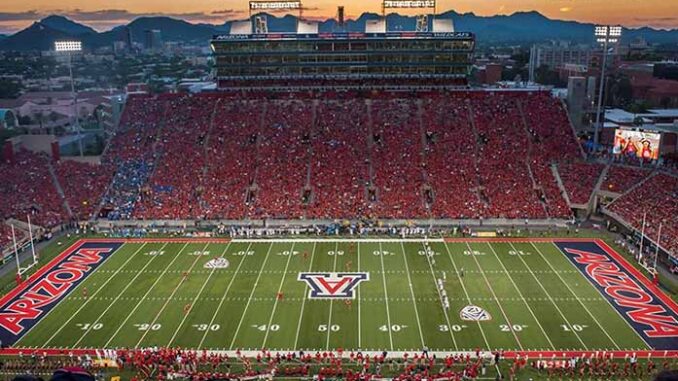
TUCSON – A recent sports column in the Arizona Daily Star unintentionally revealed a key reason why college costs so much and why students are burdened with student loans. The reason is panem et circenses, and specifically, the circus of college sports.
Greg Hansen, a sports columnist for the Arizona Daily Star, wrote that that the University of Arizona needs to spend more on its football facilities to keep up with other universities, even though the Wildcats football team has spent $127 million since 2013 on upgrades.
Across the nation, spending on sports has increased in lockstep with an increase in America’s socioeconomic problems. That’s true for both professional sports and college sports, which are amateur in name only.
My apologies to Karl Marx, but sports, not religion, is the opiate of the masses.
Spending has skyrocketed on sports stadiums, on sports gambling, on sports streaming, on sports commercials, and on the ubiquitous and formulaic sports talk shows, where highly-paid, jackal-like sports commentators jabber inarticulately about insignificance.
Hansen listed some of the recent collegiate spending. To quote:
Houston moved into the $130 million Hermann Memorial Football Operations Center at TDECU Stadium, requiring 105,000 square feet.
Cincinnati opened the $134 million Sheakley Indoor Practice Facility and Athletics Performance Center, requiring 200,000 square feet.
Not only that, Kansas is in the middle of a $300 million project to re-do Booth football stadium, Phase 1 of which opens this month, and Texas Tech — the Oregon of Big 12 sports spending — unveiled the $242 million Womble Football Center, a renovation of Tech’s football facilities.
Trying to match this lunacy would be like seeing your neighbor burn money in his backyard and doing the same. Are Tucsonans and other Arizonans that looney?
Maybe so.
Upon rising every morning in Tucson, I check the local newsfeed for the top news stories in the city. Half of the stories are about the Wildcats, and many of them are about some player—who probably has a 1.5 grade point average artificially raised to 2.5—going through a portal to join the football team. Such players are lionized like Roman emperors were lionized when they entered the gates of Rome with the spoils from their conquests.
This rehabilitated sports fan became so disenfranchised years ago from the big-time sports industries of football, basketball and baseball that I turned to the less-hyped sports of golf, tennis and track & field. Now even those have become part of the sports industrial complex. Pretty soon, all that will be left is curling.
University of Arizona football gives a new meaning to “Red Zone.” In football lingo, Red Zone means the 20 yards in front of an opponent’s goal line. On a color-coded map of crime in Tucson, red zones are the areas with the most crime. As can be seen in the map at this link, areas near Wildcat stadium are red.
The homeless are also in abundance near the stadium and throughout Tucson. (The word “homeless” is a euphemism for people living and dying on the street like animals.) That’s ironic, given that students and faculty at the University of Arizona, as is the case at other universities, virtue-signal about social justice and the disadvantaged.
If they truly cared, they’d be willing to forgo football and see the tens of millions of dollars in savings spent instead on getting the homeless off the street and into shelters, where they could undergo drug rehab and mental health counseling. Wildcat stadium and other sports facilities could be repurposed into shelters, and students majoring in pre-med, psychology, and social work could volunteer to help out and earn course credits.
The University of Arizona would get national and even international acclaim for turning phony virtue signaling into actual virtuousness. And it would demonstrate that it’s possible for Americans to stop being addicted to the opiate of the masses.
Mr. Cantoni can be reached at [email protected].